
Refined vs Crude Walnut Oil: Color/Odor Control and End-Use Fit
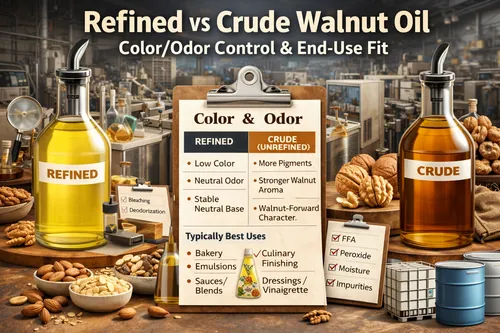
Industrial buyer guide to refined vs crude (unrefined) walnut oil: what changes during processing, why color and odor drift happens, and how to choose the right oil for your application. Includes a practical spec and COA checklist (FFA, peroxide, color, moisture, impurities), packaging options for bulk programs (drums/totes/IBCs), storage and oxidation controls, a receiving inspection checklist, and supplier questions that reduce rework and complaints.
Previous: Cold-Pressed Walnut Oil for Culinary Use: Sensory Profile and QA Checks • Next: Walnut Butter in Bulk: Grinding, Particle Size, and Separation Management
Related: bulk walnut products • products catalog • request a quote
What buyers mean by “crude” vs “refined” walnut oil
In industrial purchasing, “crude” walnut oil usually refers to oil that has been extracted and then filtered or settled to remove particulates, but still retains more of the oil’s natural pigments and aroma compounds. “Refined” walnut oil refers to oil that has been processed further to make it more neutral, more consistent, and easier to use as an ingredient without unexpected color or odor impact.
Because terminology varies by supplier and region, the practical move is to define what you need in measurable terms: color expectation, odor profile, and key quality indicators (for example FFA and peroxide value). This prevents a common problem in bulk oil programs: different lots sold under similar names behaving differently in production.
Procurement reality: “Refined” is not a single universal process. Your outcomes depend on the supplier’s refining steps, how the oil is protected from oxygen and heat, and how the lot is stored and shipped.
Why color and odor control matters in bulk walnut oil programs
Walnut oil can be an outstanding ingredient, but it is also a high-sensitivity input in many categories. Color and odor variation can create immediate customer complaints, especially when oils are used in: dressings and sauces (where aroma is noticeable), bakery and confectionery (where off-notes show quickly), and any product with a mild flavor base (where the oil becomes a dominant signal).
What “goes wrong” in real production
- Color variability: finished products appear darker or more yellow than expected; emulsions shift shade; labels don’t match reality.
- Odor drift: stronger “nutty” notes than expected, “stale” notes, or oxidative notes that show up early in shelf life.
- Flavor carryover: walnut character competes with intended flavor systems (vanilla, chocolate, fruit, savory herbs).
- Stability drift: oxidation indicators rise faster when oils are exposed to oxygen, warm storage, or repeated opening.
When buyers usually want the most control
- Neutral bases (mayo-style emulsions, cream-style sauces, dairy alternatives, mild bakery bases)
- Long shelf-life SKUs or warm distribution lanes
- Any program with strict sensory acceptance or customer complaint sensitivity
Processing overview: how walnut oil is produced (high level)
Walnut oil programs vary, but most follow a common flow: raw material selection → oil extraction → initial clarification → optional refining steps → final filtration → packaging. The differences that matter to buyers show up in two areas: (1) how the oil is extracted and (2) how much it is refined for neutrality.
Extraction and early handling are part of quality
Before refining even begins, an oil can pick up variability due to raw material condition, oxidation exposure, and processing temperatures. That’s why buyer specs should include not only “refined vs crude” but also measurable quality indicators and a clear sensory expectation.
Refining steps explained (and what they change)
Refining is typically aimed at reducing components that cause color, odor, and instability. Depending on the program, refining may include some or all of the steps below. The key for buyers is to map each step to an outcome you care about.
1) Clarification / filtration (common in both crude and refined programs)
Filtration removes suspended solids that can contribute to haze, sediment, and processing instability. In ingredient manufacturing, consistent filtration reduces downstream issues like nozzle clogging, pump wear, and sediment in finished packs.
2) Degumming (when used)
Degumming targets phospholipids (“gums”) that can cause haze and instability. A buyer impact is improved clarity and fewer issues in emulsions. If your application is a clear oil product or a highly sensitive emulsion, it can be useful to ask whether the oil is degummed and how clarity is managed.
3) Neutralization (when used)
Neutralization reduces free fatty acids (FFA). Lower FFA can help with consistency and can reduce certain off-notes and reactivity. Buyers who build long shelf-life programs often use FFA as a baseline indicator to compare lots (alongside oxidation indicators).
4) Bleaching (when used)
Bleaching is commonly used to reduce pigments and improve color consistency. If you are trying to keep a sauce, confection, or bakery product within a specific shade window, color control is one of the main reasons refined oil exists.
5) Deodorization (when used)
Deodorization aims to reduce volatile compounds that drive aroma. For industrial programs, this is often the biggest lever that separates refined oil from crude oil in terms of end-use fit: a deodorized oil typically acts more like a neutral fat input, while crude oil retains stronger walnut character.
Buyer takeaway: If you need a “neutral walnut oil,” confirm the program’s odor posture in writing (sensory expectation and acceptance criteria), not just the label “refined.”
End-use fit: choosing refined vs crude walnut oil by application
The right choice is less about ideology (“refined is bad” or “crude is premium”) and more about what your finished product needs: neutrality, color consistency, or walnut-forward character. Below is a practical way buyers segment end uses.
Typically best fit for crude (or less processed) walnut oil
- Premium culinary/finishing oils: when walnut aroma is a selling point.
- Signature dressings and vinaigrettes: where nutty notes are intended and welcomed.
- Specialty sauces: where walnut character is part of the flavor design.
- Marketing-driven “artisanal” products: where natural color is acceptable or desirable.
Typically best fit for refined walnut oil
- Bakery and confectionery: when off-notes or color shifts create complaints.
- Neutral bases and emulsions: mayo-style systems, creamy sauces, mild dairy-alternative bases.
- Blends: where walnut oil is part of a broader fat system and should not dominate aroma.
- Long shelf-life programs: especially with warm distribution lanes or strict sensory acceptance.
“In-between” use cases where the best answer depends on your spec
Some programs want a light walnut note but not strong aroma, or they want a pale oil but still some character. In these cases, buyers can often win by specifying outcomes: maximum color range, odor intensity posture, and a shortlist of quality indicators. That creates room for the supplier to match the right processing lane without over-buying.
Spec checklist: fields that actually protect production outcomes
A good walnut oil spec is short and tied to your application. The goal is to prevent the predictable problems: unexpected color shifts, odor drift, oxidation complaints, and handling issues (sediment, haze, seals, contamination).
Core identity fields
- Product identity: walnut oil (refined or crude/unrefined), intended grade/program name if applicable.
- Intended use posture: “neutral base oil” vs “walnut-forward flavor oil” (reduces supplier misunderstandings).
- Country of origin: if required for labeling/compliance workflows.
Color and odor (the headline variables)
- Color expectation: define a practical range or descriptive standard (“light/pale”, “golden”, “natural”).
- Odor/sensory posture: neutral vs walnut-forward; define unacceptable notes (rancid/painty/musty/stale).
- Clarity/post-filtration expectation: clarity at ambient temperature; haze/sediment posture if relevant.
Quality indicators buyers commonly request
- Free fatty acids (FFA): baseline indicator of oil condition and consistency (target depends on program).
- Peroxide value (PV): common oxidation indicator, useful for trending freshness and storage drift.
- Moisture / volatile matter: supports stability and reduces risk of processing issues.
- Insoluble impurities: helps prevent sediment, clogging, and visual defects.
Optional fields for sensitive programs
- Secondary oxidation indicators: used in some programs to better predict sensory drift over time.
- Filter/mesh details: when you have tight nozzle, pump, or filtration requirements.
- Odor intensity scale: internal scoring method to reduce subjective disputes.
- Allergen statement: walnut (tree nut) declaration aligned to your labeling needs.
- Microbiology: program-dependent; more common when the oil is part of a high-sensitivity category.
Simple spec philosophy: Write what you will enforce at receiving. If you can’t or won’t test a field, keep it as a supplier disclosure item rather than a hard reject limit.
COA checklist: what to ask for so receiving can move fast
COA content varies by supplier and destination requirements. A practical COA helps your receiving team accept lots quickly and gives QA the traceability needed if a complaint shows up later.
Common COA fields buyers request
- Lot identification: must match drum/tote labels and shipping documents.
- Product description: walnut oil, refined or crude; any program/grade identifier.
- Key quality indicators: commonly FFA, PV, moisture/volatile, insoluble impurities (as available).
- Allergen statement: tree nut (walnut) declaration aligned to labeling.
- Country of origin: for compliance and labeling workflows.
- Traceability identifiers: production/shipment identifiers for issue isolation.
If your customers require additional documents (audit certificates, recall program summaries, food safety plan elements), request availability early. Documentation availability varies by product and supplier program.
Packaging options for bulk walnut oil (and what to specify)
Oils are sensitive to oxygen, heat, and light. Packaging is not just logistics—it is part of your quality program. For bulk oil, buyers typically choose between drums and totes/IBCs depending on throughput and handling capability.
Common industrial packaging formats
- Drums: common for moderate volumes and easier lot segregation.
- Totes / IBCs: efficient for high-throughput lines; confirm valve type and compatibility.
- Intermediate bulk (program-dependent): confirm liner/posture, closures, and handling requirements.
Packaging details that reduce problems
- Seal integrity: tamper evidence, intact bungs/valves, no leaks.
- Labeling and lot code visibility: supports traceability and rotation.
- Headspace posture: minimize oxygen exposure; define expectations for handling after opening.
- Odor protection: avoid storage near strong odors that can transfer.
Storage and shelf-life posture: what reduces odor drift and rancidity complaints
Whether refined or crude, walnut oil can drift if exposed to heat, oxygen, and light. From a buyer standpoint, the highest ROI controls are typically: cool storage, minimized oxygen exposure, and good packaging discipline after opening.
Practical controls for industrial facilities
- Store cool and stable: avoid temperature cycling and hot warehouse zones.
- Protect from light: especially important for clear or lightly colored oils.
- Minimize oxygen exposure: close bungs/valves promptly; avoid leaving containers open during staging.
- Align pack size to use rate: reduce long-open partial containers.
- Retains: keep a retained sample by lot to investigate complaints and trend drift.
Useful mindset: “Refined vs crude” is an upstream choice, but temperature and oxygen are the downstream levers that usually decide whether shelf life succeeds.
Receiving inspection checklist (buyer-friendly for bulk oils)
- Container integrity: no leaks, dents that compromise seals, broken bungs/valves, or missing tamper evidence.
- Label/lot verification: lot code matches COA and shipping documents; correct product identity (refined vs crude).
- Appearance: clarity aligned to program; no unexpected haze or heavy sediment (unless documented/expected).
- Odor check: align to spec posture (neutral vs walnut-forward); no rancid/painty/musty/stale notes.
- COA review: verify key indicators (FFA, PV, moisture/volatile, impurities) vs your acceptance ranges.
- Temperature condition: note if the load arrived warm; warm receipts can accelerate drift and should be flagged.
- Retain sample: retain a sealed, labeled sample for each lot and store under controlled conditions.
QA tip: If your application is odor-sensitive, define a short sensory SOP (how to warm, sniff, and score) so multiple receivers evaluate lots consistently.
Questions to ask suppliers (procurement-focused)
Questions that map directly to color/odor outcomes
- How is “refined” defined in this program? Ask which steps are included and what the sensory goal is.
- What is the typical color range lot to lot? Helps you avoid surprises in visual products.
- What odor/sensory standard is used? Ask for “neutral” vs “walnut-forward” posture and how it’s verified.
- What are typical ranges for key indicators? Helps set practical acceptance ranges rather than unrealistic limits.
- How is the oil protected from oxidation? Storage temperature, packaging posture, and handling after filling.
Questions that reduce logistics and receiving friction
- What packaging formats are available? Drums vs totes/IBCs; valve type; pallet configuration.
- What documentation is available? COA, allergen statement, COO, traceability, compliance docs.
- What is the recommended storage posture? Temperature and light guidance, and what to do after opening.
Tight specs can protect quality, but they can also reduce supply flexibility. A practical approach is to tighten only the fields that affect your finished product: odor posture, color expectation, and the key indicators you can verify at receiving.
FAQ: refined vs crude walnut oil
Is “crude” the same as “cold-pressed”?
Not necessarily. “Cold-pressed” describes a processing approach intended to preserve character, while “crude” generally means less refined. Suppliers may use different terms. If you need a specific sensory outcome, specify odor and flavor posture rather than relying on a label alone.
Does refined walnut oil have no walnut flavor?
Refined oils are often more neutral, but “how neutral” depends on the refining program. If your application is highly odor-sensitive, define a sensory acceptance standard and confirm it with retained samples.
Why does walnut oil sometimes look darker than expected?
Color can vary by lot and processing. Pigments and natural components can remain higher in less refined oils, and storage conditions can also affect appearance over time. Define a color posture and verify clarity/appearance at receiving.
What is the fastest way to reduce odor complaints?
Start with a clear odor spec (neutral vs walnut-forward), protect oil from heat and oxygen, and ensure packaging seals are intact. Then standardize your receiving sensory check and keep retained samples to identify drift patterns.
Next step
If you share your application (dressings, sauces, bakery, confectionery, blends), your desired odor posture (neutral vs walnut-forward), destination, packaging preference (drums vs totes), and shelf-life target, we can recommend practical spec fields and packaging options that match your program. Use Request a Quote or email info@almondsandwalnuts.com.
For sourcing, visit bulk walnut products or browse the full products catalog.