
Walnut Butter in Bulk: Grinding, Particle Size, and Separation Management
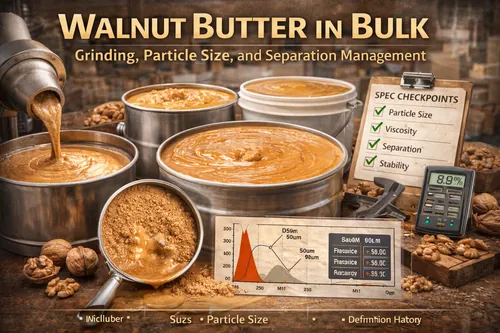
Industrial guide to walnut butter in bulk: grinding strategy, particle size targets, viscosity/rheology, and oil separation control. Includes a buyer spec checklist, QC/documentation notes, packaging and receiving guidance, and troubleshooting for production lines.
Previous: Refined vs Crude Walnut Oil: Color/Odor Control and End-Use Fit • Next: Walnuts in Bakery (Breads, Cookies, Brownies): Roast Level and Water Activity
Related: bulk walnut products • products catalog • request a quote
Quick takeaways for buyers and process owners:
1) Particle size distribution drives texture, viscosity, and separation behavior.
2) “Smooth” is not a single spec—agree on a measurable target (method + temperature + acceptance range).
3) Separation control is usually a system problem: grind + solids loading + temperature history + finishing shear + packaging.
4) A clear spec sheet + COA expectations reduce RFQ cycles and prevent line surprises.
Where bulk walnut butter fits in production
Bulk walnut butter is an industrial ingredient used when you want walnut flavor and fat functionality without handling whole kernels on your line. It can reduce steps (roast/grind/mix) and simplify dosing into batters, fillings, sauces, nutrition products, and plant-based formulations. In practice, “best format” is the one that hits texture and process targets with the fewest internal adjustments—especially when you scale from pilot to continuous production.
Common industrial use cases
- Bakery & bars: fillings, laminated inclusions, nut ribbons, brownie/cookie flavor systems, and binders.
- Confectionery: praline-style bases, flavored fat systems, centers, and enrobing-friendly pastes (when tuned for flow).
- Savory: sauces, dressings, pesto-style applications, and emulsified spreads.
- Dairy alternatives: bases for walnut “milk” concentrates, cultured products, and desserts (where mouthfeel is sensitive to grit).
- Nutrition: high-calorie blends, RTM mixes, and ready-to-eat items where oxidation control and texture consistency matter.
The success factor is alignment between application requirements (texture, viscosity, stability) and measurable incoming specs (particle size, viscosity at a defined temperature, sensory profile, and microbiological expectations).
What “bulk walnut butter” means in sourcing discussions
In industrial procurement, “walnut butter” typically refers to a ground walnut paste where the natural walnut oil phase is present and the solids are dispersed. Depending on the program, it may be produced from raw or roasted kernels, and it may be finished to different textures—from very smooth to intentionally coarse. Because naming is inconsistent across facilities, it’s best to define the product by measurable attributes, not just “smooth/crunchy.”
Typical format options buyers will see
- Raw walnut butter: lighter flavor, more “fresh walnut” notes; can be sensitive to oxidation and flavor drift if oxygen exposure is high.
- Roasted walnut butter: deeper aroma and color; roast profile affects viscosity, flavor, and oxidative stability.
- Smooth (fine grind): optimized for spreads, fillings, beverages, and applications where grittiness is unacceptable.
- Coarse / “crunchy base”: deliberate texture; often requires separate agreement on inclusion size distribution.
- Formulated walnut butter (program-specific): may include salt, sweeteners, or label-compatible emulsifiers/stabilizers (only if your spec allows it).
Practical rule: If you can’t write it into a spec sheet, you can’t consistently buy it. For bulk walnut butter, that usually means agreeing on particle size measurement, viscosity at temperature, and separation expectations over time.
Grinding architecture: how particle size is created (and why it matters)
Particle size distribution (PSD) is not only a sensory driver—it also controls how solids interact with the oil phase, which affects viscosity, settling/creaming behavior, and long-term stability. PSD is shaped by the full grinding architecture: pre-break steps, heat management, mill type, number of passes, and finishing shear.
Step 1: Pre-conditioning and size reduction
Many lines begin with a pre-break stage (coarse size reduction) to protect downstream mills and improve throughput. For roasted inputs, temperature control at this stage is important—excess heat can push oil release early and change the way the paste behaves in later milling.
- Feed consistency: uniform kernel size and stable feed rate reduce variability in PSD.
- Temperature history: warm feed can increase flow but may also accelerate oxidation or intensify separation later if not managed.
- Foreign material controls: magnets/metal detection upstream protect mills and reduce risk.
Step 2: Primary milling (creating the PSD backbone)
Different mill types generate different PSD shapes (broad vs. narrow distributions) and impart different shear/heat loads. This matters because two butters can have the same “average” particle size but feel very different in the mouth and behave differently in pumps or fillers.
- Colloid mill / wet grinder: strong shear; can produce fine PSD; watch heat rise and residence time.
- Stone mill: can create a distinct texture and flavor perception; PSD can be broader depending on settings and passes.
- Roll refining (where used): can create very fine textures; typically paired with controlled feed and finishing steps.
- Multi-pass systems: repeated passes can narrow PSD and reduce coarse tails that create grit.
Step 3: Finishing, homogenization, and deaeration
The finishing stage is where many “separation problems” are either solved or created. Insufficient dispersion leaves agglomerates; too much air entrainment increases oxidation risk and can cause foaming or density drift in packaging.
- Finishing shear: improves dispersion and reduces agglomerates that can settle or create gritty perception.
- Deaeration: reduces entrained air and can improve shelf-life robustness (less oxygen in the mass).
- Temperature setpoint: controls pumpability and fill accuracy; also influences separation behavior during cooling/storage.
Tip: When comparing supplier samples, record (1) temperature at receipt, (2) viscosity at a defined temperature, and (3) a simple separation observation after a controlled hold. Those three data points usually explain why one sample “runs” in your plant while another does not.
Particle size targets by application
The “right” PSD is the one that meets your texture requirements while remaining stable, pumpable, and scalable. Below are practical application-based targets to guide early conversations; they should be validated against your equipment and finished product expectations.
How PSD links to sensory and processing
- Grittiness threshold: coarse tails (even if small in percentage) often dominate perceived grit.
- Viscosity: finer PSD increases surface area and can increase yield stress at the same solids loading.
- Separation: broader PSD and low solids structure can allow oil to migrate and pool over time.
| Application | Texture expectation | Typical PSD direction | Process notes |
|---|---|---|---|
| Spreads & retail-style fillings | Very smooth; no detectable grit | Fine, narrow distribution | Agree on grind method and viscosity @ temperature; separation control is a primary KPI |
| Confectionery centers | Smooth, controlled flow | Fine to medium-fine | Flow window matters; watch heat history and fat migration interactions with other fats |
| Sauces & dressings | Smooth; stable dispersion | Fine with good dispersion | Consider homogenization and pH/ionic interactions in final formula; manage temperature cycling |
| Plant-based beverages (concentrates) | No sediment; minimal ring/cream | Very fine; minimal coarse tail | PSD + homogenization are critical; define acceptable sediment over a defined shelf test |
| Coarse inclusions / “crunchy” bases | Intentional texture | Controlled bimodal (base + inclusions) | Specify inclusion size distribution separately; prevent segregation during packaging and handling |
In sourcing language: ask suppliers not only “How smooth is it?” but “What is your PSD target and how do you test it?” If the answer is not measurable, you are likely buying variability.
How to measure and specify particle size (so procurement and QA align)
“Particle size” can mean different things depending on method. To avoid mismatches, define your spec using: (1) method, (2) sample preparation, (3) reporting metric, and (4) acceptance limits.
Common measurement approaches
- Grind gauge (Hegman-type): fast, practical, and widely used in viscous dispersions; good for screening coarse particles.
- Sieve analysis: useful for coarse and inclusion fractions; less informative for very fine “smooth” butters.
- Laser diffraction PSD: provides D10/D50/D90 and distribution shape; requires defined dilution/dispersion approach.
- Microscopy/image analysis: useful for investigating agglomerates and confirming coarse tails.
Recommended wording for an industrial spec sheet
Example PSD spec language (template):
Particle size: Target PSD measured by [method] at [defined prep]. Acceptance: D90 ≤ [x] µm and/or grind gauge ≤ [y].
If using viscosity as a proxy, define test temperature and method (e.g., “Viscosity @ 25°C, method: [x], target range: [y–z]”).
If your plant is not set up for laser diffraction, a grind gauge plus a simple controlled “hold test” (see separation section below) can still be an effective procurement control plan.
Rheology and viscosity: what affects pumpability and filling accuracy
Bulk walnut butter behaves like a concentrated suspension in oil. It may exhibit yield stress (it won’t move until a certain force is applied), and it often thins under shear (easier to pump once moving). This is why the same product can be “too thick” in one setup and “fine” in another.
Key drivers of viscosity in walnut butter
- Particle size distribution: finer and broader PSD increases surface area and friction—often increasing viscosity.
- Solids loading: small changes in solids-to-oil ratio can dramatically affect yield stress.
- Temperature: warmer product generally flows easier; define test temperature and receiving conditions.
- Roast level: changes oil release and can change the “body” of the paste.
- Finishing shear and dispersion: agglomerates behave like oversized particles and can spike viscosity and grit.
- Added ingredients (program-specific): salt, sweeteners, emulsifiers/stabilizers (if allowed) change structure and flow.
Plant-friendly controls to reduce surprises
- Agree on receiving temperature window: define how you will condition the product before testing or use.
- Define viscosity method: same instrument and conditions matter more than the absolute number.
- Plan transfer strategy: pump vs. scoop, heated lines, jacketed tanks, and allowable maximum temperature exposure.
Practical tip: If you fill by weight, viscosity drift often shows up as fill time drift. Logging fill time and temperature is a fast diagnostic.
Oil separation management: causes, controls, and storage realities
Oil separation (sometimes called “oil pooling” or “oil rise”) is one of the most common complaints in nut butter programs. In bulk industrial settings, separation is not just a cosmetic issue—it affects dosing accuracy, mixing time, and batch-to-batch consistency.
Why separation happens (root-cause view)
- Insufficient solids structure: if the solids network can’t “hold” the oil phase, oil migrates upward over time.
- Coarse tail particles and agglomerates: can settle, leaving oil-rich zones on top.
- Temperature cycling: repeated warming/cooling changes viscosity and can accelerate phase migration.
- Air entrainment: can destabilize dispersion and increase oxidative risk.
- Finishing shear not optimized: incomplete dispersion increases instability even when average PSD looks acceptable.
Controls that typically reduce separation
- Optimize PSD: reduce coarse tails and narrow the distribution for “smooth” programs.
- Control finishing shear: ensure solids are well dispersed and agglomerates minimized.
- Temperature management: define storage and handling conditions; minimize thermal swings.
- Deaeration/headspace: reduce oxygen exposure where possible (program-dependent).
- Packaging selection: choose formats that match your handling and re-mix strategy (pumping vs. scooping).
- Formulation levers (if allowed): some programs use label-compatible emulsifiers/stabilizers; only include if it matches your labeling, regulatory, and customer requirements.
A simple, repeatable “hold test” for incoming QA
If you want a practical, plant-friendly screen for separation risk, run a standardized hold test:
- Bring sample to a defined temperature (e.g., “tested at 25°C after 24h equilibration”).
- Fill a clear container to a defined height and record weight.
- Hold for a defined period (e.g., 24h, 72h, 7 days) at a controlled temperature.
- Measure oil layer height (or percent oil by weight), note texture shift, and record photos.
This does not replace full shelf-life studies, but it can quickly differentiate “stable enough for our process” vs. “high-risk without rework.”
Receiving reality: If your warehouse sees temperature swings, separation will be worse. If you can’t control storage temperature, plan a controlled re-mix strategy (agitation parameters, time, and acceptance criteria) before the product hits production.
Processing and shelf-life considerations
Walnut products are sensitive to oxidation because they contain unsaturated fats. Shelf-life performance depends on oxygen exposure, temperature, light, and how the product is processed and packed. “Shelf life” is also highly application-dependent: a paste used internally in a short-cycle production line has a different risk posture than a paste used in a long-dated finished product.
Oxidation management in walnut butter programs
- Limit oxygen exposure: reduce unnecessary agitation and headspace; use appropriate packaging barriers.
- Control temperature: store and ship within an agreed range; avoid long high-temperature holds.
- Light control: use opaque packaging or secondary protection where relevant.
- Define sensory acceptance: “fresh walnut” vs. “roasted walnut” targets should be documented to avoid disputes.
Food safety and microbiological expectations (program-dependent)
Nut ingredients are often treated as low-moisture foods, but that does not automatically mean “no risk.” Align microbiological expectations with your category and internal HACCP/food safety plan. If your application requires a validated kill step, confirm how your overall process addresses that requirement and what documentation is needed.
Note: This section is general guidance only; your required microbiological targets and preventive controls should be defined by your category, market, and internal food safety program.
Packaging options for bulk walnut butter programs
Packaging choice affects receiving, storage, rework time, and throughput. The “right” package is the one that fits your material handling, your transfer method (pump vs. scoop), and your temperature strategy—while protecting quality.
Common bulk formats
- Pails: flexible for R&D and smaller volume users; easier to stage; more labor per pound for large plants.
- Drums: common for bulk; can be compatible with drum pumps; define liners, seals, and pallet configuration.
- Totes: efficient for high volume; usually best for plants with pumping and temperature control infrastructure.
- Bag-in-box / liners (program-specific): can help with sanitation and reduced exposure depending on setup.
Handling notes that prevent downtime
- Define whether you will pump: if yes, confirm viscosity window and whether warming is allowed and at what maximum temperature.
- Plan re-mix: if separation occurs, define agitation method, time, and acceptance criteria.
- Dock and forklift constraints: confirm pallet footprint, stack height, and unloading constraints in advance.
- Lot coding and traceability: ensure labels remain legible through your receiving workflow.
Format and spec checkpoints buyers should confirm
A strong spec sheet prevents preventable problems. It also speeds up quotes because suppliers can match your needs to the right manufacturing lane and packaging. Below is a practical checklist you can use to build or revise a walnut butter bulk specification.
Core identity and sensory
- Input: raw or roasted; if roasted, define roast profile target (light/medium/dark) in measurable or sensory terms.
- Flavor target: “fresh walnut,” “toasted,” “deep roast,” bitterness limits, off-note rejection criteria.
- Color expectation: visual target or acceptable range; note that roast level drives color.
Physical performance
- Particle size: method + target (e.g., D90, grind gauge, or a defined screening criterion).
- Viscosity: method + temperature + range; define acceptable receiving/conditioning procedure before test.
- Separation expectation: define acceptable oil layer or separation behavior over a defined hold period (if critical).
- Foreign material controls: magnet/metal detection expectations, packaging integrity, and complaint handling.
Chemical/compositional (program-dependent)
- Moisture / water activity targets (especially if your process is sensitive to thickening or microbial criteria).
- Salt/sweetener levels if formulated (define acceptance ranges).
- Oxidation indicators (if used in your program): define method and limit, plus sensory confirmation expectations.
Microbiology and allergens
- Micro targets: specify based on your category and risk posture.
- Allergen statement: confirm tree nut handling and any facility cross-contact declarations required for your market.
- Country of origin: define required statement and documentation needs (especially for export programs).
Buyer note: If you request “smooth” without a measurement method, you’re asking the supplier to guess what your plant considers smooth. Add a measurable PSD and viscosity method, and quotes become faster and more accurate.
QA documentation and supplier qualification for bulk walnut butter
Bulk walnut butter programs often sit at the intersection of procurement, R&D, QA, and operations. The easiest way to prevent disruptions is to define documentation expectations before the first shipment, not after a hold occurs at receiving.
Common documentation requests (availability varies by program)
- COA: lot-level certificate of analysis with agreed parameters.
- Specification sheet: product identity, sensory, physical, micro targets, packaging, and storage recommendations.
- Allergen statement: tree nut declaration and cross-contact considerations.
- Country of origin: statement and supporting documents as needed.
- Microbiology documentation: as required by your category or customer program.
- Traceability support: lot codes, pack dates, and recall-readiness expectations.
Supplier qualification checklist (practical)
- Process control capability: ability to hit PSD/viscosity targets consistently.
- Change control: notification expectations for process, packaging, or raw material changes that affect your spec.
- Complaint handling: timeline and data requirements for investigations (photos, samples, lot codes).
- Program continuity: consistent supply lane and packaging availability; contingency options for forecast changes.
Troubleshooting guide: common defects and likely causes
When walnut butter “doesn’t behave,” the fastest path to resolution is mapping the symptom to measurable causes. Use this table for first-pass triage before you redesign the whole process.
| Symptom | Likely drivers | What to check first |
|---|---|---|
| Gritty mouthfeel | Coarse tail PSD, agglomerates, insufficient finishing shear | Grind gauge/PSD method; dispersion step; sample temp during evaluation |
| Too thick / poor pumpability | Fine PSD + high solids, low temperature, agglomerates | Viscosity @ defined temp; receiving temperature history; re-mix parameters |
| Oil pooling / separation | Broad PSD, low structure, temperature cycling, incomplete dispersion | Hold test results; storage temperature swings; finishing/air entrainment |
| Flavor drift / rancid notes | Oxidation from oxygen, heat exposure, long holds | Packaging integrity/headspace; storage temp; sensory reference standard |
| Dark / burnt character | Roast profile too aggressive, heat rise during milling | Roast target; processing temps; compare retained sample vs. spec sensory |
If you want faster troubleshooting, keep a retained sample from each lot and record three numbers at receipt: temperature, viscosity (defined method), and simple separation observation. That mini-dataset often resolves disputes quickly.
How to request a quote with fewer back-and-forths
Bulk walnut butter quotes slow down when key parameters are missing. The goal is to tell the supplier exactly what you will test at receiving and what your line needs. Use this RFQ template to accelerate the process.
RFQ template (copy/paste):
Product: Walnut butter (raw or roasted)
Texture: Smooth / medium / coarse (define PSD method & target if available)
Particle size spec: [method] / [target] / [acceptance range]
Viscosity spec: [method] @ [temperature] / [target range]
Separation expectation: [hold test method + acceptable result] (if critical)
Micro requirements: [targets appropriate for your category]
Packaging: pails/drums/totes + liners + pallet config + net weight per unit
First order volume: [lbs/kg] • Annual forecast: [lbs/kg]
Destination: [city, state/country] • Incoterms (if applicable): [ ]
Timeline: sample needed by [date], first production by [date]
Documentation needed: COA, spec sheet, allergen statement, country of origin, other: [ ]
Notes: receiving constraints (dock, forklift), pumping vs. scooping, allowable warming temperature: [ ]
If you already have a spec sheet, include it. If you don’t, the checklist above provides a practical starting point.
FAQ
Is “smooth walnut butter” the same across suppliers?
Not reliably. “Smooth” can describe multiple PSD shapes and finishing approaches. For consistent results, define a measurement method (grind gauge or PSD metric) and pair it with a viscosity test at a defined temperature.
Can we reduce separation without changing the formula?
Often yes—by optimizing grind/dispersion, minimizing air, and tightening temperature control in storage and handling. Formulation changes (like emulsifiers/stabilizers) may help in some programs, but they should be evaluated against label requirements and customer expectations.
How should we store bulk walnut butter?
Store in a cool, dry environment with minimal temperature swings. If your operation experiences significant thermal cycling, plan a controlled re-mix step before use. Always align storage and handling with your internal food safety and quality programs.
What’s the fastest way to qualify a new walnut butter supplier?
Run a structured trial: confirm PSD/viscosity at receipt, conduct a simple separation hold test, evaluate sensory against a reference, and validate performance in your real process conditions. Document the method so future lots can be compared apples-to-apples.
Next step
If you share your application (what you’re making, how you dose/pump, and your texture target), we can help confirm common spec targets, packaging options, and the fastest supply lane for your walnut butter program. Use Request a Quote or email info@almondsandwalnuts.com.
Looking for additional formats? See bulk walnut products or browse the products catalog.