
Cold-Pressed Walnut Oil for Culinary Use: Sensory Profile and QA Checks
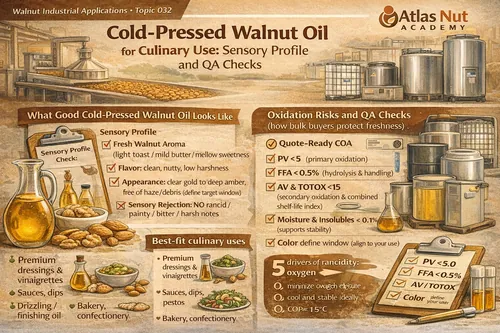
Cold-pressed (often “virgin”) walnut oil is a flavor-forward ingredient used for premium culinary systems—dressings, sauces, dips, finishing oils, and certain bakery and confectionery applications. Because the sensory target is delicate and the oil is oxidation-sensitive, buyers should treat it like a performance ingredient, not a generic commodity: align sensory specs, freshness gates, filtration/clarity expectations, and packaging choices to your shelf-life and production reality.
Previous: Defatted Walnut Protein Powder: Applications in Nutrition and Dry Mixes • Next: Refined vs Crude Walnut Oil: Color/Odor Control and End-Use Fit
Related: bulk walnut products • products catalog • request a quote
On this page
Where this format fits in production
Cold-pressed walnut oil is primarily purchased for its aromatic, nutty character. In industrial settings, it typically performs best in applications where the oil’s aroma remains intact—meaning low heat, short heat exposure, or post-cook addition. Define the use case first, then match the oil program (freshness gates + packaging + handling).
Best-fit culinary uses
- Dressings and vinaigrettes: premium nutty top-notes; often paired with acid, herbs, or aged components.
- Finishing oil: drizzles over salads, roasted vegetables (post-cook), soups (post-cook), pasta, and grain bowls.
- Sauces, pestos, dips: useful in cold emulsions or blended systems where aroma is protected.
- Specialty bakery and confectionery: select formulations that want walnut aroma without adding kernel particulates.
- Foodservice / kits: single-use or smaller-pack programs where “fresh-open” aroma is critical.
Watch-outs (where buyers get surprised)
- High-heat frying: cold-pressed walnut oil is generally a poor economic and stability fit for high-heat operations.
- Long dwell time in warm rooms: even a “good” oil can develop off-notes if stored warm or repeatedly exposed to air.
- Open-tank dosing: oxidation accelerates when oil sits in open day tanks without headspace control.
- Inconsistent filtration: sediment or haze can affect appearance and dosing consistency in some plants.
Practical rule: if the oil’s aroma is a selling point, design the program around freshness protection—sensory gates, oxygen control, stable storage temperature, and packaging that matches how quickly you consume inventory.
What “cold-pressed” walnut oil usually means (and what to confirm)
“Cold-pressed” in trade language typically refers to oil expressed mechanically (pressed/expeller) with minimal thermal processing compared to refined oils. In culinary buying, the intent is usually maximum aroma retention. However, “cold-pressed” can still vary widely between suppliers based on:
- Starting material: walnut kernel quality, storage age, and defect levels directly influence oil aroma and bitterness.
- Press conditions: temperature management, press speed, and residence time affect flavor pickup and oxidation initiation.
- Post-press clarification: settling vs filtration level affects clarity, sediment risk, and sometimes perceived mouthfeel.
- Exposure control: oxygen contact during pressing, tank transfer, and filling impacts shelf-life more than many teams expect.
Cold-pressed vs refined (quick buying logic)
Cold-pressed walnut oil
- Flavor and aroma are primary value
- Typically more color and “character”
- More oxidation-sensitive; needs tighter handling
- Best for finishing and low-heat culinary systems
Refined walnut oil
- More neutral sensory profile
- Often more consistent color/odor
- Typically more process-tolerant
- Can be better for some high-heat or neutral-oil roles
Buyer tip: If your product spec depends on “walnut aroma,” you are buying a sensory target. Ask the supplier how they protect aroma through pressing, storage, and packaging—not just how they press it.
Sensory profile: what “good” cold-pressed walnut oil looks like
Walnut oil is often judged first by aroma. A high-performing culinary lot typically presents a clean, fresh nut character with balanced sweetness and minimal bitterness. Because sensory language varies by team, it helps to define “good” with a few consistent reference descriptors and a rejection list.
Typical positive descriptors (when fresh and clean)
- Aroma: fresh walnut, light toast/nut skin, gentle sweetness, mild buttery notes
- Flavor: clean nutty profile, rounded mouthfeel, low harshness
- Finish: short-to-moderate walnut finish without painty/metallic notes
Appearance and texture expectations buyers should align
- Color: can range from pale gold to deeper amber depending on process and filtration; set an acceptable window.
- Clarity: some cold-pressed oils are intentionally “less filtered”; if you need clear oil, specify filtration/insolubles.
- Sediment: define whether light settling is acceptable and how it will be managed (agitation, filtration, or both).
- Viscosity/flow: usually stable at standard room temps, but can thicken or haze in cool warehouses.
Best practice: Put a simple sensory line in your spec—“clean walnut aroma; no rancid/painty/fishy/burnt notes”—and require approval against a retained reference when the program is aroma-critical.
Common off-notes (and what they usually signal)
Off-notes are not random—they typically map to oxidation, hydrolysis, or raw-material issues. Knowing the “why” helps buyers decide whether to tighten QA gates, change packaging, or adjust receiving and storage practices.
Oxidation-driven off-notes (most common)
- Painty / varnish / stale: classic oxidation progression; often worsened by warm storage and oxygen exposure.
- Cardboard / dull aroma: loss of fresh top-notes; can show up before obvious rancidity.
- Harsh / prickly finish: secondary oxidation compounds; may correlate with anisidine/TOTOX drift.
Hydrolysis and handling issues
- Soapy or sharp notes: can be associated with higher free fatty acids (FFA) and moisture-driven breakdown.
- Musty or cellar-like: can originate from poor walnut kernel storage, odor pickup, or contamination.
- Excess bitterness: can be raw-material driven (kernel quality, skins), pressing conditions, or age.
Process and packaging contributors buyers can control
- Headspace oxygen: too much air in containers accelerates oxidation—especially when containers are partially used over time.
- Light exposure: prolonged light exposure can degrade delicate aromatics; use opaque or protected storage when possible.
- Temperature swings: cycling between cool nights and warm days increases oxidation rate and can create haze/sediment behavior.
QA checks: what to test, what to monitor, and what to put on the COA
For cold-pressed walnut oil, a strong QA plan combines sensory gating with a small set of analytical checks that predict freshness and stability. Not every buyer needs every test; choose a package aligned to your shelf-life target and risk tolerance.
Tier 1 (most common): buyer-ready basics
- Sensory evaluation: aroma + flavor check against your acceptance language (and ideally a retained reference).
- Peroxide value (PV): indicator of primary oxidation; useful for screening “freshness at ship.”
- Free fatty acids (FFA): indicator of hydrolytic breakdown; helps catch moisture/handling problems.
- Color: define an acceptable color window (especially for dressings and retail-visible uses).
- Clarity / insoluble impurities: if dosing precision or appearance matters, specify a limit or method.
Tier 2 (shelf-life sensitive): better prediction of future performance
- Anisidine value (AV): indicator of secondary oxidation compounds; catches lots that “smell okay today” but are trending.
- TOTOX: combined index (commonly calculated from PV and AV) that helps compare lots across time.
- Moisture & volatiles: lower moisture supports stability and reduces hydrolysis risk; useful for bulk programs with long dwell time.
- Oxidative stability index (OSI) or equivalent: optional, program-dependent; can help compare stability across lots or suppliers.
Tier 3 (program-dependent): compliance and customer-specific checks
- Pesticide residue and contaminants: depends on your customer set and export lanes.
- Heavy metals: sometimes requested for premium or infant/child-focused programs (requirements vary by market).
- Fatty acid profile / authenticity checks: optional for verification and to detect adulteration risk in certain markets.
- Allergen statement + cross-contact documentation: required in most programs; align statement language to your customers.
Buyer tip: If you sell “premium walnut aroma,” don’t rely on PV alone. PV can be low while aroma has already dulled or secondary oxidation is rising. Pair sensory with PV and add AV/TOTOX for long shelf-life programs.
Processing and handling considerations that affect line performance
Even if the oil is analytically “in spec,” handling choices can change how it behaves in a plant—especially in dressings, emulsions, and portioning systems. Align these operational details early to prevent surprises.
Filtration and clarity: choose what your process needs
- Clear oil requirement: specify filtration level or an insolubles limit if you need consistent appearance or precise dosing.
- “Natural” / less filtered oil: may carry more flavor character but can settle; confirm whether agitation is acceptable.
- Haze and sediment behavior: can appear after temperature drops; confirm your warehouse temperatures and tank heating policy.
Dosing and transfer (where oxygen gets introduced)
- Pumping and splashing: high turbulence can increase oxygen pickup; gentle transfer practices reduce oxidation initiation.
- Day tanks: if you use intermediate tanks, consider headspace control (covered tanks, minimized air contact).
- Container management: partially used drums sitting open for weeks are a common root cause of “mysterious” rancidity complaints.
Formulation compatibility notes
- Emulsions: walnut oil can emulsify well, but sensory is delicate—protect it from over-shearing heat and long oxygen exposure.
- Acid systems: dressings with acid are common; ensure your acceptance spec considers how aroma reads in the finished matrix.
- Blends: some buyers blend walnut oil with neutral oils for cost and stability; if you blend, align your incoming spec to the blend target.
Shelf-life and oxidation risk drivers (what actually moves the needle)
Walnut oil’s shelf-life is dominated by oxidation. The four biggest drivers are oxygen, temperature, light, and time. A good bulk program manages those drivers from fill to your point-of-use.
What buyers can do to protect shelf-life
- Specify freshness gates: PV + sensory at minimum; add AV/TOTOX for long shelf-life programs.
- Choose packaging that matches usage rate: don’t buy a tote if you’ll use it slowly and can’t protect headspace.
- Keep storage cool and stable: avoid warm warehouses and temperature cycling; store away from light.
- Control oxygen in-plant: minimize open time; reseal containers; avoid long-open day tanks.
- Set receiving discipline: quick sensory check on arrival catches problems before they become finished-goods defects.
Shelf-life is often won or lost after delivery: a strong oil can degrade quickly if it sits warm, open, or half-used for long periods. Align packaging size to how fast you consume inventory.
Packaging options for bulk walnut oil programs
Packaging is not just logistics—it is a stability tool. Match your pack format to receiving equipment, consumption rate, and oxidation risk posture.
Common bulk formats
- Pails: useful for smaller runs or faster “open-and-use” cycles; reduces risk of long-open drums.
- Drums: common for medium-volume programs; confirm drum lining/food-grade suitability and seal integrity.
- IBCs / totes: best for high-throughput plants with closed transfer systems and strong oxygen/temperature control.
Packaging features that reduce oxidation risk (program-dependent)
- Headspace management: minimized air headspace at fill; closed dispensing helps maintain quality after opening.
- Oxygen protection: options can include controlled headspace or inerting approaches depending on supplier capability.
- Light protection: opaque containers or secondary protection where light exposure is expected.
- Clean transfer: specify whether you need bottom discharge, pump-compatible fittings, or dedicated valves.
Share early: receiving equipment (forklift, drum handling, tote discharge), max pallet height, warehouse temperature profile, and whether you need re-pack or portion packs.
Specs checklist (quote-ready)
If you have a spec sheet, send it. If not, this checklist usually gets to a quote with fewer revisions:
Product definition
- Product: Cold-pressed (virgin) walnut oil
- End use: finishing oil / dressing / sauce / bakery / blend component
- Refined vs cold-pressed: confirm you require cold-pressed aroma (or specify refined if you need a neutral oil)
Sensory and appearance targets
- Sensory: “clean walnut aroma; no rancid/painty/fishy/burnt notes” + any reference expectations
- Color window: acceptable range (especially for retail-visible products)
- Clarity/sediment: clear vs natural; acceptable settling; filtration expectation
QA gates (choose tier aligned to your program)
- Tier 1: PV + FFA + sensory + color + insolubles/clarity (as needed)
- Tier 2: add AV and/or TOTOX; add moisture & volatiles for long dwell time programs
- Tier 3: authenticity/fatty acid profile, residues/contaminants, customer-specific compliance checks
Packaging, volume, and logistics
- Packaging: pails / drums / totes (IBCs) + discharge fitting needs
- Volume: first order + forecast; delivery cadence
- Destination: city/state/country + required delivery window
- Receiving constraints: pallet height, dock, equipment, any re-pack requirements
Documentation
- COA: required tests and format
- Traceability: lot coding, production date, country of origin (as applicable)
- Allergen statement: walnut/tree-nut declaration and cross-contact language needed by your customers
- Certifications: if required (availability varies by supplier program)
If you’ve had rancidity issues before, include: “critical-to-quality = sensory freshness at delivery + stability through our expected inventory turns” and share your storage temperature and time-open after first use.
FAQ
Is cold-pressed walnut oil suitable for high-heat frying?
Usually no. Cold-pressed walnut oil is typically purchased for aroma and used as a finishing or low-heat oil. High heat can strip aroma and accelerate oxidation. If you need a walnut-branded oil for higher-heat use, discuss refined walnut oil or a blend strategy.
Which tests best predict rancidity risk?
Sensory is the fastest gate. PV helps screen primary oxidation, while AV (and combined indexes like TOTOX) better reflect secondary oxidation trends. FFA and moisture/volatiles help catch hydrolytic breakdown and handling risks.
Why does some walnut oil look hazy or develop sediment?
Cold-pressed oils may retain fine solids or naturally occurring compounds that can settle, especially after temperature drops or temperature cycling. If clarity is important, specify filtration/insolubles and confirm how the supplier manages settling.
What packaging is safest for aroma and shelf-life?
The safest pack is the one you use quickly and can keep sealed. For slow usage, smaller packs (pails or smaller drums) often outperform totes. For high-throughput plants with closed transfer systems, totes can be efficient and stable when headspace and temperature are managed.
Next step
Share your application (finishing oil, dressing, sauce, bakery, blend), your sensory target, and your inventory turns. We’ll recommend a practical QA gate set and packaging format, then align documentation and the fastest supply lane. Use Request a Quote or email info@almondsandwalnuts.com.