
Market Price Drivers for Almonds and Walnuts: Crop Size, Quality, and Logistics
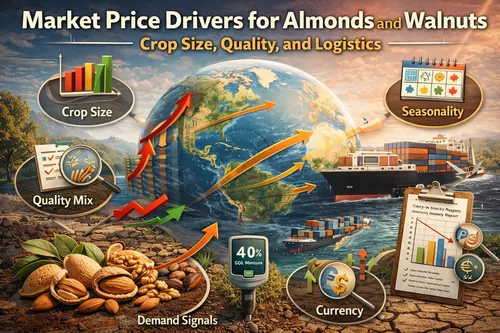
Global market guide: almonds and walnuts trade in a year-round market, but supply is seasonal and pricing is influenced by a set of recurring drivers. This guide explains the practical mechanics behind price moves—crop size, carry-in inventory, quality/grade mix, trade lanes, freight, currency, and buyer coverage—so procurement teams can plan smarter sourcing decisions.
Previous: Walnut Trade Lanes and Export Markets: Major Destinations and Seasonality • Next: How Buyers Track Almond and Walnut Prices: Reports, Contracts, and Timing
Related: bulk almond and walnut products • products catalog • request a quote
Fast takeaway for buyers: Markets move when (1) expected supply changes, (2) the quality mix changes, or (3) logistics and financing conditions change. Prices can also move without headline crop changes when coverage shifts (buyers “rush” or “pause”), or when specific product cuts tighten.
Table of contents
- Market basics: why nut prices behave differently than many commodities
- What drives demand and consumption patterns
- Supply drivers: crop size, carry-in, and available exportable supply
- Quality and grade mix: the “hidden” price driver
- Seasonality and timing: how the calendar shapes pricing
- Trade lanes and destination dynamics
- Logistics and freight: containers, lead times, and landed cost
- Currency and macro effects: why FX and interest rates matter
- Contract structure: spot vs forward, coverage strategies
- A practical buyer playbook: how to use these drivers
- QA + procurement alignment: specs, COA, and risk buffers
- FAQ: almond and walnut pricing
- Next step
Market basics: why nut prices behave differently than many commodities
Almonds and walnuts are agricultural commodities, but they don’t trade like exchange-listed products with a single transparent daily benchmark. Pricing is typically negotiated across a network of growers, handlers, processors, exporters, importers, and ingredient users. That means: availability of specific product cuts (variety, size, grade, color, form, packaging) can matter as much as headline production numbers.
Another key difference: nuts are stored and shipped over long periods. Carry-in inventory, warehouse conditions, and the pace of shipments can change the market’s “tightness” even when the crop estimate looks stable. In other words, pricing is not just about production—it’s about sell-through and usable supply.
For bulk buyers, the most reliable approach is to treat pricing as an outcome of a few recurring levers: supply volume, quality mix, demand pace, and delivered cost (freight + handling + currency). The sections below unpack those levers.
What drives demand and consumption patterns
Demand for almonds and walnuts is diversified across retail, foodservice, and industrial ingredient use. The demand profile changes based on form factor (kernels vs in-shell), processing format (whole, diced, sliced, blanched, meal/flour, paste, oil), and end-market uses (snacks, bakery, confectionery, dairy alternatives, sauces, cereals, bars, and culinary).
Consumer trends that influence bulk demand
- Snack behavior: flavor launches, portion packs, and protein/“better-for-you” positioning can pull demand forward.
- Bakery & confectionery cycles: seasonal programs and promotional calendars can create predictable peaks.
- Plant-forward and ingredient innovation: almond and walnut pieces, flours, and pastes can benefit from new SKU development.
- Price substitution effects: when one nut becomes expensive, some formulations shift toward alternative nuts or inclusions (program dependent).
Industrial demand is spec-driven
Many industrial users aren’t simply “buying almonds”—they’re buying a specific spec that must run through equipment with predictable yield. This is one reason price moves can look “odd” from the outside: a market may have plenty of almonds overall, but limited supply of a particular cut (for example, a specific size range, tighter defect limits, a blanched-ready profile, or a preferred packaging format).
Procurement tip: When demand feels “strong,” ask a precise question: “Is demand strong for the category overall, or strong for specific cuts (sizes, grades, forms)?” That one distinction often explains why certain items are firm while others are stable.
Supply drivers: crop size, carry-in, and available exportable supply
Supply is the foundation of pricing. But “supply” has layers: production volume, usable quality, inventory held back for domestic use, and inventory already committed under prior contracts. Buyers get the clearest signal when they separate these drivers.
1) Crop size: expected vs realized production
Crop estimates shape early expectations, but markets adjust when reality differs: yield, kernel size distribution, hull/shell behavior, and harvest timing can all change realized output. Even without citing numbers, the logic is consistent: bigger crops tend to pressure pricing if demand pace doesn’t keep up; smaller crops tend to support pricing if buyers need coverage.
2) Carry-in inventory: how much product exists before the new crop
Carry-in is often the most overlooked driver. If inventories are comfortable, a new crop can arrive into a market that feels “covered,” which reduces urgency and can soften nearby pricing. If inventories are tight, buyers often compete earlier for forward positions, especially on high-volume SKUs.
3) Available exportable supply: what can actually ship
Exportable supply depends on processing capacity, quality outcomes, and commercial commitments. In some years, the market may have production volume but limited exportable availability for certain windows because handlers prioritize program customers, sort-outs require additional work, or logistics bottlenecks slow shipment flow.
4) Competing origins and substitution
Almond and walnut markets are global. Competitive origins can influence pricing by offering alternatives in certain destinations or product forms. For buyers, the practical takeaway is not to chase every origin change, but to understand when alternate origins are real substitutes for your spec (and when they are not).
Quality and grade mix: the “hidden” price driver
Two crop years can have similar volume but very different pricing because the quality mix differs. Quality mix includes grade distribution, defect rates, size distribution, kernel color, breakage behavior, moisture variability, and the portion of the crop that is well-suited for premium cuts versus manufacturing-grade applications.
Why quality mix moves prices
Buyers do not consume “average quality.” They consume a target cut that must meet spec and perform in a process. If a crop year produces fewer lots that cleanly hit a high-demand spec (for example, tight defect limits, uniform sizes, strong blanching performance, or consistent color), pricing for that subset can firm even if overall supply is adequate.
Almond-specific quality signals buyers should watch
- Kernel size distribution: affects yield into certain formats (whole vs cut sizes) and process consistency.
- Moisture uniformity: influences storage stability and roast behavior.
- Defect pressure: insect damage, foreign material risk, and lots requiring extra sorting can affect available “clean” supply.
- Program suitability: some lots are better suited for whole kernels, others for diced/sliced or further processing.
Walnut-specific quality signals buyers should watch
- Color and appearance: can be critical for retail and premium ingredient uses; mixed color outcomes can segment the market.
- Kernel integrity: breakage rates affect yield into halves/pieces specifications.
- Moisture and storage sensitivity: impacts shelf-life management and handling requirements.
- Sort-out distribution: drives what is available for higher-value cuts versus manufacturing streams.
Simple rule: Crop volume sets the “direction,” but quality mix sets the “shape.” If your program requires a narrow spec, you are buying the quality mix—not the headline crop.
Seasonality and timing: how the calendar shapes pricing
Almonds and walnuts are harvested seasonally, but they are consumed year-round. That seasonality creates predictable decision windows: pre-harvest expectation building, harvest reality checks, early-crop shipment momentum, and late-season inventory management.
What seasonality means for buyer timing
- Pre-harvest: market prices often reflect expectations and coverage positioning. Forward offers are common for planning.
- Harvest period: quality and size distribution become clearer; logistics and processing throughput matter more.
- Early shipment window: availability and load-out pace can influence nearby pricing and lead times.
- Late season: tightness can appear in specific cuts as inventories narrow; carry-in expectations begin to form.
The right time to buy depends on your business: if you need high confidence on supply continuity, forward coverage may be rational. If you have flexibility and can accept spec ranges, staged buying may reduce risk of “all-in” timing errors.
Trade lanes and destination dynamics
Trade lanes matter because they influence netbacks and availability. A strong pull from a major destination market can tighten exportable supply and support pricing, while weaker demand can increase offers and improve nearby availability.
Why destinations move prices
Destination demand is not only about total consumption. It’s also about: (1) product preferences (in-shell vs kernels; halves vs pieces; specific sizes), (2) packaging norms, (3) regulatory/quality requirements, and (4) shipment timing (peak season programs).
Trade policy and compliance considerations
Tariffs, import rules, documentation requirements, and inspection behavior can influence landed cost and flow. For procurement teams, the practical move is to align early on documentation expectations (COA, origin, allergen statements, micro where required), and to plan lead times that reflect destination realities.
Related reading: Walnut trade lanes and export markets.
Logistics and freight: containers, lead times, and landed cost
Freight is a direct input into landed cost and a hidden input into availability. When freight is cheap and capacity is abundant, buyers can keep less inventory and reorder more frequently. When freight is expensive or congested, buyers often increase safety stock, which can pull demand forward and firm nearby pricing.
What logistics variables matter most
- Container availability and booking reliability: impacts shipment timing and planning confidence.
- Port conditions and routing: affect transit times and risk of delay.
- Domestic trucking and warehouse load-out: can influence lead time even before cargo reaches port.
- Insurance and risk management: matters more when transit times are long or temperatures are high.
Why freight changes can move the product market
Even if the commodity price is stable, a spike in freight can reduce buyer willingness to commit. Conversely, a drop in freight can unlock demand because the same delivered price becomes more attractive. Freight can also “segment” the market—some destinations become temporarily expensive, while others remain accessible.
Storage and shelf-life angle
Longer transit times increase the importance of warehouse conditions and packaging selection. If your program is oxidation-sensitive, consider packaging and loading practices that match your shelf-life targets and climate exposure.
Currency and macro effects: why FX and interest rates matter
Almond and walnut trade is international, and most buyers ultimately care about delivered cost in their local currency. Exchange rates can make the same USD price feel cheaper or more expensive, which can change buying pace in key markets.
FX effects in plain language
- If a buyer’s currency weakens versus USD, imported nuts become more expensive locally, which can slow demand or shift buying patterns.
- If a buyer’s currency strengthens, buyers may accelerate purchases, improving shipment pace and supporting prices.
Interest rates and inventory behavior
Higher financing costs can reduce willingness to hold large inventories, which can shift buying toward “just-in-time” behavior if logistics allow. But if logistics are tight, buyers may still hold inventory and accept higher carrying costs—especially for critical SKUs.
The point: macro conditions don’t replace supply-and-demand fundamentals, but they influence how aggressively buyers cover and how quickly product moves.
Contract structure: spot vs forward, and why coverage strategy changes outcomes
Two buyers can face the same market and experience very different results based on contract structure. Pricing strategy isn’t only “what price did you pay?” It’s also “what risk did you remove, and what flexibility did you keep?”
Spot buying (nearby purchases)
Spot purchases maximize flexibility. This approach can work well when you have spec flexibility, you can substitute formats, and your demand forecast can move. The tradeoff is exposure to sudden market tightening or logistics delays.
Forward buying (coverage)
Forward coverage improves planning: you can align supply with production schedules and reduce shortage risk. The tradeoff is that you may lock in pricing before the market moves in your favor, and you may face constraints if demand changes.
A staged coverage approach (common in practice)
Many industrial buyers use a blended strategy: cover a portion of expected demand forward for core SKUs, and keep a portion flexible for spot buying. The exact split depends on shelf-life needs, demand stability, and tolerance for substitution.
Next topic: How buyers track almond and walnut prices.
A practical buyer playbook: how to use these drivers
Market knowledge is only valuable if it changes decisions. Below is a practical framework procurement teams use to translate market drivers into actions.
Step 1: Define your “must-have” spec and your “acceptable range”
Price volatility hurts most when specs are vague. If your process truly requires narrow parameters, document them and align your supplier program early. If your process can handle a range (for example, multiple sizes, or a broader pieces spec), you can buy more opportunistically.
Step 2: Separate category signals from cut-specific signals
Ask suppliers two questions: (1) “What’s the broad market tone?” and (2) “What’s tight for my exact cut and packaging?” This prevents overreacting to headlines that don’t apply to your item.
Step 3: Build a coverage ladder
Instead of making one big decision, plan coverage in tranches tied to your production calendar (for example: near-term, mid-term, and later needs). This reduces the risk of “perfect timing” requirements.
Step 4: Treat logistics as part of procurement—not an afterthought
If your destination has long lead times, ship early and build buffers. If you require temperature-sensitive handling, align packaging and loading practices with that requirement. In many cases, the biggest “price surprise” is not the commodity price—it’s the delivered cost and delay risk.
Step 5: Use supplier program controls as a risk filter
Especially in variable crop years, the supplier’s sorting, warehousing, moisture management, and documentation practices are part of your risk management. Strong programs make markets feel less volatile because your received quality is more consistent.
QA + procurement alignment: specs, COA, and risk buffers
Price and quality are connected in real life: higher-quality cuts often face tighter availability, and variable crop years often require tighter controls. Align procurement and QA early on:
- Sampling plans: define what you test at receiving and how often.
- Documentation expectations: COA and supporting documents as required by your program.
- Defect tolerance: align internal tolerance with what the supply lane can consistently deliver.
- Storage and packaging: match to shelf-life targets and destination conditions.
If you’re launching a new SKU, build this alignment before you place large-volume orders. The most expensive problems in nuts are usually not “price” problems— they’re spec mismatch, inconsistent performance, or avoidable logistics delays.
FAQ: almond and walnut pricing
Why do prices move quickly right after crop updates?
Crop updates change expectations, but the market also reacts to coverage behavior. If buyers believe supply will tighten, they accelerate purchasing, which can firm pricing quickly. If buyers feel covered, they pause, which can soften pricing even before physical supply changes.
What’s the difference between “crop size” and “available supply”?
Crop size is production volume. Available supply is what can be shipped for your cut and window after accounting for quality distribution, commitments, processing throughput, and logistics constraints.
Is it better to buy forward or spot?
It depends on your risk tolerance and demand stability. Many buyers use staged coverage: lock a portion forward for core SKUs and keep a portion flexible. If your spec is narrow and your demand is stable, forward coverage can reduce disruption risk.
How do product formats influence pricing behavior?
Different formats have different supply dynamics. Whole kernels and premium walnut halves may be more sensitive to quality mix. Pieces and manufacturing streams can be more available but still move with overall supply and demand. Processing formats (blanched, diced, sliced, flour/meal) also add capacity constraints and yield considerations.
Next step
If you share your application and the format you need, we can confirm common spec targets, packaging options, and the fastest supply lane. Use Request a Quote or email info@almondsandwalnuts.com.
To get the fastest, most accurate offer, include: product (almond or walnut), format (whole/diced/sliced/meal/flour/oil), target specs, packaging, volume, destination, and timeline.
Quick links: bulk almond and walnut products • products catalog • contact