
How Buyers Track Almond and Walnut Prices: Reports, Contracts, and Timing
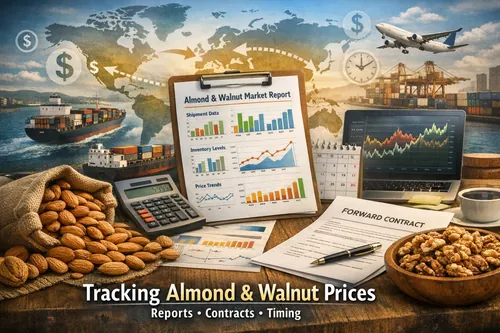
Global market guide: How Buyers Track Almond and Walnut Prices: Reports, Contracts, and Timing. This deep dive shows how professional procurement teams translate crop signals, shipment and inventory data, and logistics constraints into actionable buying decisions for bulk almonds and bulk walnuts.
Previous: Market Price Drivers for Almonds and Walnuts: Crop Size, Quality, and Logistics • Next: Risk Management for Nut Buyers: Currency, Freight, and Crop-Year Strategy
Related: bulk almond and walnut products • products catalog • request a quote
Buyer note: “Price” is not one number. It changes by product format (in-shell vs kernels, halves vs pieces, meal/flour, oil/butter), by spec (grade, color, moisture), and by delivery terms (FOB, delivered, export Incoterms). The goal is to compare like-for-like and model landed cost.
What “price” means in industrial nut buying
In ingredient procurement, the word “price” is shorthand for a bundle of decisions: product definition, quality risk, service level, and delivery commitment. Two quotes can differ materially even when they both say “almonds” or “walnuts,” because the following variables change the supplier’s cost and your risk:
1) Product form and processing state
- In-shell vs kernels: different storage behavior, shipping density, and destination market demand.
- Whole kernels, halves, pieces, diced, meal/flour: each step adds yield loss, sorting time, and QA controls.
- Raw vs roasted (dry roast, oil roast): roasting introduces additional variability (color, moisture, oil management, sensory drift).
- Pasteurization / kill-step programs (when applicable): processing step, validation, and documentation expectations can affect cost and lead time.
2) Spec and grade definition
“Same item” is often a misconception. A quote for walnut halves with a tighter color requirement, lower allowable defects, or a narrower size distribution is not comparable to a more flexible spec—even if the commodity name is identical. For almonds, variety, sizing, defect allowances, and moisture targets also matter.
3) Delivery terms and service level
- Spot vs forward timing: immediate shipment draws from existing inventory; forward coverage shifts crop and financing risk.
- Shipping terms: FOB origin, delivered, or export terms define who carries freight risk and who controls the carrier.
- Packaging: cartons, bags, supersacks, totes, drums; liner type; vacuum or gas flush; pallet configuration.
- Documentation and compliance: COA expectations, microbiology, allergen statements, country of origin, lot traceability.
Practical takeaway: Buyers track markets to time commitments, but they manage outcomes by controlling specifications, documentation, and delivery terms. A “cheap” quote that increases rework, rejects, or shelf-life risk is rarely cheap in total cost.
The market signal stack buyers follow
Most professional teams use a layered view. Instead of reacting to a single headline (“crop up” or “crop down”), they build a stack of signals—some slow-moving, some fast—that explains why prices are moving and whether that move is likely to persist.
Layer A: Structural signals (slow-moving)
- Acreage and orchard age profile: expansion or removals affect future supply; younger orchards increase potential output over time.
- Water availability and cost: irrigation constraints can reduce yield and influence long-term planting decisions.
- Labor and input costs: harvesting, energy, and compliance costs influence the floor price needed for sustainable supply.
- Processing capacity: hulling/shelling, sorting capacity, and warehouse availability impact how quickly product can move.
Layer B: Crop-year signals (seasonal)
- Bloom and set conditions: weather at bloom affects fruit set and quality potential.
- Forecast updates: early estimates guide expectations; later-season estimates often move the market more if they surprise.
- Harvest pace and quality: rain events, heat, or delays can shift quality distribution (and therefore grade availability).
- Inventory and shipment pace: the “is product clearing?” question—especially important when supply is large.
Layer C: Transactional signals (fast-moving)
- Near-term offers and basis levels: what suppliers are willing to ship now, at what terms.
- Freight quotes and capacity: a tight freight market can raise delivered cost even if the commodity itself is flat.
- Currency swings: export competitiveness changes quickly when exchange rates move.
- Demand spikes: retail promotions, new product launches, or destination restocking cycles can tighten nearby supply.
Reports and data sources buyers actually use
Buyer teams typically blend “industry reports” (shipment/inventory and crop forecasts) with “transaction proxies” (market news and freight quotes) and with internal signals (usage forecasts, production schedules, and QC performance by supplier/lot). Below is a practical map of the information ecosystem—what each source is good for, and how buyers interpret it.
1) Shipment and inventory reporting (market balance)
Shipment pace is one of the most actionable signals because it answers a simple question: is the market absorbing supply? For almonds, many buyers and sellers watch a monthly position-style reporting cadence tied to the almond crop year. For walnuts, shipment/inventory reporting also helps buyers gauge how quickly handlers are clearing product after harvest.
- What buyers look for: year-to-date shipments vs last year, domestic vs export split, and inventory changes.
- How it translates to pricing: strong shipments + falling inventory tends to support price; slow shipments + rising inventory can pressure it.
- Common mistake: comparing numbers from different crop-year windows or mixing in-shell equivalents with kernel/meat weight without conversion.
2) Crop forecasts and acreage signals (supply expectation)
Forecasts help buyers set a baseline narrative: “big crop,” “tight crop,” or “normal crop.” The key is not just the number—but the market’s expectation of that number. A forecast can be “bearish” even if the crop is smaller, if the market expected an even smaller crop, and vice versa.
- What buyers look for: forecast range, bearing acreage, yield per acre assumptions, and any notes on weather/quality risk.
- How it translates to buying: forecasts influence forward coverage decisions and the willingness of suppliers to offer fixed prices for future shipment windows.
- Buyer practice: treat early-season forecasts as directional, and tighten assumptions as harvest approaches.
3) Market news and terminal/wholesale reporting (transaction proxy)
Some teams track public market-news style pricing as a proxy for “what’s happening now.” These sources are not always a clean match for industrial spec buying, but they can be useful when interpreted correctly.
- Best use: confirming whether nearby offers are tightening or loosening and whether there is unusual activity in a given week.
- Limitation: the reported item may be different from your industrial spec (pack size, grade, destination, or channel).
- Tip: if you use a market-news proxy, standardize it: follow the same report, same product line, and same time series over time.
4) Trade lane data and destination market signals (export demand)
Almonds and walnuts are globally traded. Even if you buy domestically, export pull can tighten supply for certain grades and formats, while a weak export lane can increase nearby availability and pressure prices.
- Watch items: major destination demand, import policies, customs clearance friction, and seasonal holiday demand cycles.
- Practical approach: focus on directionally correct signals (demand strong/weak; logistics smooth/disrupted), not precision forecasts.
5) The most underrated “report”: your own receiving and QC history
The best buyers treat internal quality performance like a market signal. If one supplier consistently delivers on moisture, defect limits, and sensory targets with fewer claims, that reliability is part of “price.” It reduces hidden cost (rework, scrap, downtime, and customer complaints).
- Track: defect rates by supplier/lot, moisture drift by season, oxidation/rancidity complaints, and foreign material incidents.
- Turn it into dollars: estimate the internal cost of rejects and rework, then compare “true” landed cost across suppliers.
Spot vs forward contracts (and common price structures)
Once you understand the signals, the next question is execution: how do you lock supply without overpaying or taking on unnecessary risk? That’s where contract structure matters. Most industrial programs fit into one of the patterns below.
Spot buying (near-term coverage)
Spot buying typically covers immediate needs—often weeks to a couple of months—depending on supplier inventory and logistics. It can be efficient for flexible users, but it exposes you to short-term swings and to availability constraints on specific grades or sizes.
- Best for: variable demand, short shelf-life needs, or when you are still qualifying product/spec.
- Key risk: if the market tightens suddenly, you may face delays, substitutions, or premium pricing for “must-ship” orders.
Forward buying (future shipment windows)
Forward contracts secure volume for future delivery. This is common for high-volume SKUs where production cannot stop, or where the business needs price stability for budgeting.
- Best for: baseline volume, core SKUs, long lead-time export programs, and plants with strict production schedules.
- Key risk: locking too early without spec clarity or demand certainty can create mismatch (wrong packaging, wrong grade, wrong timing).
Common pricing mechanisms
- Fixed price: one unit price for a defined spec and shipment window.
- Tiered / window pricing: price depends on shipment month or quarter (reflecting inventory carry and risk).
- Formula or index-referenced: price floats with an agreed reference plus/minus a differential (often used to reduce negotiation friction).
- Open price / to-be-fixed: volume reserved now, price set later based on an agreed method—useful when timing is uncertain.
Terms that quietly change the “real” price
- Incoterms / delivery terms: who pays freight, who chooses carrier, and where risk transfers.
- Payment terms: net days, deposits, letters of credit for exports; these affect financing cost.
- Quality and claims language: how defects are handled, sampling method, dispute window, and remedies.
- Substitution rules: whether the seller can swap equivalent grade/size if the exact item is tight (and how equivalency is defined).
Pro buyer move: When comparing offers, normalize them into the same unit and the same terms (spec, packaging, freight, payment, and timeline). “Cheaper” often disappears after you model landed cost and risk.
Seasonality and timing: how the calendar moves markets
Almonds and walnuts are harvested seasonally, but demand is continuous. That mismatch is why timing matters: buyers are constantly choosing between (a) buying now from inventory or (b) buying forward and letting suppliers carry inventory risk.
A practical seasonal map (high-level)
Timing varies by region and year, but buyers often use a simple “market calendar” to frame expectations. The exact dates shift; the pattern is what matters.
- Pre-harvest: forecast chatter and early indications can move the market before product is available.
- Harvest window: quality distribution becomes clearer; nearby offers can tighten or loosen depending on crop size and demand.
- Post-harvest: inventory and shipment pace becomes the main signal; prices often follow “is it moving?” rather than headline estimates.
- Mid-season: buyers watch whether shipment pace stays consistent and whether specific grades are getting tight.
When prices tend to move the most
- Surprise forecast changes: revisions that contradict market expectations.
- Quality shocks: weather events, mold/moisture issues, or unusual defect distribution that changes usable supply.
- Freight disruptions: port congestion, container tightness, or capacity constraints can increase delivered cost quickly.
- Destination restocking: when key import markets re-enter aggressively, especially for export-heavy specs.
Coverage strategies buyers use (instead of “guessing the bottom”)
Many teams use layered coverage: securing a baseline volume forward (so production is safe), then layering spot purchases for flexibility. This reduces the cost of being wrong—because you are rarely all-in at one price point.
- Baseline coverage: 50–80% of forecasted need for core SKUs, forward.
- Flex coverage: remainder bought in tranches, based on demand updates and market conditions.
- Safety stock policy: aligned with transit time, shelf-life risk, and supplier lead times.
Landed cost modeling: freight, Incoterms, and lead times
For bulk almonds and bulk walnuts, logistics can be a meaningful share of total cost—especially for exports or for temperature-sensitive programs. Buyers who win long-term don’t just negotiate commodity price; they design a repeatable landed-cost model.
Start with a clean landed-cost template
- Commodity price: unit price tied to spec, packaging, and shipment window.
- Packaging and palletization: cartons vs bags, liner type, pallet count, and cube utilization.
- Freight: truck / rail / intermodal / ocean; fuel surcharges; accessorials.
- Handling: warehouse in/out, drayage (export), port fees (export), inspection fees when applicable.
- Quality cost allowance: expected defect/trim loss, rework, sampling time, and claims reserve (based on history).
- Financing: the cost of carrying inventory, especially for forward buying and long transit lanes.
Freight and shelf-life are linked
Nuts are oxidation-sensitive. Longer lead times increase the importance of moisture control, temperature stability, and packaging that limits oxygen exposure. A “cheaper freight mode” can become expensive if it increases sensory drift or shortens usable shelf life at the customer.
Incoterms and control
Incoterms don’t only define who pays what; they define who controls the carrier, who manages delays, and where risk transfers. For predictable supply, many buyers prefer terms that give them visibility and control—especially for critical production programs.
Quality and spec differences that quietly change price
Price tracking is only useful if your comparisons are apples-to-apples. Below are common spec variables that cause “same product, different price” confusion. If your procurement team standardizes these definitions, negotiations become cleaner and QC disputes drop.
For walnuts (common industrial variables)
- Style/cut: halves, pieces, light pieces, combo, diced—each has different yield and sorting requirements.
- Color expectations: lighter color typically commands a premium in many applications.
- Defect allowances: shell fragments, insect damage, mold, foreign material controls.
- Moisture target: affects texture, shelf life, and risk of mold or quality degradation.
- Packaging and protection: liner type, vacuum/gas flush options (program dependent), and light/oxygen exposure control.
For almonds (common industrial variables)
- Size and count: sizing affects run rate, portion control, and appearance in finished products.
- Variety mix: some buyers specify varieties; others accept blends—this can affect availability and price.
- Defect tolerances: insect damage, chips/breakage, foreign material limits, and lot consistency.
- Moisture target: ties directly to storage safety and oxidation behavior.
- Processing step requirements: if your application requires specific treatments or validations, align it early in the quote process.
Quick rule: If you cannot put two quotes under the same spec sheet and the same delivery terms, you are not comparing prices—you are comparing offers.
A practical procurement workflow (step-by-step)
Below is a simple, repeatable workflow used by many industrial buyers. The objective is to reduce surprises: fewer emergency buys, fewer QC disputes, and fewer “we bought cheap but paid later” outcomes.
Step 1: Define what you are really buying
- Application: snack, bakery, confectionery, dairy alternative, sauce, cereal, nutrition, or ingredient blend.
- Format: in-shell, kernel, cut, meal/flour, oil/butter; raw vs roasted.
- Spec: moisture, grade/color, defect limits, micro requirements, packaging constraints.
- Service: delivery windows, safety stock expectations, documentation needs.
Step 2: Build a “market + internal” dashboard
- External: shipment/inventory cadence, crop forecasts, supplier availability notes, freight quotes.
- Internal: weekly usage, forecast accuracy, lot-level QC performance, and claims history.
- Decision rule: define what would trigger forward coverage vs spot (e.g., shipment pace accelerates + lead times extend).
Step 3: Run an apples-to-apples quote process
- Send one standardized spec sheet to all bidders.
- Request the same Incoterms, packaging, and shipment window structure.
- Ask suppliers to list assumptions (availability, minimum order, lead time, and documentation included).
Step 4: Evaluate total cost, not just unit price
- Convert all offers into a comparable landed cost model.
- Assign a cost to quality risk (based on your QC history or category risk posture).
- Prefer repeatable supply lanes over “one-time bargains” for core programs.
Step 5: Lock baseline, keep flexibility
For high-volume programs, consider a baseline forward position for core SKUs and use spot or shorter forward windows for variable demand. This balances budget stability with the ability to respond to market changes.
FAQ: common questions from buyers
What’s the difference between “market price” and “supplier quote”?
Market commentary is a directional reference. A supplier quote is a specific commercial offer tied to a defined spec, packaging, availability, and delivery terms. The quote is what you can buy; the “market” is context.
How often should a procurement team check reports?
Many teams track a monthly cadence for shipment/inventory reports and a weekly cadence for supplier availability + freight. During harvest or major disruptions, the check-in frequency often increases.
Why does freight sometimes matter more than the commodity move?
Because your plant pays delivered cost. A flat commodity price combined with rising freight can still raise your unit cost, and transit delays can affect shelf-life risk.
Should we buy on spot or lock forward?
It depends on your demand predictability and your risk tolerance. If production continuity matters, forward coverage for baseline volume is common. If demand is highly variable, spot buying with an approved backup supply lane can be safer.
What’s one mistake that causes the most negotiation friction?
Undefined specs. When moisture, defects, grade/color, packaging, and documentation expectations are not written clearly, suppliers price conservatively (or prices become non-comparable), and QC disputes increase later.
Next step
If you share your application and the format you need, we can confirm common spec targets, packaging options, and the fastest supply lane. Use Request a Quote or email info@almondsandwalnuts.com.
To get an accurate quote fast, include: product + format, grade/size, moisture target, defect/color expectations, packaging, first order volume, annual forecast, destination, preferred delivery terms, and shipment window(s). If you have a spec sheet, attach it.