
Walnut Trade Lanes and Export Markets: Major Destinations and Seasonality
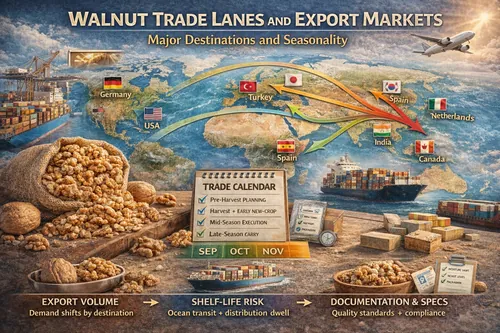
Global market guide: where California walnuts move, why demand is seasonal even when consumption is year-round, and how logistics, shelf-life risk, and documentation shape international sourcing decisions.
Previous: Almond Trade Lanes and Export Markets: How California Supply Moves • Next: Market Price Drivers for Almonds and Walnuts: Crop Size, Quality, and Logistics
Related: bulk almond and walnut products • products catalog • request a quote
What drives demand and consumption patterns
Walnut demand is not one market—it’s a stack of use cases. Snack and retail programs care about visual grade, piece integrity, and flavor consistency. Industrial users (bakery, confectionery, cereals, sauces, plant-based foods) focus more on line performance, defect tolerance, and shelf-life risk across storage and distribution.
Practical takeaway: define your end use first (retail, confectionery inclusion, sauces/emulsions, frozen, bakery). Then align (1) kernel style/cut, (2) defect & color limits, (3) packaging barrier level, and (4) transit time risk.
Demand can also swing by form factor: in-shell vs shelled kernels, and within shelled: halves, pieces, meal/flour. Each form has different price sensitivity, packing requirements, and customer expectations.
Trade lanes and seasonality
California walnut supply is seasonal, but customer demand is year-round. Harvest typically runs from late August through late November, with post-harvest drying/sorting and program grading feeding the pipeline afterward. Most buyers experience “seasonality” as a combination of: new-crop availability, storage carry-in, freight lead times, and how aggressively customers lock coverage.
Seasonality timeline (buyer view)
- Pre-harvest planning: specs, approvals, and contracts; align QA documentation early.
- Harvest + early new-crop: the market discovers quality signals; offers can move quickly.
- Mid-season execution: steady shipments; shelf-life management becomes more important than “new crop” headlines.
- Late-season / carry: storage duration and oxidation risk become bigger parts of risk pricing.
Where walnuts go (major destination markets)
Export demand spans multiple regions. Commonly cited major markets for California walnuts include: Germany, Turkey, Japan, South Korea, Spain, the UAE, Italy, India, Canada, and the Netherlands. These destinations often reflect a blend of retail consumption, confectionery/bakery demand, and re-distribution hubs.
Buyer tip: treat “destination” as a spec variable. Different markets can have different tolerance for color variation, piece size distribution, packaging expectations, and lead-time constraints.
Transit time and shelf-life risk
Walnuts are oxidation-sensitive. For export lanes, the risk driver is often not “will it arrive,” but “will it arrive with the same sensory performance after long transit + warehouse dwell time.” If your program has long distribution tail, consider higher barrier packaging, stronger oxygen control, and tighter sensory requirements on the front end.
Key factors that move prices
Walnut prices tend to react to a handful of repeatable variables. The exact mix changes by year, but procurement teams usually watch the same dashboard.
- Crop size & quality: yield, kernel size distribution, color/defect profile.
- Carry-in inventory: how much product is available before the next crop fully flows.
- Competing origins: alternate supply options can cap prices or pull demand away.
- Freight capacity & cost: container availability, port congestion, route volatility.
- Currency & destination economics: FX movement changes buying power and substitution pressure.
- Contract structure: spot vs forward coverage, and how much spec flexibility is negotiated.
If you’re comparing offers, separate “price” into: product value (spec + grade), packaging value (barrier level), and logistics value (lead time + risk control). That framing reduces surprises later.
How buyers monitor markets
Strong walnut programs use a simple cadence: monitor signals, validate with suppliers, and connect that back to internal demand planning. The goal isn’t perfect timing—it’s avoiding “last-minute buys” that force compromises.
A practical monitoring stack
- Crop signals: early quality indicators, size distribution, defect trends.
- Supplier lane health: capacity, packing schedules, QA backlog, documentation readiness.
- Freight signals: route pricing and lead times; identify choke points early.
- Internal usage: forecast accuracy, promo calendars, production seasonality.
For export programs, add a “documentation lane check” to your weekly rhythm: confirm COA format, allergen statement, country of origin, and any destination-required certificates before you ship.
Building a practical sourcing strategy
The best sourcing strategies are boring (in a good way): tight specs where they matter, flexibility where it doesn’t, and redundant supply options when a single lane failure would stop production.
Strategy checklist
- Define spec priorities: what must be tight (micro, sensory, color), what can be ranged (piece distribution).
- Qualify at least two lanes: primary + backup for core SKUs when possible.
- Match packaging to risk: higher barrier for long transit/long shelf; standard packaging for fast turns.
- Document once, reuse often: lock a spec sheet + COA template + packaging standard early in the program.
- Time coverage to your calendar: forward coverage for base demand, spot coverage for variable demand.
If you want fewer problems: avoid “one spec for everything.” Make a spec tiering system: Tier A (tight retail/sensory), Tier B (industrial), Tier C (grind/meal).
What to include in an export-ready quote request
Send these upfront to reduce back-and-forth:
- Product form (in-shell / shelled; halves/pieces/meal), grade/color expectations, defect limits
- Moisture target, microbiology requirements (if any), sensory notes (freshness/odor limits)
- Packaging format (bags/cartons/liners) + barrier expectations; pallet pattern and receiving constraints
- Destination, Incoterms preference (if applicable), target ship window, and desired lead time
- Volume (first order + forecast) and documentation needs (COA, COO, allergen, etc.)
Next step
If you share your destination market, application, and preferred format, we can recommend a practical spec range, packaging level, and shipping lane that matches your shelf-life risk posture. Use Request a Quote or email info@almondsandwalnuts.com.