
Milled ingredient • Quote-ready specs • California sourcing

Bulk Almond Meal

Atlas Nut Supply, LLC supplies bulk almond meal (also called ground almonds in many markets) to manufacturers, brands, and distributors that need consistent granulation, moisture control, and documentation for production and global trade. We cooperate with multiple California suppliers to align the right grind/mesh target (or PSD), color profile (blanched vs skin-on), food safety requirements, packaging, and delivery lane for your procurement.

Almond meal is best specified by particle size and functional needs (crumb, bite, binding, flowability)—not by a single universal definition. If you share a target mesh/PSD or a benchmark sample, we can match programs built for bakery mixes, coatings, bars, and plant-based dry blends.

Input options: blanched or skin-on Spec levers: mesh/PSD, moisture, PV/FFA Packaging: 25 kg bags, cartons, totes Docs: COA + traceability
Formats
Meal + controlled grinds
Programs
USA + export lanes
Support
COA • traceability • docs

Request a quote Product specifications Quote checklist Back to catalog

Looking for extra-fine grind? See Extra fine almond meal (flour) for tighter mesh programs.
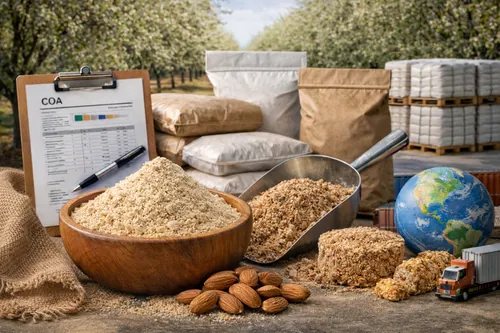
Bulk Almond Meal for wholesale supply — Atlas Nut Supply

Almond meal options

Common specification levers (availability varies by supplier program):

  • Granulation / mesh targets: meal-style grinds and tighter (flour-like) programs by request
  • Blanched vs skin-on: align color requirements for finished product appearance
  • Moisture management: targets to improve flowability, reduce clumping, and protect shelf-life
  • Oxidation controls: peroxide value (PV) and free fatty acids (FFA) targets to manage freshness
  • Defect limits: foreign material controls, speck limits, and sensory targets as specified
  • Food safety options: pasteurized programs and micro targets where required (program dependent)
  • Packaging: bulk bags/cartons and pallet constraints supported; lot coding and traceability by program
  • Documentation: COA, allergen statements, country of origin and traceability documents upon request

If you are replacing wheat flour, tell us the target functionality (binding, crumb, moisture retention, texture). We’ll help match a granulation profile that performs in your line.

Industrial applications

Typical manufacturing and ingredient uses:

  • Bakery & mixes: gluten-reduced formulations, macaron-style systems, cookies, cakes, and inclusions
  • Coatings & breading: texture systems for savory applications and prepared foods
  • Bars & nutrition: particle-driven texture, fat contribution, and binding in blends
  • Plant-based bases: dry mixes, dessert bases, and nut-forward formulations
  • Confectionery: fillings, pastes, and specialty inclusions (spec dependent)

For deeper application guides, see the Atlas Nut Academy.

Choosing the right almond meal spec

Most production issues with almond meal come from mismatched particle size, moisture, or oxidation tolerance. These quick checkpoints help align a spec that performs consistently.

Granulation (mesh/PSD)

  • Coarser meal for texture and visible particle
  • Finer meal for uniform crumb and smoother mouthfeel
  • Ask for mesh targets or particle size distribution if your line is sensitive

Moisture & flowability

  • Moisture targets impact clumping and hopper flow
  • Define storage conditions and ambient humidity
  • Specify liner/barrier packaging expectations if critical to your process

Color profile

  • Blanched meal supports lighter baked goods and consistent color
  • Skin-on meal can be more rustic with visible flecks
  • Share finished product photos or targets when possible

Oxidation tolerance

  • Almond meal contains natural oils—PV/FFA and sensory specs matter
  • Define shelf-life expectations and storage temperature
  • Align packaging barrier and lot rotation (FIFO) for consistency

Product specifications (typical / program-defined)

Below are common industry specification targets used to qualify almond meal programs. Exact limits vary by supplier, grind, and destination. If you have internal targets, send them—otherwise we can propose a quote-ready spec for your application.

Core composition & quality

ParameterTypical targetWhy it matters
Ingredient statement 100% almonds (blanched or skin-on) Impacts label, color, and “clean label” positioning.
Moisture Program-defined (commonly ≤3–6%) Flowability, clumping, and shelf-life stability.
Fat (lipids) ~55–60% (typical by nutrition data) Texture, richness, binding, oxidation sensitivity.
Protein ~20–22% (typical by nutrition data) Functional contribution in mixes and nutrition systems.
Peroxide value (PV) Program-defined (commonly ≤2–3 meq O2/kg) Freshness indicator; supports rancidity control.
FFA (as oleic) Program-defined (commonly ≤0.3–1.0%) Hydrolytic breakdown; affects flavor drift over time.
Aflatoxins Program-defined (destination-dependent; often specified on COA) Regulatory and customer QA requirement for many markets.

If you’re running high-volume bakery or bar lines, ask for a COA set that includes PV/FFA and agreed sensory notes to reduce lot-to-lot surprises.

Granulation & food safety

ParameterTypical targetNotes
Granulation (mesh/PSD) Fine meal, medium meal, or custom PSD Specify mesh/PSD if your process is sensitive (beverages, hoppers, extrusion, coating lines).
Example: “fine” programs Majority passing ~1.0–1.2 mm (program-defined) Useful for uniform crumb and consistent distribution in mixes.
Example: “extra-thin” programs High share <0.8 mm (program-defined) Often requested for smoother mouthfeel and tighter appearance control.
Microbiology Program-defined; pasteurized options where required If you need RTE alignment, specify targets and preferred pasteurization approach.
Allergen Contains tree nuts (almond) Declare per your regulatory/label program; confirm cross-contact expectations if needed.

Fastest alignment: send mesh/PSD target + blanched vs skin-on + PV/FFA targets + packaging + destination. We’ll match a program and return quote-ready options.

Packaging & logistics (common options)

Packaging depends on your handling equipment, throughput, and freshness targets. Share constraints and we’ll align the pack-out.

  • Industrial bags: commonly 25 kg (or 50 lb) bags with liners (program dependent)
  • Cartons/cases: lined cartons used in some fine-grind programs
  • Totes / super sacks: available in some programs for high-throughput receiving
  • Pallet constraints: max height/weight, dock access, and forklift limitations
  • Lot coding: align traceability and FIFO rotation expectations

Storage, shelf-life & oxidation control

Almond meal contains natural oils—oxygen, heat, and light management matters. We can align a storage plan to your targets.

  • Store cool and dry; avoid temperature swings and high humidity
  • Keep sealed in barrier packaging; minimize oxygen exposure after opening
  • Use FIFO rotation and maintain lot-level traceability
  • Define your shelf-life window so we can align PV/FFA and packaging barrier

If your line is sensitive to clumping or flow issues, share hopper/feeder details and ambient conditions—moisture targets and packaging liners can be tuned.

Specs checklist (quote-ready)

Send your spec sheet if you have one. Otherwise, start with the checklist below for faster alignment.

  • Product: Almond meal (note if you also want extra-fine meal / flour)
  • Granulation: mesh target or particle size distribution (PSD) if available
  • Blanched vs skin-on: color requirement and defect limits (specks/flecks)
  • Moisture target: and any flowability/clumping concerns in your process
  • Oxidation expectations: PV/FFA targets (if used), sensory/rancidity tolerance, shelf-life expectations
  • Micro requirements: pasteurized program or specific micro targets (if applicable)
  • Packaging: bag/carton/tote format and pallet constraints; inner liners if required
  • Volume: first order + forecast and delivery cadence
  • Destination: city/state/country and required delivery window
  • Documentation: COA, traceability/COO, allergen statement, certifications if required

Share the end application (mix, bakery, coating, bars) and your handling steps (mix time, shear, bake temp, storage). We’ll help confirm the best almond meal spec targets for performance and shelf-life.

Request a quote Contact options

FAQ: almond meal

What is almond meal vs almond flour?

Almond meal is typically a coarser grind, while almond flour is usually extra-fine with tighter mesh targets. Definitions vary by supplier, so specifying your target mesh/particle size distribution (PSD) is the fastest way to align.

Can you supply blanched (skinless) or skin-on almond meal?

Yes, depending on program availability. Blanched meal is often used when color uniformity is critical; skin-on meal can add a more rustic look and different functional characteristics. Tell us your color and defect expectations.

Which specs matter most for bakery lines?

For bakery and mix systems, the biggest drivers are granulation/PSD (crumb and mouthfeel), moisture (flow and clumping), and oxidation controls (PV/FFA and sensory). If you have a benchmark flour/meal, share it and we’ll match a comparable performance profile.

What specs do you need to quote bulk almond meal?

At minimum: target granulation/mesh or PSD, blanched vs skin-on, moisture and oxidation expectations (PV/FFA if used), packaging, volume/forecast, destination, and documentation needs. If you have a spec sheet, share it for faster matching.

How should almond meal be stored for best shelf-life?

Keep sealed, cool, and dry; limit heat, light, and oxygen exposure; and rotate FIFO with lot-level traceability. Shelf-life depends on moisture targets, packaging barrier, and storage temperature—share your conditions and target shelf-life so we can align a program.

Do you ship almond meal outside the United States?

Yes. We support export lanes depending on destination, volume, and required documentation. Share the country/port and timeline for planning.