Almonds • Flour/meal • Spec-sheet ready • California sourcing

Bulk Extra-Fine Almond Meal (Almond Flour)

Atlas Nut Supply, LLC supplies bulk extra-fine almond meal (almond flour) to manufacturers, brands, and distributors. We cooperate with multiple California supplier programs to align your particle size spec (sieve / % through), moisture, oxidation controls (PV/FFA), micro targets, packaging, documentation, and delivery lane.

Extra-fine flour programs are most commonly specified by target sieve / % through (not just “fine” vs “extra-fine”), plus moisture max for flowability and oxidation limits to protect flavor over shelf life.

Format
Extra-fine almond flour / meal
Programs
U.S. + global export
Support
COA • traceability • QA docs

Request a quote View spec checklist Back to catalog

Fastest quoting: share sieve/% through, moisture max, any PV/FFA limits, micro targets, packaging, volume, and destination (and port if export).
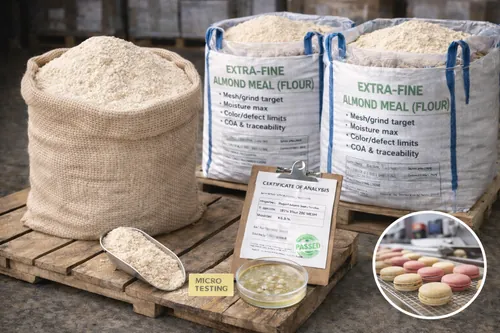
Particle size sieve / % through Moisture max % PV / FFA oxidation limits Micro targets & sampling Packaging case / pallet
Bulk Extra-Fine Almond Meal (Almond Flour) for wholesale supply — Atlas Nut Supply

Specification snapshot (typical targets)

Published almond flour/meal programs commonly control moisture, oxidation (PV/FFA), micro, and contaminants. Your final limits can be set tighter depending on end-use and destination compliance needs.

Parameter Typical spec target Why buyers control it
Ingredient 100% almonds (blanched or natural) Color, flavor, and texture consistency
Particle size Sieve / % through (define your screen + tolerance) Macarons/pastry performance, blend uniformity, dusting, flow
Moisture ≤ 6.0% (common) or as required Flowability, clumping control, shelf-life stability
Peroxide Value (PV) Max 2.0–5.0 meq/kg (program dependent) Oxidation indicator; protects flavor and “fresh” aroma
Free Fatty Acids (FFA) Max 1.0–1.5% (as oleic; program dependent) Hydrolytic rancidity control; flavor stability
Micro (examples) Salmonella: absent (per program method); Yeast/Mold limits defined Food safety assurance for ready-to-eat or inclusion uses
Aflatoxin (examples) Total: 10–20 ppb; B1: 5–8 ppb (program dependent) Compliance and customer risk management

Note: the snapshot above reflects common published program targets across the market. If you need specific standards (EU, UK, GCC, etc.), share your destination and we’ll align a compliant program.

What “extra-fine” usually means

“Extra-fine” is not a single universal number—buyers typically define it by sieve retention or % through on an agreed screen. Some programs define a “super fine” grade with minimum % passing a specified sieve, plus moisture and micro controls.

  • Specify by sieve: “% retained on Screen X” and “% through Screen Y” (preferred for clarity).
  • Choose blanched vs natural: blanched generally targets lighter color; natural retains skin flecks and a more rustic appearance.
  • Plan for oil content: almond flour is naturally higher in fat than wheat flour and behaves differently in baking.
  • Food safety option: programs may include a validated kill step—share your micro targets and destination requirements.

If you’re making macarons, pastries, coatings, bars, or dry beverage mixes, tell us the application—particle size and moisture targets can shift based on performance needs.

Extra-fine almond meal (almond flour) options

Common program variables (availability varies by season and supplier program):

  • Blanched vs natural: blanched (skin removed) for lighter color; natural (skin-on) for rustic appearance.
  • Particle size control: sieve/% through targets; ability to set retention bands and “fines” limits.
  • Moisture targets: moisture max to reduce clumping and protect flowability.
  • Oxidation targets: PV/FFA limits set to protect flavor over shelf life.
  • Food safety programs: micro targets and validated treatment options (destination/customer dependent).
  • Packaging: 25 lb cartons with poly liner; 10–12.5 kg cases; totes/drums by program.
  • Documentation: COA, traceability/COO, allergen statements; certifications by program (e.g., organic, kosher/halal where available).

Industrial applications

Typical manufacturing and ingredient uses:

  • Bakery: macarons, pastries, cakes, cookies, and gluten-reduced formulations
  • Coatings: breading/batter systems and texture builds
  • Bars & mixes: protein bars, nutrition blends, dry inclusions
  • Desserts: frozen dessert bases and confections
  • Dry blends: spice mixes, beverage powders, and plant-forward formulations (program dependent)

Almond flour retains moisture and contains natural oil, which can change bake time and fat/sugar usage versus wheat flour. If you share your formula goal, we’ll help recommend a practical particle size and moisture target.

For deeper application guides, see the Atlas Nut Academy.

Technical notes buyers ask for

1) Particle size = performance

Fine grind improves blend uniformity and smooth crumb, but can increase dusting and compacting if moisture or “fines” aren’t controlled. Many QA programs define “extra-fine” as a sieve retention band (e.g., a maximum retained on a coarse sieve and a minimum passing).

  • Request format: “% retained on sieve X” + “% passing sieve Y”.
  • Macaron/pastry: typically needs tighter particle size and lighter color (blanched).
  • Coatings/breading: may tolerate a broader distribution depending on texture target.

2) Moisture + oxidation controls

Because almond flour contains natural oil, industrial buyers often set both moisture and oxidation limits. Common published programs include moisture caps and PV/FFA thresholds to protect flavor over shelf life.

  • Moisture max: often ≤ 6.0% (confirm per program).
  • PV/FFA: set limits aligned to expected hold time and storage temperature.
  • Storage: sealed, cool, dry; reduce heat/humidity swings to minimize clumping and flavor change.

If you have a target shelf life (e.g., 9–12 months) and storage temperature (ambient vs chilled), include it in your inquiry—those inputs affect the practical PV/FFA and packaging choices.

Specs checklist (quote-ready)

Send your spec sheet if you have one. Otherwise, start with the checklist below for faster alignment.

  • Product: Extra-fine almond meal (almond flour)
  • Almond type: blanched (skin removed) or natural (skin-on)
  • Particle size spec: sieve / % through (preferred) + tolerance band
  • Moisture target: moisture max to reduce clumping and improve flowability
  • Oxidation limits: PV max and FFA max (if required); target shelf-life and storage conditions
  • Color / defect limits: skins or dark pieces limits (if appearance-critical)
  • Micro requirements: Salmonella requirement, yeast/mold, APC/TPC; sampling expectations
  • Contaminants: aflatoxin limits; pesticide/heavy metal expectations (destination dependent)
  • Packaging: 25 lb cartons w/ liner; 10–12.5 kg cases; pails/drums/totes (by program) + pallet pattern
  • Volume: first order + forecast and delivery cadence
  • Destination: city/state/country (and port if export)
  • Delivery window: required ship/receipt dates
  • Documentation: COA, traceability/COO, allergen statement, certifications if required

Share the end application and processing details and we’ll help confirm the best particle size and moisture targets for performance and shelf-life.

Example spec ranges (for reference)

Buyers often start from published program targets and then tighten for their product and destination. If you want, we can send a quote-ready spec template.

Spec item Example published targets (range) Notes
Moisture Max 6.0% (common); some standards allow up to 6.5% Lower moisture can improve flowability and shelf-life stability.
PV Max 2.0–5.0 meq/kg Align PV limit to storage temp, packaging barrier, and hold time.
FFA Max 1.0–1.5% (as oleic) Used for rancidity control, especially for long shelf-life programs.
Salmonella Absent (per method; commonly per 25g) / negative in larger composite tests Define test method and sampling plan expectations with your QA team.
Yeast & mold Max 2×10² to 1×10³ cfu/g (program dependent) Often tightened for RTE inclusions.
Aflatoxin Total 10–20 ppb; B1 5–8 ppb (program dependent) Destination-specific compliance may apply.

The ranges above are provided as market reference points; final limits and test methods are agreed per program, customer QA, and destination compliance.

FAQ: Extra-fine almond meal (almond flour)

What specs do you need to quote bulk extra-fine almond meal (almond flour)?

At minimum: target sieve/% through (particle size), moisture max, packaging, volume, and delivery lane. If you have a spec sheet, share it; otherwise use the checklist above.

Is almond meal the same as almond flour?

They’re often used interchangeably, but buyers typically use “flour” to indicate a finer grind and frequently blanched material. “Meal” can be slightly coarser and may be natural (skin-on). The safest path is to specify sieve/% through and whether you need blanched or natural.

Can you align micro targets or a validated kill-step program?

Yes. Many almond ingredient programs support validated pathogen reduction steps. Share your microbiological targets, sampling plan expectations, and destination requirements so we can align the right program.

Do you ship extra-fine almond flour outside the United States?

Yes. We support export lanes depending on destination, volume, and required documentation. Share the country/port and timeline for planning.

How should extra-fine almond flour be stored for best shelf-life?

Keep sealed, cool, and dry; protect from heat and humidity to reduce clumping and oxidation risk. If you expect long holding times, specify your storage temperature and packaging preference so we can recommend a practical PV/FFA target.