Walnuts for Granola and Cereal: Crunch Retention and Packaging to Prevent Rancidity
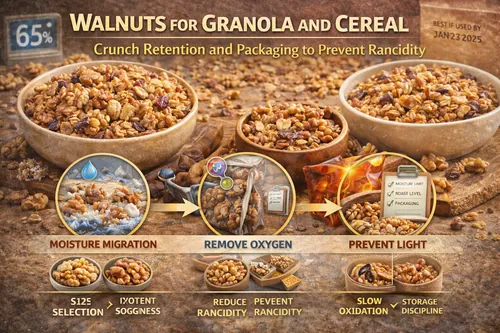
Industrial guide for walnuts in dry systems (granola, cereal, clusters, toppings): how walnut format and cut size affect crunch retention, how humidity and moisture migration drive texture loss, and how oxygen- and moisture-barrier packaging helps reduce rancidity risk over shelf life. Includes spec checkpoints, bulk packaging options, and buyer documentation for walnut programs.
Previous: Walnuts in Confectionery: Chocolate Compatibility and Inclusion Preparation • Next: Walnuts in Sauces (Pesto-Style, Romesco-Style): Emulsions and Heat Stability
Related: bulk walnut products • products catalog • request a quote
Where walnuts fit in granola and cereal production
Walnuts are used in baked granola, cluster cereals, muesli-style blends, inclusions for bars, and as toppings for ready-to-eat cereals. The key performance targets are typically:
- Crunch retention: staying crisp through shelf life, especially in humid environments.
- Flavor stability: avoiding rancid or stale notes in long distribution windows.
- Distribution consistency: minimizing segregation, breakage, and fines generation.
In dry systems, most “quality complaints” trace back to two things: humidity control (texture) and oxygen control (flavor).
Crunch retention: why walnuts soften in cereal and granola
1) Moisture migration from the formulation
Syrups, honey, fruit inclusions, and sugar-rich binders can hold water and slowly move it to walnut surfaces. More surface area means faster softening, so smaller cuts typically lose crunch sooner.
2) Ambient humidity exposure after baking
Even if the granola exits the oven “dry,” exposure during cooling, staging, and packaging can raise water activity at the surface. Open bins, long residence time, or high RH rooms can degrade texture quickly.
3) Mechanical stress creates fines
Handling and conveying can break walnuts into fines/dust, which read as stale or “powdery” and reduce perceived crunch. They can also accelerate oxidation due to higher surface area.
Format selection: choosing cut size for bite and stability
The right cut balances consumer bite with distribution and stability:
- Large pieces: premium look and bite; can break during mixing and transit, increasing fines.
- Controlled pieces: best for uniformity, reduced segregation, and repeatable bowl experience.
- Small pieces / meal: higher surface area, faster softening, and higher oxidation sensitivity—best used when flavor dispersion is the goal.
Practical note: if you’re seeing “walnut dust” at the bottom of cases, tighten cut tolerance and revisit conveying/mixing intensity.
Raw vs roasted: flavor vs oxidation runway
Roasting can improve flavor and reduce bitterness, but it can also shorten oxidation runway if warm nuts are exposed to air or if packaging is not oxygen-controlled. If you buy roasted walnuts, define roast level and sensory targets, and align on storage guidance.
- Raw walnuts: more flexibility to roast in-house or add late; may require tighter sensory screening depending on your profile targets.
- Roasted walnuts: ready-to-use flavor; pay extra attention to oxygen exposure, storage time, and barrier packaging.
Packaging to prevent rancidity and protect crunch
For cereal and granola, packaging is doing two jobs: keeping moisture out (texture) and keeping oxygen out (flavor). Consider these levers:
Moisture barrier
Use packaging structures and liners that reduce water vapor ingress. If the outer carton is decorative, the inner liner/film is your real barrier. Tight seals matter as much as film choice.
Oxygen barrier + oxygen control
Walnuts are oxidation sensitive. Higher oxygen barrier films, reduced headspace oxygen (where applicable), and disciplined storage conditions help reduce rancidity risk during long shelf-life programs.
Light control
Light accelerates oxidation. If you use clear windows or transparent films, verify whether the product’s light exposure in retail meaningfully affects shelf life.
If you can only “fix one thing,” fix oxygen exposure first for flavor stability and humidity control for crunch retention.
Format and spec checkpoints buyers should confirm (granola/cereal focused)
Typical checkpoints include moisture, size/cut specification, defect and color limits, and microbiological requirements. For granola/cereal programs, add:
- Cut tolerance + consistency: reduces segregation and improves bowl-to-bowl repeatability.
- Fines/dust tolerance: reduces powdery mouthfeel and limits oxidation acceleration.
- Oxidation posture: align sensory expectations and recommended storage guidance for your shelf-life target.
- Foreign material controls: critical for consumer safety and complaint prevention.
Processing and shelf-life considerations
Walnuts can oxidize during storage even in dry products. Manage exposure to oxygen, heat, and light. Also align plant practices (cooling time, humidity control, staging) to the shelf-life target of the finished cereal/granola.
Packaging options for bulk walnut programs
Bulk programs commonly use lined bags/cartons for kernels and cuts, sealed bulk bags for meal/flour, and drums or totes for oils and butters. For cereal and granola inclusions, liners and seal integrity are often more important than the outer box format.
Share receiving constraints, pallet configuration, and any re-pack requirements early to avoid delays.
How to request a quote with fewer back-and-forths
Send: product + format (pieces/halves/meal), target cut size and fines tolerance, raw vs roasted (and roast level if applicable), defect/color limits, micro requirements, packaging preference, first order volume, annual forecast, destination, and timeline. If you have a spec sheet, include it—this is the fastest path to an accurate offer.
Next step
If you share your product type (baked granola, cluster cereal, muesli, topping), inclusion rate, target bite size, and your shelf-life goal + distribution lane, we can confirm common spec targets and packaging options that support crunch and flavor stability. Use Request a Quote or email info@almondsandwalnuts.com.