
Walnut Halves and Pieces: Grade Selection for Industrial Buyers
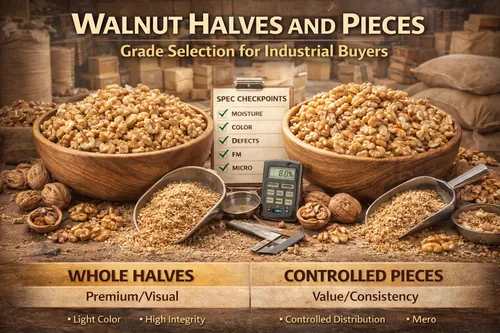
Practical guide to selecting walnut halves vs pieces for industrial use. Learn how grade, color, cut size, defect limits, and packaging choices affect line performance, yield, appearance, and shelf-life risk in bulk walnut programs.
Previous: How to Request a Quote for Bulk Almond Products: The Spec Sheet Buyers Use • Next: Pasteurized Walnut Kernels: Micro Targets, Shelf Life, and When to Specify
Related: bulk walnut products • products catalog • request a quote
Why grade selection matters (more than just “looks”)
For most plants, “grade” is really a shorthand for three procurement outcomes: appearance (especially color and integrity), process yield (how much becomes dust/breakage), and risk (defects, foreign material, and shelf-life performance). The right choice depends on where the walnut appears in your finished product:
- Top-of-pack visibility: inclusions and toppings typically justify higher integrity and lighter color.
- Inside the matrix: baked goods, bars, and cereals often tolerate more piece variability if specs are controlled.
- Milled/ground use: meal/flour applications care less about whole-piece integrity and more about moisture, micro, and oxidation control.
Buyer shortcut: pay for halves when you need “visual identity.” Buy pieces when you need “texture + flavor” at scale.
Halves vs pieces: how to choose by application
The simplest decision tree starts with how the walnut is handled on your line and how consumers see it.
Walnut halves are a strong fit when:
- You need premium visual appeal (chocolate bars, confectionery inclusions, bakery toppings).
- Breakage loss is expensive for your process (gentle depositing, limited post-mix handling).
- Your spec is color-forward (lighter appearance is part of brand expectations).
Walnut pieces are a strong fit when:
- You want consistent distribution and bite (granola, bars, cereals, snack mixes).
- High-throughput mixing would break halves anyway (you’d be paying for integrity you can’t keep).
- You need better cost-per-functional-unit (texture and flavor with controlled size distribution).
What “grade” usually signals to industrial buyers
Supplier programs vary, but grade is commonly linked to these practical attributes:
- Color band: how light/amber/dark the kernels present in the lot.
- Integrity: halves percentage, large piece percentage, and how much becomes dust in transit.
- Defect posture: tolerance for insect damage, shrivel, dark pieces, decay, and shell fragments.
- Consistency: how tight the distribution stays from lot to lot (critical for standard work on a line).
A useful way to frame grade internally is: “What % of the lot contributes to our finished product experience?” (not “What’s the highest grade we can buy?”).
Spec checkpoints to lock before you approve a grade
If you want fewer surprises at receiving and fewer reformulations, confirm these checkpoints with any halves/pieces program:
1) Size / cut definition
- Define the cut you actually use (halves, large pieces, medium, small, “bakery cut,” etc.).
- If you’re automating dosing, confirm size distribution and allowable “fines/dust.”
2) Moisture target (and tolerance)
- Moisture affects shelf life, texture retention, and mold risk.
- Confirm your acceptable range and how it’s tested/verified at shipment.
3) Defect and foreign material limits
- Clarify limits for shell fragments, insect damage, dark/bitter pieces, and general defects.
- Align internal receiving inspection to those limits so you’re not “over-rejecting” against a looser spec—or under-protecting against a tighter one.
4) Sensory expectations
- Define “clean, fresh walnut flavor” and identify unacceptable notes (rancid, musty, overly bitter).
- For confectionery and premium inclusions, sensory is often as important as color.
5) Micro and control statements (category dependent)
- If your product is ready-to-eat or low-kill-step, confirm microbiological expectations and any process controls (e.g., pasteurization when required).
- Make sure documentation matches your QA program: COA, allergen statement, COO, traceability.
Processing & shelf-life: where halves/pieces differ in risk
Both halves and pieces are sensitive to oxidation, but pieces typically present more surface area and more handling points, which can increase variability if packaging and storage are not tight. Practical implications:
- Oxygen exposure matters: ask about packaging that limits oxygen ingress (especially for long transit or warm climates).
- Handling matters: more transfers can mean more fines and more exposed surfaces.
- Roasted formats add variability: if you specify roast, align roast profile to flavor targets and shelf-life posture.
Rule of thumb: the more “premium-looking” the walnut must remain, the more you should treat packaging and temperature control as part of the spec—not an afterthought.
Packaging options (and why buyers should care)
Packaging is one of the easiest levers to reduce breakage, oxidation, and receiving headaches. Common bulk configurations include lined cartons/bags for kernels and cuts, with pallet configuration aligned to your dock constraints. If you re-pack internally, share it early so the supplier can recommend the best configuration for your workflow.
- For halves: prioritize packaging that protects integrity (reduced compression, careful pallet patterning).
- For pieces: prioritize packaging that protects freshness and controls fines/dust.
- For long lead times: discuss oxygen management and warehouse temperature posture.
Quick selection matrix (buyer-friendly)
- Premium chocolate / visible inclusion: halves or large pieces; tight color and defect limits.
- Granola / cereal / bars: pieces with controlled size distribution; manage fines and oxidation.
- Bakery mix-ins (inside product): pieces; focus on moisture and consistency.
- Meal/flour systems: don’t overpay for integrity; lock micro + moisture + oxidation posture.
How to request a quote with fewer back-and-forths
To get a clean offer quickly, send: format (halves vs pieces + cut), color/grade expectation, moisture target, defect/FM limits, micro expectations (if any), packaging, first order volume, annual forecast, destination, and timeline. If you already have a spec sheet, include it.
Next step
If you share your application (where the walnut shows up), your preferred cut, and your shelf-life target, we can recommend a practical grade/spec target that balances appearance, yield, and risk for your program. Use Request a Quote or email info@almondsandwalnuts.com.