
How to Request a Quote for Bulk Almond Products: The Spec Sheet Buyers Use
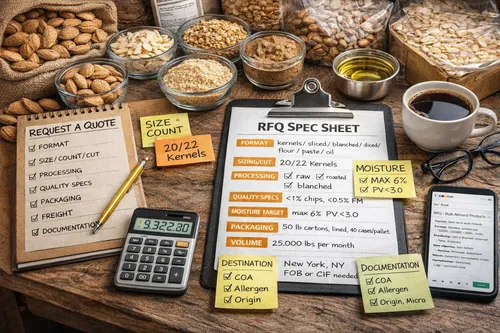
Industrial guide for how to request a quote for bulk almond products: the spec sheet buyers use. If you’ve ever asked for “almonds” and received prices that don’t match, it’s usually not a pricing problem—it’s a spec definition problem. Almond programs vary by format (kernels vs cuts vs milled), sizing/count, blanching or roasting, defect tolerance, moisture and oxidation expectations, packaging, and freight lane. This page gives you a practical, procurement-friendly RFQ structure so you can get accurate pricing with fewer emails.
Previous: Almond Ingredients for Beverage Systems: Suspension, Mouthfeel, and Flavor Balance • Next: Walnut Halves and Pieces: Grade Selection for Industrial Buyers
Related: bulk almond products • products catalog • request a quote
Fast rule: A quote is only as good as the spec. If your RFQ is missing sizing, format, packaging, or lane details, suppliers must assume values—and different assumptions produce different prices. Complete RFQs get faster, firmer offers.
Table of contents
- Why the spec sheet matters (and why almond quotes vary)
- Step 1 — Define the almond format
- Step 2 — Define sizing/count, cut, or particle distribution
- Step 3 — Define processing: raw, blanched, roasted, seasoned
- Step 4 — Define quality limits: defects, foreign material, and sensory
- Step 5 — Define moisture, oxidation, and shelf-life expectations
- Step 6 — Define food safety & microbiology requirements
- Step 7 — Define packaging, pallet, and receiving constraints
- Step 8 — Define destination, lead time, and buying structure
- Step 9 — Define documentation and compliance needs
- Copy/paste RFQ templates (email + form)
- How to compare almond quotes fairly
- Common RFQ mistakes that cause delays
- FAQ
- Next step
Why the spec sheet matters (and why almond quotes vary)
Almonds are a category with multiple formats and multiple spec windows. A supplier can quote a premium, tight-tolerance kernel program—or a functional inclusion-grade program—and both might be described as “almonds” in casual language. The spec sheet turns “almonds” into a measurable, receivable product definition.
A complete spec sheet does three things:
- Makes offers comparable: suppliers are pricing the same format, sizing, and quality window.
- Reduces QA disputes: receiving inspections align to what was quoted and approved.
- Improves supply reliability: the supplier can match inventory and processing steps to your needs.
Procurement tip: If you want quotes you can compare line-by-line, request a “spec-confirmed” offer: the supplier repeats the key fields (format, sizing, moisture, packaging, destination, documents) in the quote.
Step 1 — Define the almond format
Start with how your plant uses almonds. The “right” format is the one that hits finished-product targets with the fewest extra steps on your side: less labor, less rework, and fewer quality variables.
Common bulk almond formats buyers request
- Almond kernels (whole): used for inclusions, toppings, roasting programs, and repack.
- Blanched kernels: skins removed; used when color uniformity matters (confectionery, dairy alternatives, premium bakery).
- Sliced / slivered: common for bakery toppings, bars, cereals, and confectionery.
- Diced / chopped pieces: inclusion format; can be specified by cut size or screen approach (program dependent).
- Meal / flour: for bakery blends, batters, coatings, fillings, and plant-based formulations.
- Almond paste / almond butter: for fillings, flavor systems, spreads, and specialty foods.
- Almond oil: culinary and industrial use; confirm refining/filtration notes and packaging.
- In-shell almonds: often export or retail presentation driven; different sorting and moisture handling applies.
Format details that can change price and lead time
- Skin status: natural (skin-on) vs blanched (skin-off) is a major cost and availability variable.
- Cut style: sliced vs slivered vs diced changes yield and processing intensity.
- Raw vs roasted: roasted adds roast profile control and shelf-life variability; specify clearly.
- Intended use: visible topping vs inclusion vs milling changes which defects matter most.
Shortcut: If you’re not sure which format is best, describe the product and process step (mixer, depositor, enrober, topping line, grinder). A supplier can recommend a format that reduces steps and stabilizes quality.
Step 2 — Define sizing/count, cut, or particle distribution
Sizing is one of the most common “hidden” reasons almond quotes differ. A narrow size band can cost more and may have different availability than a broad band. The correct approach depends on whether almonds are consumer-visible (presentation) or function-driven (inclusion/grinding).
For whole kernels: specify size/count
Whole kernels are often specified by a size band (commonly expressed as a count range) or by an established program standard. For RFQs, state the size band you need and whether you accept a range. If your application is tolerant, a broader range can reduce cost and improve supply flexibility.
For pieces, diced, sliced, and slivered: specify cut definition
- Sliced: confirm thickness expectations if critical to your application (toasting, toppings, visual coverage).
- Slivered: confirm the length/shape expectation (some programs define by process and screen).
- Diced/chopped: define your target cut size and acceptable fines percentage.
For meal/flour: specify particle size distribution
“Almond flour” can mean different grind levels. If you need predictable hydration, viscosity, or flow, request: target mesh or micron range, acceptable fines, and any performance notes relevant to your line.
Step 3 — Define processing: raw, blanched, roasted, seasoned
Processing steps change both price and shelf-life behavior. The RFQ should specify what processing is required and what “done” looks like. If you leave this ambiguous, suppliers may quote different assumptions (especially around blanching and roasting).
Raw vs blanched
- Raw/natural (skin-on): often preferred for certain bakery and snack inclusions where almond skin is acceptable.
- Blanched (skin-off): used when color uniformity matters; specify whether you want whole blanched kernels or blanched cuts (sliced/slivered).
Roasted programs: define roast profile expectations
If you request roasted almonds (whole or pieces), include:
- Roast type: dry roast vs oil roast (if applicable).
- Color/sensory target: light/medium/dark is often not enough—describe the sensory goal (toasty vs deep roast) and your application.
- Salt/seasoning: if seasoned, specify target salt level, seasoning type, and allergen considerations.
- Oil management: if oil-roasted or seasoned, confirm the oil type and any “no peanut oil” or other constraints.
Practical note: If you are qualifying a new supplier for roasted almonds, request a pre-production sample that matches your packaging plan. Roast outcomes can drift if packaging and oxygen control are not aligned to your shelf-life target.
Step 4 — Define quality limits: defects, foreign material, and sensory
Quality specifications should match your end use. What matters most for a visible topping is different than what matters for a ground flour application. Your RFQ should define which quality limits are critical, and which are “nice to have.”
Common quality fields buyers specify (program dependent)
- Defect limits: specify the defect categories your QA team tracks and your tolerance thresholds.
- Foreign material controls: define your expectations and any special requirements (for example, metal detection notes at receiving, if applicable).
- Skin/pellicle: for blanched products, specify acceptable residual skin if critical.
- Broken/fines: particularly important for slices/slivers/diced where fines change visual coverage and processing behavior.
- Sensory: taste and aroma should be clean and characteristic; note any restrictions (no smoky notes, no stale notes, etc.).
Use a “target + acceptable range” approach when possible
Many industrial programs work best with a target spec plus an acceptable range—tight enough for product performance, but not so narrow that availability becomes fragile and lead times expand.
Step 5 — Define moisture, oxidation, and shelf-life expectations
Almond stability is strongly influenced by moisture, temperature, oxygen exposure, and time. Your shelf-life risk is not just “the almonds”—it’s the almonds plus packaging plus your warehouse practices.
Moisture (and why it matters)
Moisture affects texture and storage risk. Many kernel programs specify a maximum moisture target (often in the mid single-digit percent range), but the “right” target depends on your program and storage plan. If your inventory turns slowly or ships long distances, be explicit about your moisture expectations.
Oxidation and rancidity risk
Almonds contain oils that can oxidize over time. If you have a long shelf-life target, consider including oxidation-related fields in your spec:
- Peroxide value (PV): commonly used indicator of early oxidation (confirm your internal standard).
- Free fatty acids (FFA): can reflect hydrolytic rancidity risk depending on storage conditions.
- Sensory requirement: clean, sweet/nutty almond flavor; no rancid or painty notes.
Storage and handling notes buyers should include
- Planned storage: ambient vs cool storage; expected dwell time before use.
- Packaging needs: whether you want higher barrier packaging, sealed liners, or oxygen management options (program dependent).
- Transit considerations: long transit times or hot routes can increase oxidation risk without proper packaging.
Buyer lens: If shelf life is mission-critical, ask for packaging options that reduce oxygen exposure and request “packed on” dates or lot age guidance. The best quote is one that matches the shelf-life reality of your lane.
Step 6 — Define food safety & microbiology requirements
Food safety requirements can change cost, lead time, and documentation. Define what your program requires up front. This is especially important for RTE (ready-to-eat) applications or when almonds go into products with strict customer specifications.
Common buyer requirements (program dependent)
- Microbiology targets: specify which tests are required and whether you need lot-by-lot results.
- Process/intervention statements: some programs require confirmation of validated processing steps appropriate to destination regulations.
- Allergen program expectations: cross-contact controls, labeling statements, and facility controls.
- Traceability: lot code structure and recall readiness expectations.
- Third-party audits: if required by your customers, include the audit expectation in RFQ notes.
Note: requirements vary by application and destination. The best RFQs list required tests and documents explicitly or attach the internal spec sheet.
Step 7 — Define packaging, pallet, and receiving constraints
Packaging is not a detail—it’s part of your quality system. Packaging affects shelf-life performance, damage risk, handling speed, and freight efficiency. Define packaging up front to avoid re-quotes.
Common bulk packaging options
- Kernels and cuts: lined bags or cartons; define net weight and liner type expectations if applicable.
- Meal/flour: sealed bulk bags; define net weight and whether you need enhanced barrier packaging.
- Pastes/butters: pails, drums, or totes; define lining, seals, and temperature guidance needs.
- Oils: drums or totes; define whether refined/unrefined, filtration notes, and packaging expectations.
Receiving and warehouse details that prevent delays
- Pallet limits: max height, max weight, and pallet footprint your dock and racks can handle.
- Unloading method: dock vs liftgate, clamp vs fork considerations (if relevant).
- Labeling requirements: lot codes, item numbers, origin, and any customer-specific labels.
- Re-pack constraints: if you re-pack internally, specify any case/pallet preferences.
Step 8 — Define destination, lead time, and buying structure
A quote should be tied to a lane: where it’s going, when you need it, and whether you are buying spot or building a recurring program. Freight and lead time can materially change landed cost and quality risk.
Lane details to include
- Destination: city/state/country, delivery point, and whether you need export documentation.
- Timeline: requested ship window and required arrival date.
- Volume structure: one-off order vs recurring shipments; forecast if available.
- Buying posture: spot quote vs forward coverage vs program pricing discussions (if applicable).
Speed tip: If you can share a rolling 3–12 month forecast (even a rough one), suppliers can plan inventory and processing windows. That often reduces lead-time surprises during peak demand periods.
Step 9 — Define documentation and compliance needs
Documentation is often the reason an “easy” quote turns into a slow one. If a supplier must assemble a specific document set, define it in the RFQ so it’s priced and planned correctly from the start.
Common documentation requests (availability varies by program)
- COA: aligned to your spec (moisture, defects, and required tests).
- Allergen statement: and any cross-contact declarations needed.
- Country of origin: and supporting origin statements if required.
- Lot traceability: how lot codes map to packaging and shipping documents.
- Additional compliance documents: as required by customer program or destination market.
Simple win: Add a “Required documents” bullet list to every RFQ. You’ll eliminate a full round of back-and-forth.
Copy/paste RFQ templates (email + form)
Email RFQ template (fast)
Subject: RFQ – Bulk Almonds (format + spec + destination)
Product: Almond [kernels / blanched kernels / sliced / slivered / diced / meal/flour / paste/butter / oil / in-shell]
Use case: [bakery/snack/confectionery/beverage system/dairy alternative/etc.]
Sizing/Cut: [kernel size band (count range) OR cut size OR grind/mesh target]
Processing: [raw/blanched/roasted], roast profile & seasoning notes (if any)
Quality limits: [key defect limits + foreign material expectations + fines/breakage tolerance]
Moisture / shelf-life: [target range], storage plan and shelf-life goal (if relevant)
Food safety/micro: [tests required, audit needs, any program requirements]
Packaging: [bag/carton/pail/drum/tote], net weight, pallet preferences, label requirements
Volume: first order + annual forecast (if available)
Destination: [city/state/country], requested ship window and required arrival date
Documents: COA + [origin/allergen/micro/etc.]
Notes: receiving constraints (pallet height, unloading method), any special handling needs
Request-a-Quote form template (compact)
- Product + format: almond [format]
- Sizing/Cut/Grind: [count range / cut size / mesh target]
- Processing: raw/blanched/roasted (+ seasoning notes if any)
- Spec targets: defects + fines/breakage + moisture + any oxidation/sensory needs
- Packaging: type + net weight + pallet notes + label needs
- Volume: initial + forecast
- Destination + timeline: where/when
- Docs: COA + additional needs
How to compare almond quotes fairly
Before you decide one price is “better,” confirm the quotes match on these fields:
- Same format: kernels vs blanched vs cut vs milled vs paste/oil.
- Same sizing/cut definition: kernel size band or cut size/mesh target.
- Same processing assumptions: blanching, roasting, seasoning, and any special handling.
- Same quality window: defect limits, fines/breakage tolerance, and foreign material expectations.
- Same moisture/shelf-life posture: targets + packaging barrier assumptions.
- Same destination and lead time: lane matters—freight can dominate differences.
- Same documentation set: COA + any program-specific items.
If one quote is lower but vague on key fields, treat it as a preliminary range until the spec is aligned.
Common RFQ mistakes that cause delays
- Asking for “almonds” without format and sizing — kernels, cuts, and milled products are not interchangeable.
- Not specifying blanched vs natural — this single field can change cost and availability significantly.
- Leaving packaging undefined — quotes may assume a packaging format you can’t receive or that doesn’t match your shelf-life needs.
- Skipping destination and timeline — landed cost and availability cannot be planned accurately.
- Adding documentation requirements late — creates a second quote cycle and can delay shipment.
FAQ
Do I need to attach a spec sheet?
If you have one, attach it. If you don’t, the templates above cover the fields required to produce an accurate, comparable quote. The goal is to define the quality window and lane so both sides measure the same thing.
What if I’m not sure about sizing or defect targets?
Describe the application and whether almonds are visible to consumers. Many industrial users can accept a practical range that improves availability and lowers cost without impacting finished-product performance.
How far in advance should I request pricing?
For spot needs, earlier is better—especially before seasonal demand spikes. For recurring programs, request pricing with enough time to align specs, qualify documentation, and plan logistics.
Next step
If you share your application and the format you need, we can confirm common spec targets, packaging options, and the fastest supply lane. Use Request a Quote or email info@almondsandwalnuts.com.
To speed things up, include: format (kernels/blanched/cut/flour/paste/oil), sizing/cut definition, processing (raw/roasted/seasoned), defect limits, moisture target, packaging, first volume + forecast, destination, requested ship window, and required documents (COA + program items).