Sliced Almonds for Bakery & Confectionery Toppings: Sizing and Breakage Control
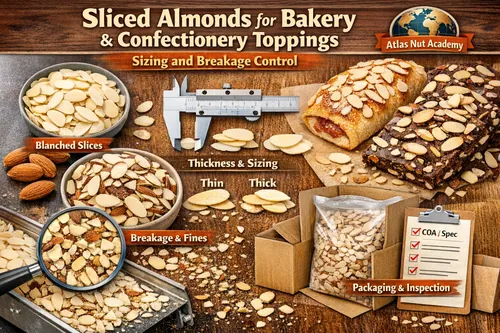
Industrial buyer guide for sliced almonds used as bakery and confectionery toppings. Learn how to choose the right slice format, specify thickness and sizing, and control breakage and fines so your line runs smoothly and your finished product looks consistent. Includes a practical spec checklist, COA fields, packaging options, and a receiving inspection method for bulk programs.
Previous: Dry Roasted vs Oil Roasted Almonds: Flavor, Shelf Life, and Processing Tradeoffs • Next: Diced Almonds as Inclusions in Bars and Snacks: Cut Size and Dispersion
Related: bulk almond products • products catalog • request a quote
Where sliced almonds fit in production (and why topping applications are different)
Sliced almonds are often chosen when a manufacturer needs maximum surface area (fast toasting, strong aroma release), a premium visual (thin, elegant slices), or a topping that can be applied evenly across a surface. But topping applications also create unique challenges: slices are fragile, they can shatter into fines, and they can brown quickly if thickness varies.
That’s why buying sliced almonds for toppings is less about the “almond grade name” and more about controlling three variables: thickness, slice size distribution, and breakage/fines posture. When those variables are stable, most plants see smoother depositing, less waste in dust collection, and more consistent finished-product appearance.
Common topping use cases
- Bakery: Danish, croissants, laminated pastries, muffins, breads, cookies, cakes
- Confectionery: chocolate bars, clusters, enrobed items, bark, dragées
- Frozen: ice cream inclusions/toppings (where moisture control and packaging become even more important)
- Prepared foods: salads, pilafs, coatings (less common, but used for texture)
What “good” looks like for toppings
- Uniform visual distribution on product (not patchy, not dusty)
- Consistent toasting/browning behavior during baking
- Low fines generation during shipping, handling, and depositing
- Clean flavor with stable shelf-life behavior in your storage conditions
Choose the right sliced almond format: blanched vs natural, roast status, and cut style
The first decision is the appearance and flavor target. Sliced almonds are available in different styles that trade off visual color, handling robustness, and cost.
Blanched sliced almonds (skin removed)
Blanched slices provide a cleaner, lighter, more uniform appearance and are widely used in premium bakery and confectionery toppings. They tend to photograph well, look consistent across production lots, and create less “color noise” on the finished product.
- Best for: premium pastries, light-colored bakery, white chocolate or pastel coatings, high-visibility toppings
- Tradeoffs: typically higher cost than natural; still fragile and needs breakage control
Natural sliced almonds (skin-on)
Natural slices provide more visual contrast and a “rustic” look. They can be ideal for artisan bakery, dark chocolate products, and applications where the brown skin reads as intentional rather than inconsistent.
- Best for: rustic bakery, darker confections, products where contrast is desired
- Tradeoffs: color variability is more visible lot-to-lot; toasting patterns can look more uneven if thickness varies
Raw vs roasted slices
Many topping programs use raw slices that toast on the product during baking. Others buy pre-roasted slices for consistent flavor and reduced oven variability. Pre-roasted slices can improve flavor consistency, but they may be more sensitive to oxidation over time (depending on roast intensity and storage).
- Raw slices: toast in-process; more control but more variability if ovens run hot/cold
- Roasted slices: consistent flavor baseline; can simplify your process but requires careful shelf-life handling
Buyer shortcut: If your #1 priority is premium look, start with blanched sliced almonds. If your #1 priority is rustic contrast or cost, start with natural sliced almonds. Then specify thickness and breakage posture to protect line performance.
Thickness and sizing: the two specs that drive toasting, appearance, and breakage
For toppings, “size” is not just length or width—your biggest driver of consistent browning is usually thickness distribution. Mixed thickness slices toast unevenly: thinner pieces brown quickly and can look burnt while thicker slices remain pale.
Thickness: what it changes in real production
- Toasting speed: thinner slices brown faster; thicker slices take longer but can deliver more bite.
- Breakage resistance: thicker slices generally survive conveying and packaging better.
- Surface coverage: thinner slices often give better visual “coverage” per pound.
- Dust/fines generation: thinner slices can create more fines if packaging and handling are not optimized.
Sizing (slice size distribution): what it changes
- Deposit uniformity: consistent slice size spreads more evenly and reduces clumping.
- Visual appearance: too many tiny pieces can look like “crumb topping” rather than slices.
- Process waste: small fragments behave like fines; they get pulled into dust collection or fall through screens.
How to specify sizing without over-complicating your spec
Many buyers succeed with simple language such as “uniform sliced almonds with controlled fines,” paired with a measurable fines limit and a receiving method. If your deposit system is sensitive (vibratory feeders, narrow chutes), consider adding a size distribution requirement or a “minimum % intact slices” target.
Breakage and fines control: how to reduce waste, dust, and appearance issues
Breakage is the most common pain point in sliced almond toppings. Even high-quality slices can arrive with elevated fines if packaging is crushed, pallets shift in transit, or the product experiences excessive vibration. Your goal is to define what you can tolerate and then control the variables that cause breakage.
Why breakage matters operationally
- Yield loss: fines don’t deliver the same topping appearance, so you effectively lose “usable slices.”
- Dust and housekeeping: fines increase airborne dust and cleanup burden.
- Deposit inconsistency: fines can flow differently than slices, causing patchy coverage.
- Over-browning risk: small fragments can toast faster and create dark specks.
What drives breakage in sliced almonds
- Slice thickness: very thin slices are naturally more fragile.
- Packaging and palletization: crush damage, shifting loads, poor liner protection.
- Transit vibration: long lanes, rough handling, multiple transfers.
- Plant handling: high drops, aggressive vibration, fast belt transfers, narrow chutes.
Practical breakage controls buyers can use
- Choose thickness for the lane: if you ship long distances or export, slightly thicker slices often reduce fines significantly.
- Specify a fines/breakage tolerance: define what % is acceptable, and how it will be measured at receiving.
- Protect with packaging: strong cartons/bags, stable pallets, and liner/seal integrity reduce crush and moisture events.
- Match pack size to use rate: reduce repeated opening and handling of partial containers.
- Control internal handling: reduce drop heights and vibration in topping deposit systems.
Buyer framing: For toppings, you’re buying “intact slices delivered to the depositor,” not just pounds of almonds. Breakage control is how you protect usable yield and consistent product appearance.
Processing and application notes: what to watch in bakery and confectionery lines
Bakery: adhesion and toasting behavior
For bakery toppings, slice adhesion depends on surface moisture and stickiness (egg wash, syrup, glaze, dough hydration). If slices bounce off or cluster, the culprit is often a mismatch between slice size distribution and your topping application method.
- Too many fines: creates a dusty look and dark specks after baking.
- Mixed thickness: drives uneven browning and a “spotty” appearance.
- Overly dry surface: slices don’t stick; consider timing and application method.
Confectionery: appearance and fat migration considerations
In confectionery, sliced almonds are often applied to chocolate surfaces or embedded in clusters. Appearance is critical, and so is controlling off-odors or stale notes that become obvious against chocolate.
- Color uniformity: blanched slices usually look cleaner on white or milk chocolate.
- Crunch retention: moisture pickup can soften slices; packaging and storage matter.
- Handling damage: enrobed lines can be rough; breakage posture should match the line.
When to consider alternative formats
If breakage remains a chronic issue, consider whether a diced format or a slightly thicker sliced spec would deliver a more stable outcome. The “best” format is often the one that hits targets with the fewest processing interventions and the most stable supply lane.
Shelf-life, oxidation, and storage: protecting sliced almonds over time
Almond products are sensitive to oxidation. Sliced formats expose more surface area than whole kernels, which can increase sensitivity to oxygen and to storage conditions. If you use sliced almonds in long-shelf-life products or warm distribution lanes, align your program with a strong storage and packaging posture.
What increases oxidation drift risk
- Heat exposure: warm storage or hot transit lanes accelerate drift.
- Oxygen exposure after opening: partial containers left open or poorly resealed.
- Light exposure: prolonged exposure can accelerate sensory drift over time.
- Slow inventory turns: long warehousing windows increase risk.
Practical storage best practices
- Store cool and dry; avoid temperature cycling when possible.
- Reseal liners immediately after opening; minimize headspace.
- Use FIFO/FEFO rotation aligned to your internal shelf-life policy.
- Keep sliced almonds away from strong odors (they can pick up odors in storage).
Packaging options for bulk sliced almond programs
Packaging is part of breakage control. The wrong packaging can turn a good lot into a fines-heavy lot by the time it arrives at your plant. Packaging also affects moisture protection and oxygen exposure posture.
Common bulk packaging formats
- Lined cartons: common for sliced almonds; protect against crush when palletized properly.
- Lined bags: may be used depending on program; confirm liner thickness and seal expectations.
- Barrier packaging (program-dependent): used for long shelf-life or oxidation-sensitive programs.
Packaging details buyers should specify
- Seal integrity: liners sealed; no punctures or compromised closures.
- Pallet stability: reduces crush damage; define pallet height and wrap expectations if needed.
- Lot code visibility: case and liner labeling supports traceability.
- Pack size: align to consumption rate to reduce repeated opening of partial cases.
Simple rule: If your receiving shows fines increase in certain lanes or seasons, packaging and transit handling are part of the solution—not just slice thickness.
Specs checklist for sliced almonds used as toppings
Below is a buyer-friendly checklist that keeps your spec focused on what drives outcomes in bakery and confectionery toppings: appearance, breakage control, and shelf-life posture.
Minimum fields most buyers should define
- Product description: sliced almonds; blanched or natural; raw or roasted.
- Thickness target: define target and allowable range (or reference supplier’s standard thickness program).
- Slice size distribution: define “uniform” expectation; optionally minimum % intact slices.
- Breakage/fines tolerance: define max fines/broken pieces and receiving measurement method.
- Moisture: target max/range and verification method.
- Defect posture: discoloration tolerance (especially for blanched), insect damage posture, no visible mold/decay.
- Foreign material posture: shell fragments tolerance and escalation on hard foreign material/metal.
- Packaging: lined cartons/bags; seal integrity; lot code visibility; pallet configuration if needed.
Optional fields for premium or sensitive programs
- Sensory acceptance language: clean, fresh almond aroma; no rancid/stale/musty notes.
- Microbiology (program-dependent): align to finished-product category requirements.
- Color target: “uniform light color” for blanched slices when appearance is critical.
COA checklist: what to request for sliced almonds
A practical COA supports fast receiving decisions and traceability. Content varies by supplier program and destination requirements.
Common COA fields buyers request
- Lot identification: must match case labels and shipping documents.
- Product description: sliced; blanched or natural; raw/roasted; any thickness identifier if used.
- Moisture: value and (if provided) method reference.
- Allergen statement: tree nut (almond) declaration aligned to labeling needs.
- Country of origin: for compliance and labeling workflows.
- Traceability identifiers: production/shipment identifiers for issue isolation.
- Additional testing (program-dependent): microbiology and defect summaries when required.
If your customer or category requires additional documentation (audit certificates, recall program summaries, food safety plan elements), request availability early. Documentation availability varies by program and destination.
Receiving inspection for sliced almonds (toppings program)
Receiving is where you protect your appearance and breakage posture. Sliced almonds can look “fine” on top of a bag, but fines may be concentrated at the bottom after transit vibration. Use a representative sampling method.
Buyer-friendly receiving checklist
- Packaging integrity: no crush damage, punctures, water damage, or broken seals.
- COA match: lot ID matches case labels and shipping documents.
- Composite sample: take increments from multiple cases and from top/middle/bottom of product.
- Visual check: slice appearance and thickness consistency; no excessive discoloration (especially blanched).
- Fines/breakage check: estimate fines level against your tolerance; note if fines are concentrated.
- Odor check: clean, fresh almond aroma; no stale, musty, rancid, or chemical notes.
- Foreign material scan: check for shell fragments/debris; escalate immediately on hard FM or metal.
- Retains: retain a labeled sample per lot for investigation and shelf-life tracking.
QA tip: If breakage is a chronic issue, start tracking fines by lane/season and correlate with transit conditions and pallet damage. Many plants find that packaging + handling changes reduce fines more than tightening the slice spec alone.
Questions to ask suppliers (to reduce breakage and appearance risk)
- What thickness options do you offer for sliced almonds? Ask which thickness is most stable for long lanes.
- How do you control slice thickness distribution? Understand how consistent the slicing program is.
- What is the typical fines/breakage range for this program? Helps set realistic tolerances.
- What packaging formats are available? Ask what best protects slices from crush and vibration.
- What foreign material controls are used? Screens, aspiration, de-stoning, and metal controls (program-dependent).
- What is your storage/shipping posture? Connect to oxidation risk and summer transit lanes.
- What documentation is available? COA, allergen, COO, traceability, and category-specific compliance docs.
Tight specs can improve appearance but reduce supply flexibility. The most effective approach is to tighten only the parameters that control outcomes: thickness distribution, fines/breakage posture, and foreign material posture—then protect the product with packaging and handling.
FAQ: sliced almonds for bakery and confectionery toppings
Do thinner slices always look better?
Not always. Thinner slices can look elegant and toast quickly, but they are more fragile and can create more fines. Many topping programs choose the thinnest slice that still survives their lane and depositing method with acceptable breakage.
Why do sliced almonds toast unevenly on pastries?
Common reasons include mixed thickness, mixed slice size, surface moisture differences, and oven hot spots. Specifying a consistent thickness range and controlling fines can reduce variation significantly.
Are blanched slices required for premium bakery?
Often, yes—especially when a clean, light appearance is the acceptance driver. However, natural slices can be a better match for rustic products, darker coatings, or programs where contrast is intentional.
How do I reduce fines without changing suppliers?
Start with packaging and handling: prevent crush, reduce vibration, lower drop heights, and avoid aggressive vibratory feeding. Then consider a slightly thicker slice program and define a realistic fines tolerance with consistent receiving checks.
What should I include in a quote request to get accurate pricing?
Include: blanched vs natural, raw vs roasted, thickness preference (or “standard thickness”), expected fines tolerance, moisture target, packaging format, volume (first order and annual forecast), destination, and timeline.
Next step
If you share your application (bakery topping, chocolate, clusters, frozen), your deposit method, and your target appearance, we can recommend a practical thickness and breakage posture (plus moisture and packaging options) that fits your program. Use Request a Quote or email info@almondsandwalnuts.com.
For sourcing, visit bulk almond products or browse the full products catalog.