
Diced Almonds as Inclusions in Bars and Snacks: Cut Size and Dispersion
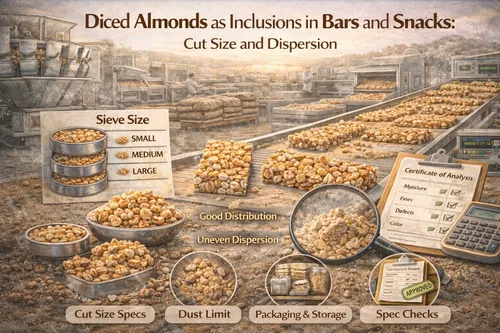
Diced almonds are a go-to inclusion for bars and snack systems because they deliver bite, visible identity, and a clean nutty note. But “diced” can hide a wide range of particle distributions. The cut you choose influences dispersion, depositor/weigher performance, dust generation, and oxidation risk—especially in long shelf-life SKUs.
Previous: Sliced Almonds for Bakery & Confectionery Toppings: Sizing and Breakage Control • Next: Almond Butter in Bulk: Viscosity Targets, Oil Separation, and Packaging
Related: bulk almond products • products catalog • request a quote
Why cut size matters for dispersion and bite
In bars and snack clusters, inclusion performance is mostly about distribution and texture control. If pieces are too large, you can get uneven bite, weak spots during cutting, and localized hardness. If pieces are too small, you increase dust, reduce visual identity, and raise oxidation risk because of higher exposed surface area.
- Too large: uneven dispersion, “hot spots,” higher breakage during mixing, cutter drag/tear risk.
- Too small: more fines/dust, faster flavor fade, greater binder uptake, muddier bite.
Buyer shortcut: don’t spec only “diced.” Specify a particle distribution (screens/sieves) plus a max fines limit. That single change prevents most “dice mismatch” problems.
How to specify diced almonds (without ambiguity)
The cleanest way to buy diced almonds is to define a target band and a fines ceiling:
- Screen/sieve distribution: target % retained between key screens (primary band), plus max % passing the fines screen.
- Nominal cut + sieve table: “small dice / medium dice” backed by a distribution table so plants and suppliers interpret it the same way.
- Application framing: “bar inclusion, low fines” or “snack mix, high flow” to guide sorting and handling.
If you run multihead weighers, tight-tolerance depositors, or you fight segregation in vibratory conveyance, a tighter particle distribution typically pays back in fewer line interventions.
Dispersion problems in bars: what’s really happening
Most “uneven almond distribution” complaints trace back to one of three root causes:
- Wide particle distribution (large pieces + fines together) that segregates during vibration or conveyance.
- Mixing intensity that breaks almonds further and creates dust mid-process.
- Binder interactions where small pieces absorb binder differently, changing flow and causing clumping.
Practical fix: tighten the incoming cut spec, then validate your mixing sequence (add inclusions later, reduce shear where possible).
Fines and dust: why you should care
Fines (small fragments and meal) increase surface area exposure, which can accelerate oxidation and dull flavor over shelf life. They also change how your binder behaves:
- Texture drift: fines can stiffen a bar, increase chew, or create dry pockets.
- Oil migration: very small almond particles can release oil faster into coatings/binders.
- Housekeeping/allergen control: dust builds quickly around weighers and depositors.
If you’re qualifying a new supplier, request a retained sample and measure fines % against your internal tolerance before full-scale validation.
Oxidation and shelf-life risk for diced almonds
Almonds are oxidation-sensitive, and diced formats increase risk relative to whole kernels because more surface is exposed. The biggest controllable levers are:
- Fines control (lower surface area exposure and less “powder” fraction).
- Packaging that limits oxygen and protects against heat swings.
- Storage discipline: cool, dry storage and minimizing time-open after bag opening.
- First-in/first-out: diced inclusions should not sit indefinitely even if whole almonds might.
Spec checkpoints buyers should confirm (diced almonds)
For diced almond inclusion programs, consider confirming:
- Cut and distribution: sieve targets (primary band) + max % fines.
- Moisture: target and max for crunch/handling and storage safety.
- Defects/foreign material: insect damage, shell fragments, and FM controls aligned to your risk posture.
- Color limits (if visible inclusions matter for your SKU).
- Micro targets: align to your category and whether you require pasteurized programs.
- Sensory expectations: clean/nutty vs bitter/off-notes; define reject criteria for rancid notes.
- Documentation: COA fields, allergen statement, country of origin, and any compliance documents you need.
Packaging options for bulk programs
Bulk diced almond programs commonly ship in lined bags/cartons. For long shelf-life products or warm transit lanes, align packaging and storage with your exposure risk.
- Share receiving constraints early: pallet configuration, storage temperature range, and repack/staging practices.
- Plan for partial use: if you don’t consume a full pack quickly, reseal protocols or smaller pack sizes can reduce oxidation drift.
How to request a quote with fewer back-and-forths
Send these fields up front for diced almond inclusions:
- Application (slab bar, extruded, baked bar, cluster, snack mix) + target bite/visibility.
- Desired particle distribution (screens) + max fines/dust.
- Moisture target + max; any defect/color limits; micro requirements (pasteurized if needed).
- Packaging preference, first order volume, annual forecast, destination, and timeline.
- Documentation requirements (COA/micro/allergen/country of origin/certifications if applicable).
Next step
If you share your product format (bar type or snack mix), depositor/weigher sensitivity, and whether you’ve had dust or oxidation issues, we can suggest a practical diced almond spec (screens + fines limit) and packaging approach that reduces dispersion and shelf-life surprises. Use Request a Quote or email info@almondsandwalnuts.com.