Shelling and Sorting Walnuts: How Halves/Pieces Grades Are Produced
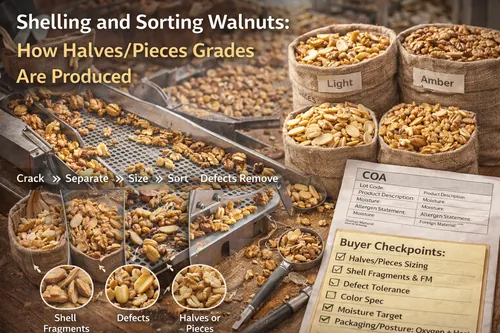
Industrial guide to California walnuts: how shelling, sizing, color sorting, and defect removal create the halves and pieces grades used in bulk ingredient programs. Understand the field-to-plant flow, cracking and separation steps, and the quality checkpoints buyers should validate to protect yield, line performance, and shelf-life stability.
Previous: Drying Walnuts Safely: Moisture Targets, Mold Risk, and Storage • Next: Color and Defect Control in Walnuts: What Buyers Should Specify
Related: bulk walnut products • products catalog • request a quote
Why shelling and sorting details matter to buyers
Walnut kernels are an ingredient where “grade” is the combined outcome of kernel integrity (how many halves survive), size distribution (how pieces are separated), and cleanliness (shell fragments and foreign material controls), plus the commercial expectations of color and defect posture.
For industrial buyers, these details translate into everyday plant outcomes: edible yield, rework burden, line interruptions, and shelf-life complaint risk. Two lots can be offered under similar names but behave very differently in production if the shelling and sorting intensity differs.
- Halves recovery drives value in premium visible applications and reduces fines generation in handling.
- Pieces sizing drives dosing accuracy and inclusion appearance in bars, bakery, and prepared foods.
- Foreign material posture (especially shell fragments) drives complaint risk and customer trust.
- Color and defects influence appearance acceptance and can signal handling stress in some programs.
Procurement reality: When you buy walnut kernels, you’re buying a process result—how the lot was cracked, separated, sized, cleaned, and sorted—plus how it was stored and protected from oxidation afterward.
Key steps in the field-to-warehouse flow (what happens before “kernel grading”)
Shelling and sorting work best when incoming walnuts are dry, stable, and consistent. The earlier the chain introduces variability (moisture events, field debris, handling stress), the harder sorting must work and the more yield can drop.
High-level sequence
Orchard management → bloom/pollination → growing season conditions → harvest → hulling → drying → storage-in-shell (program-dependent) → shelling/cracking → separation → sizing → color sorting → defect removal → packaging → warehousing → shipment
Where variability typically enters
- Harvest timing and weather: moisture events and delayed drying can increase defect expression and storage risk posture.
- Field sanitation: soil contact and debris increase foreign material load and separation burden.
- Drying uniformity: uneven drying can raise mold risk posture and change shelling behavior.
- Storage temperature and oxygen exposure: key drivers of oxidation drift and rancidity complaints.
Hulling and drying context: why shelling performance starts before cracking
Walnuts are hulled to remove the outer green hull and then dried to a stable moisture level for safe storage and processing. While this article focuses on kernel grading, it’s important for buyers to recognize how drying quality influences later steps: overly wet walnuts can create handling and quality risk, while overly aggressive handling can increase kernel damage and breakage.
From a buyer perspective, the practical takeaway is simple: if a supplier program controls moisture and storage well, you typically see more consistent shelling performance and fewer downstream surprises.
Shelling and kernel recovery: how cracking influences halves vs pieces output
Shelling is not a single action—it’s a controlled process designed to crack shells while preserving kernel integrity. The more intact the kernel remains through cracking, the more halves can be recovered. When cracking is more aggressive or incoming shells behave differently, the output shifts toward pieces.
What affects halves recovery in real processing
- Shell integrity and variety behavior: different lots can crack differently depending on shell strength and uniformity.
- Moisture condition: moisture impacts brittleness and how cleanly shells fracture.
- Mechanical settings: cracking intensity is tuned to balance throughput vs kernel damage.
- Preconditioning: some programs condition walnuts to improve cracking behavior and separation efficiency.
Why buyers should care
Even if you buy “pieces,” shelling intensity can still affect your outcomes. More aggressive cracking can increase small fragments and fines, which changes inclusion appearance and can increase oxidation sensitivity due to higher surface area.
Shell separation and foreign material controls: the biggest operational risk
After cracking, the product stream contains kernel pieces, shell fragments, and other incidental material. Separating shells from kernels is a core step in building a safe, clean ingredient—especially for visible applications like snacks, bakery toppings, and confectionery where shell fragments are immediately noticeable.
Common separation and cleanliness tools
- Screening/scalping: separates by size and removes oversized debris.
- Aspiration: uses airflow to separate lighter shell material from kernels.
- Density separation: can help remove heavy foreign material and separate by density differences.
- Optical sorting (program-dependent): can remove some shell fragments and visually distinct foreign material.
- Metal controls (program-dependent): magnets/metal detection as part of preventive controls.
How to specify foreign material posture (buyer-friendly)
Many disputes happen because “clean” is subjective. Buyers reduce risk by defining a clear foreign material posture: what level of shell fragments is tolerable for the application, and what triggers an immediate hold/escalation (hard foreign material, metal, stones, plastic).
Fast win: If you add only one line to your walnut kernel spec, add a foreign material posture plus an escalation rule for hard FM/metal. This prevents the most expensive surprises.
Sizing halves and pieces: how walnut formats are standardized
Once kernels are separated from shells, they’re typically sized into commercial formats. “Halves” are the premium format for visible applications. “Pieces” are separated into size ranges to support consistent inclusions, dosing, and processing performance.
Why sizing matters for industrial applications
- Appearance: consistent piece size looks better in bars, bakery, and prepared foods.
- Process flow: consistent sizes feed more predictably and reduce bridging in hoppers.
- Roasting/toasting behavior: smaller pieces heat faster and can brown more quickly.
- Oxidation sensitivity: smaller pieces have more surface area and may drift faster if storage is warm or oxygen exposure is high.
Pieces vs fines: why “too many smalls” is often a hidden cost
Most plants can tolerate some small fragments, but a high fines level can change your product: it can create “dusty” appearance in toppings, increase dark specks after baking, and increase oxidation drift risk over time. If your application is sensitive, define a practical limit for fines or specify a minimum % in your target piece band.
Color sorting: commercial acceptance and, sometimes, a handling signal
Walnut kernel color is a key commercial expectation, especially for premium snacks, confectionery, and visible inclusions. Many programs separate kernels into color groups to meet buyer requirements and to keep finished products consistent.
When buyers should specify color tightly
- Premium snacks and visible inclusions
- Confections and bakery toppings where appearance drives acceptance
- Customer programs with strict visual standards
When buyers may relax color requirements
- Milled/blended applications (butters, pastes, fillings)
- Heavily flavored products
- Fast-turn programs where cosmetic variation does not affect outcomes
How to define color without over-buying
- Use clear language: “light and uniform” vs “broader range acceptable.”
- If your QA uses reference photos or a “golden lot,” document it for receiving.
- Align your color language to the supplier’s classification system to reduce disputes.
Defect removal: what gets screened out (and why it matters)
Defects matter because they reduce edible yield, create sensory risk, or increase customer complaint probability. In walnuts, defects can also correlate with shelf-life stability because damaged kernels can oxidize faster.
Common walnut defect categories buyers care about
- Insect damage: reduces edible yield; can increase bitter notes in some cases.
- Mold/decay: quality and food safety posture concern; many buyers specify “no visible mold/decay.”
- Shrivel/poor fill: impacts texture and appearance in certain applications.
- Excess breakage: shifts sizing distribution and can increase fines.
- Foreign material: shell fragments, stones, metal/plastic; managed by both controls and spec posture.
Defects that show up later (not just at receiving)
Some lots pass visual checks but drift faster in storage or create more sorting burden during production. This is why retained samples and consistent sensory checks can be valuable in flavor-sensitive walnut programs.
How halves/pieces grades are produced: a practical “grade build” model
Think of walnut grades as the result of stacking layers of selection: cracking intensity influences halves recovery, separation removes shell and foreign material, sizing separates formats, and color/defect sorting creates commercial consistency. The final grade reflects both the incoming crop condition and the intensity of the processor’s sorting program.
Simplified grade build sequence
- Cracking/shelling: controlled cracking to recover kernels while limiting damage.
- Primary separation: remove shell material and debris using screens/air separation/density tools.
- Sizing: separate halves and pieces into target bands; manage fines.
- Color sorting: classify kernels by color expectations for different applications.
- Defect removal: reduce insect damage, mold/decay appearance, and other rejectable defects.
- Verification and packaging: QA checks, lot coding, sealed liners, and traceability identifiers.
Buyer takeaway: A “grade name” is a shortcut, but your outcomes are driven by the specific variables: halves recovery, size distribution, color range, defect posture, and foreign material controls.
Buyer spec checkpoints (what to write so you buy consistent outcomes)
The best walnut kernel specs are short, practical, and tied to finished-product outcomes. Over-specifying reduces supply flexibility; under-specifying creates rework and complaint risk.
Minimum spec fields most buyers should include
- Format: halves or pieces (and the target piece size band if applicable).
- Color expectation: tight for premium visible uses; broader for blended uses.
- Defect posture: insect damage, mold/decay posture, shrivel tolerance, breakage/fines posture.
- Foreign material posture: shell fragments tolerance + escalation rule for hard FM/metal.
- Moisture: target max/range and verification method.
- Packaging: lined cartons/bags, seal integrity, lot code visibility, pallet configuration if needed.
Optional fields for sensitive programs
- Sensory acceptance language: clean, fresh walnut aroma; no rancid/painty/musty notes.
- Microbiology (program-dependent): align to finished-product category and customer requirements.
- Retain policy: required retained sample size and storage method for complaint investigation.
COA checklist: fields that support acceptance and traceability
COA content varies by supplier and destination. A practical COA supports receiving decisions and traceability without slowing production.
Common COA fields buyers request
- Lot identification: must match packaging labels and shipping documents.
- Product description: walnut kernels; halves or pieces; any size band identifier if used.
- Moisture: value and (if provided) method reference.
- Allergen statement: tree nut (walnut) declaration aligned to labeling needs.
- Country of origin: for compliance and labeling workflows.
- Traceability identifiers: production/shipment identifiers for issue isolation.
- Defect/grade summary (if provided): aligned to your key defect and color checkpoints.
- Microbiology (program-dependent): aligned to your category requirements.
If your customers require additional documents (audit certificates, recall program summaries, food safety plan elements), request availability early. Documentation availability varies by program and destination.
Receiving inspection checklist (buyer-friendly)
- Packaging integrity: no punctures, water damage, broken seals; correct labeling and lot codes.
- COA match: lot ID on COA matches case labels and shipping documents.
- Odor check: clean, fresh walnut aroma; no painty, rancid, musty, or stale notes.
- Visual check: color distribution aligns to spec; size distribution matches the format; no visible mold/decay.
- Shell fragment scan: check for shell pieces; escalate immediately on hard foreign material or metal.
- Moisture verification: confirm against target (especially in warm/humid seasons).
- Retains: keep a retained sample by lot for complaint investigation and shelf-life tracking.
QA tip: For flavor-sensitive programs, define a sensory acceptance standard and keep a “golden lot” reference sample to reduce subjective disputes.
Questions to ask suppliers (procurement-focused)
- What halves recovery or size distribution is typical for this program? Helps set realistic expectations.
- How is color classified and controlled? Ask how lots are separated and what drives variability.
- What shell fragment and foreign material controls are used? Screening, aspiration, optical sorting, metal controls (program-dependent).
- What are storage and shipping practices? Connect to oxidation risk and transit lane exposure.
- What documentation is available? COA, allergen, COO, traceability, and compliance documents as needed.
Tight specs protect quality but can reduce supply flexibility and increase cost. Tighten specs when your product is appearance- or flavor-sensitive, your shelf-life target is long, your lane is warm/long, or your customers have strict expectations. If your application is robust and inventory turns are fast, broader ranges may be acceptable without changing outcomes.
FAQ: shelling and sorting walnuts for halves and pieces
Do defects always show up at receiving?
Not always. Some issues show up later as faster oxidation drift or higher sorting burden during production. That’s why retained samples and defined sensory checks are useful in sensitive programs.
Is lighter walnut color always “better”?
Lighter, more uniform color is often required for premium visible applications, but darker lots may be acceptable in robust or blended uses. Define “acceptable” clearly in your spec to reduce subjective disputes and over-buying.
How do I reduce shell fragment complaints?
Combine preventive controls (supplier sorting/cleaning) with a clear spec posture and a receiving check that includes a representative composite sample. Also align packaging and handling to prevent damage that can create additional fragments in transit.
How do I reduce rancidity complaints in walnuts?
Start with low-defect lots, then protect them: cool storage, minimize oxygen exposure after opening, avoid heat during transit, and align packaging size with consumption rate so product doesn’t sit open in partial containers.
Next step
If you share your application (snacks, bakery, confectionery, ingredient blending), your target format (halves or pieces), destination, and shelf-life target, we can recommend practical size and color checkpoints, defect and foreign material posture, and packaging options aligned to your program. Use Request a Quote or email info@almondsandwalnuts.com.
For sourcing, visit bulk walnut products or browse the full products catalog.