
Hulling and Shelling Almonds: How Post-Harvest Steps Influence Quality
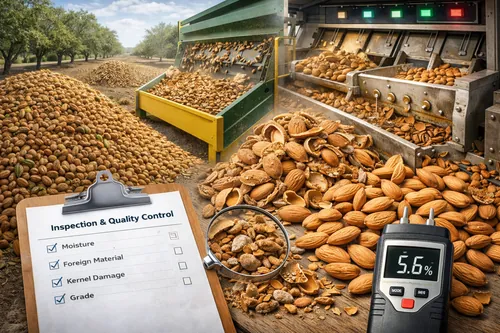
California almond crop & harvest guide: a practical, buyer-focused breakdown of what happens after almonds leave the orchard. Hulling and shelling are not just mechanical steps—they shape cleanliness, foreign material risk, kernel damage, grade consistency, and how reliably product meets moisture and shelf-life expectations.
Previous: Harvest Timing for Almonds: Hull Split, Shaking, and Field Drying • Next: Drying Targets for Almond Kernels: Moisture, Storage Safety, and Quality
Related: bulk almond products • products catalog • request a quote
Buyer takeaway: When two offers look similar on paper, the difference is often the post-harvest program: line controls, sorting capability, foreign material prevention, and storage discipline. These factors determine how predictable your receiving results will be.
Table of contents
- Why hulling and shelling matter to buyers
- From field drying to the huller/sheller: timing and risk
- Hulling: what is removed and what can go wrong
- Shelling: cracking, separation, and kernel protection
- Foreign material controls: where shells, stones, and metal are managed
- Kernel damage and defect development: how processing changes grade
- Moisture and drying interaction: stability versus brittleness
- Sorting and grading: turning field product into a spec-ready lot
- Post-processing storage and logistics: shelf-life risk starts here
- Procurement checklist: what to ask, what to verify on COA
- Common issues and how buyers can prevent them
- Next step
Why hulling and shelling matter to buyers
Almond quality is built across the season, but it becomes measurable during post-harvest processing. Hulling and shelling are where field variability is converted into outcomes that procurement teams see: moisture values, foreign material findings, damage rates, and ultimately grade.
From a buyer perspective, post-harvest steps matter because they influence:
- Defect rates and grade outcomes: damage, insect impact, and staining can move lots up or down grade ladders.
- Receiving performance: foreign material controls and lot uniformity reduce rejects and rework.
- Shelf-life predictability: moisture targets and rapid transition into controlled storage reduce oxidation and quality drift.
- Program consistency: strong programs reduce lot-to-lot surprises—critical for industrial production schedules.
In short: buyers aren't just buying kernels—they're buying a processing system that either reduces or amplifies risk.
From field drying to the huller/sheller: timing and risk
After harvest, almonds are typically dried (often via field drying practices that reduce moisture). Once they reach a stable condition for handling, they move through the supply chain into huller/sheller operations. The time and conditions between harvest and processing can affect quality, especially when lots experience heat spikes, humidity, or delays.
Why timing matters
- Moisture drift: product that re-absorbs moisture can become more claim-prone in storage and transit.
- Contamination exposure: each handling step is an opportunity for foreign material pickup if controls are weak.
- Quality drift during delays: extended staging without proper conditions can reduce freshness and increase risk.
Procurement translation: ask about pack windows and storage conditions, not just crop year. Two lots from the same crop year can behave differently if one was processed and stabilized quickly and the other sat longer under variable conditions.
Hulling: what is removed and what can go wrong
Hulling removes the outer hull, which is the dried fruit layer surrounding the shell. This step separates almonds into streams: hull material, shells (still intact at this point), and product that continues down the line. Hulling also reduces bulk and prepares almonds for shell cracking and separation.
Quality implications of hulling
- Cleanliness: effective hulling reduces residual hull material that can carry dust and contribute to foreign material concerns.
- Mechanical stress: aggressive handling can begin the damage chain that later shows up as chips or splits after shelling.
- Line hygiene: hull fragments and dust require strong housekeeping and separation controls to protect finished product streams.
Where buyers may see hulling-related issues
- Higher-than-expected foreign material notes at receiving (hull/shell fragments, field debris).
- Inconsistent appearance that triggers extra QA screening.
- Lot variability if hulling performance differs across runs or facilities.
Shelling: cracking, separation, and kernel protection
Shelling cracks the hard shell and separates kernels from shell pieces. This is one of the most quality-sensitive steps because the shell must be opened efficiently without crushing or chipping kernels. The best shelling programs strike a balance between high kernel recovery and low damage.
Why shelling settings matter
Shelling is not a single “on/off” step—performance depends on how equipment is set up for the incoming lot. Almonds vary in size, shell thickness, and dryness. If settings don't match the lot, outcomes shift quickly.
- Too aggressive: more kernel chips, splits, and excessive breakage; may reduce finished grade yield.
- Too gentle: more uncracked or partially cracked shells; may increase downstream sorting load and contamination risk.
- Poor separation: more shell fragments mixed into kernels, increasing risk of receiving nonconformance.
What buyers typically care about downstream
- Kernel integrity: whole kernels versus pieces can change how a lot fits into a spec and pricing tier.
- Shell fragment prevention: one of the most important operational quality points for industrial users.
- Consistency: stable outputs reduce line adjustments for manufacturers.
Foreign material controls: where shells, stones, and metal are managed
Foreign material (FM) is a major driver of claims, rejections, and downstream safety concerns. In almond processing, FM risk can include shell fragments, stones, field debris, wood, and metal. The strongest programs apply multiple controls across the line rather than relying on a single “catch all” step.
Typical control layers in post-harvest processing
- Screening and aspiration: removes light material (dust, small hull pieces) and separates by size.
- Density or stone removal steps (program dependent): targets heavy contaminants like stones.
- Magnets/metal detection (program dependent): targets metal risk introduced from equipment wear or handling.
- Optical sorting (program dependent): improves removal of visually detectable defects and non-almond material.
Buyer lens: Ask suppliers how FM is controlled across the program (not just “we have a metal detector”). The best answer describes layered controls and how they are verified (checks, calibration, documentation).
Kernel damage and defect development: how processing changes grade
Defects come from the field and from handling. Post-harvest processing can either protect kernels or amplify damage. For bulk buyers, the most important point is that the same crop can deliver different quality outcomes depending on how it's processed.
Common damage categories influenced by post-harvest steps
- Chips and splits: often linked to mechanical stress during shelling and conveying.
- Broken kernels: can increase when product is too dry/brittle or when cracking is too aggressive.
- Skin damage and scuffing: can affect appearance and may matter for certain grades and applications.
- Shell fragment inclusion: separation performance and housekeeping are critical.
Why this matters for procurement specs
Many industrial specs implicitly assume a certain distribution of whole kernels versus pieces, and a certain ceiling on defects. If your application is sensitive (premium snack, high-appearance retail, confectionery), damage tolerance is tighter. If your application is more forgiving (butters, meal/flour inputs), damage may be less critical but FM control remains critical.
Moisture and drying interaction: stability versus brittleness
Moisture is one of the most important measurable variables because it affects both storage stability and processing behavior. Moisture targets are often discussed later in the chain, but hulling and shelling outcomes are influenced by how the product was dried and how it is staged.
Moisture affects quality in two directions
- Too wet: higher risk of storage instability and quality drift; can increase sorting difficulty and reduce predictability in long logistics lanes.
- Too dry: kernels become more brittle; shelling can create more chips/breakage and reduce whole-kernel yield.
The practical goal is controlled moisture that supports safe storage and stable processing. For buyers, the key is alignment: the moisture target must match the storage plan, packaging choice, and transit time.
Sorting and grading: turning field product into a spec-ready lot
After shelling, almonds typically go through additional sorting and grading steps (program dependent) to achieve consistent lots. This is where processors reduce variability, remove defects, and produce marketable grades and formats for different applications.
What “sorted” should mean in a strong supplier program
- Clear format definition: whole kernels, pieces, slices, diced, meal/flour inputs, etc.
- Defect control: defined tolerances and repeatable inspection approach.
- Lot uniformity: consistent outcomes across shipments, not just within one pallet.
- Traceability: lot coding and documentation that map cleanly to COA and shipping marks.
Why buyers should care about grading language
Grading is a commercial shorthand for expected defect levels and appearance outcomes. Two suppliers may use similar labels but implement different control intensity. When you are onboarding a new supplier, align on the spec language that actually matters to your QA team: the measurable limits and how they are verified.
Post-processing storage and logistics: shelf-life risk starts here
Even with excellent post-harvest processing, storage conditions (temperature, humidity, oxygen exposure) are major drivers of rancidity risk. The transition from processing into warehousing is where shelf-life outcomes become predictable or fragile.
Warehouse practices that protect quality
- Temperature discipline: cooler storage slows oxidation and preserves sensory quality.
- Humidity control: reduces moisture pickup and condensation risk.
- Odor control: nuts can absorb odors—keep away from strong-smelling materials.
- FIFO rotation: reduces aging variability and helps QA predict performance.
- Packaging alignment: barrier choices should match your shelf-life target and destination transit time.
Procurement translation: If your route includes long dwell times or warm warehouses, you may need tighter moisture targets, stronger packaging, or more frequent replenishment rather than large bulk holds.
Procurement checklist: what to ask, what to verify on COA
If you want to reduce back-and-forth and increase first-time acceptance rates, align on these items early. The goal is to connect what happens in hulling/shelling and sorting to what your QA team will verify.
Questions buyers should ask suppliers
- Processing scope: what steps are controlled in the supplier program (hulling/shelling, sorting, optical, metal controls, packaging)?
- Foreign material controls: what layers exist and how are they verified (checks, calibration records, logs)?
- Damage management: how does the program control chips/splits and shell fragment inclusion?
- Moisture targets: what target range is typical for the program and how is it measured/verified?
- Storage conditions: what is the storage practice before shipment (temperature approach, FIFO, dwell time expectations)?
- Lot traceability: how do lot codes map to COA, packaging labels, and shipping documents?
Common COA/receiving checkpoints (program dependent)
- Moisture: confirms storage readiness and helps predict stability.
- Defect measures: insect damage, mold risk indicators, and other defect categories relevant to your spec.
- Foreign material statements/controls: what controls are used and what the receiving expectations are.
- Grade and format confirmation: ensures what is shipped matches your functional needs (whole, pieces, etc.).
If you have an internal spec sheet, include it with your RFQ—this is the fastest path to an accurate offer and reduces onboarding time.
Common issues and how buyers can prevent them
Issue: More shell fragments or foreign material than expected
Prevention is mostly program design: layered FM controls, documented verification, and packaging/handling discipline. In RFQs, specify your FM expectations and ask how they are controlled and verified.
Issue: Too many chips/splits for a premium application
Chips and splits can increase from aggressive cracking, brittle product, or rough conveying/handling. Specify your damage tolerance and ask how the processor manages line settings and lot variability. If your application requires high whole-kernel yield, make that explicit.
Issue: Moisture mismatch or stability problems on long lanes
Align moisture target, packaging, and transit conditions. For long transit or warm destinations, reduce dwell time, improve storage conditions, and ensure packaging matches the lane risk.
Issue: Inconsistent receiving outcomes across shipments
Often caused by mixing lots, variable processing controls, or inconsistent storage conditions. Request clearer lot integrity, consistent pack windows, and defined inspection methods for acceptance.
Next step
If you share your application and the format you need, we can confirm common spec targets, packaging options, and the fastest supply lane. Use Request a Quote or email info@almondsandwalnuts.com.
To get the fastest quote, include: product format (kernel, pieces, etc.), grade/defect tolerance, moisture target, packaging, volume, destination, timeline, and required documentation (COA + any program-specific compliance documents).