Harvest Timing for Almonds: Hull Split, Shaking, and Field Drying
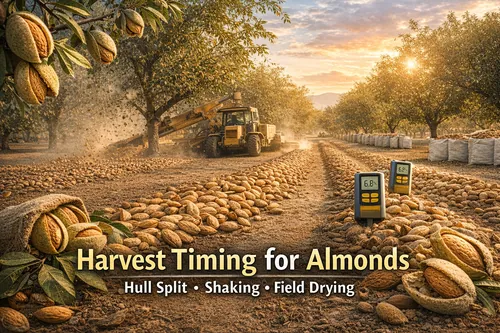
This guide breaks down hull split, shake timing, and windrow/field drying in plain operational terms—then connects those steps to the outcomes buyers care about: moisture, defects, shelf life, and shipping reliability for bulk almond products.
Previous: Pest and Disease Pressure in California Almonds: What Affects Grade • Next: Hulling and Shelling Almonds: How Post-Harvest Steps Influence Quality
Related: bulk almond products • products catalog • request a quote
One-line takeaway: Harvest timing is a controlled tradeoff—earlier harvest can reduce insect exposure and shorten drying time, while later harvest can improve maturity and reduce orchard damage risk. The “best” timing is the one that meets your quality and logistics targets with predictable execution.
What this guide covers
- Why harvest timing matters for quality, yield, and procurement
- Key terms: hull split, abscission, windrows, pickup, stockpiles
- Understanding hull split: what to monitor and why it varies
- When to shake: timing options and real-world tradeoffs
- Shaking operations: orchard prep, equipment, and common failure points
- Field drying and windrows: moisture targets and risk control
- Pickup, transport, and stockpile realities that affect buyers
- How timing shows up on grades, defects, and COA
- Buyer & QA checklist: how to specify and verify harvest-sensitive quality
- FAQ: hull split, drying time, rain events, two-shake harvest
Why harvest timing matters for buyers
“Harvest timing” sounds like a grower topic, but it shows up directly in the outcomes that procurement and QA teams validate: moisture, insect damage, staining, chips/breakage, and shelf-life stability. The timing window also affects drying duration and logistics predictability—which impacts when product can ship, how long it can sit in transit, and how aggressively you need to protect against oxidation during storage.
For bulk programs, the business question is simple: Will this crop year and supplier program deliver a consistent spec at scale? Harvest timing is one of the reasons “same origin, same variety” can still produce different receiving results across lots.
Procurement lens: Harvest timing influences the shape of risk you carry. If your finished product is sensitive to off-notes, rancidity, or visible defects, you should treat harvest timing and moisture control as first-class buying variables—not afterthoughts.
Key terms in the almond harvest flow
Almond harvest discussions often assume shared vocabulary. Here are the terms that matter most when you’re trying to connect orchard reality to warehouse specs:
- Hull split: The almond hull opens along the suture as the nut reaches maturity. It’s a practical signal that harvest is approaching.
- Abscission layer: A natural separation layer forms where the nut attaches, helping nuts detach during shaking. (Operationally: nuts “come off” more readily at the right stage.)
- Shaking: Mechanical harvesters shake nuts from the tree to the orchard floor.
- Windrows: Nuts on the ground are swept/raked into rows to dry more uniformly and make pickup efficient.
- Field drying: Natural drying of nuts in windrows until moisture reaches safe handling/storage targets.
- Pickup: Mechanical pickup collects dried nuts from windrows and transfers them for hauling.
- Stockpile: Temporary bulk storage at receiving points/hullers. Moisture management here matters—especially for “tight” harvest windows or weather disruptions.
Understanding hull split: what to monitor and why it varies
Hull split isn’t a single moment—it's a progression across the orchard. Different varieties split at different times, and even within a variety, nuts on the top/outer canopy can advance sooner than shaded interior nuts. Heat units, irrigation strategy, tree vigor, crop load, and microclimate all influence the curve.
What “% hull split” really means
In practice, harvest decisions often reference “percent hull split.” That’s the share of sampled nuts showing a visible hull opening. In many regions, older baseline guidance favored shaking near “full” or “100%” hull split, but modern decision-making is more nuanced: timing is adjusted to balance removal efficiency, insect risk, drying speed, and orchard health.
How growers actually check hull split (and why buyers should care)
A simple monitoring approach is to sample representative trees and canopy positions (edge + interior, high + low), then track how quickly the orchard is moving from early split to wide split. Buyers don’t need to run this sampling themselves, but it helps to understand why a supplier might describe harvest as “early,” “on time,” or “late,” and how that impacts defect expectations.
Buyer note: If you have a defect-sensitive application (visible pieces, premium whole kernels, or strict sensory expectations), ask suppliers how they manage timing across varieties and orchard blocks—especially for late pollinizers.
When to shake: timing options and the tradeoffs behind them
“When should you shake?” is a deceptively hard question because the right answer depends on what you’re optimizing. Here’s the most useful way to think about it: harvest timing is a multi-variable optimization with a handful of common failure modes.
Tradeoff #1: Cleaner shake vs. insect exposure
Starting a bit earlier can sometimes produce a cleaner shake and reduce the time nuts spend vulnerable during hull split. Waiting later can improve maturity alignment and, in some situations, reduce orchard “barking” risk from equipment—but nuts may be exposed longer. University and industry discussions of harvest timing often frame it exactly this way: timing choices change insect pressure exposure and operational outcomes.
Tradeoff #2: Drying time on the orchard floor
Nuts shaken earlier (with higher starting moisture) generally take longer to dry in the field. Longer dry time increases the chance that a weather event (high humidity, poor airflow, unexpected rain) interrupts drying and raises defect risk.
Tradeoff #3: Orchard health and mechanical damage
Harvest isn’t only about the nuts. Shaker timing and technique can influence tree stress and bark damage—especially in sensitive blocks. If orchard managers are optimizing for long-term productivity, they may prioritize reduced damage risk even if it slightly changes harvest timing.
Two-shake harvest: a practical tool for high-risk situations
In some orchards—especially where insect pressure is high or split timing is uneven—harvest can be done in two passes: an early shake to remove early-ripening nuts and a second shake for the rest. This can reduce the time that the earliest nuts sit exposed and drying while the last nuts mature. It also provides a way to separate lots by risk profile, which can matter for buyers who want consistent specs.
Procurement tactic: For large programs, ask whether your supplier can segregate lots by variety, orchard block, or harvest timing band. Segregation can improve consistency (and reduce blending surprises).
Shaking operations: what has to go right (and what can go wrong)
Shaking is the start of a tight chain: shake → sweep/windrow → field dry → pickup → hauling → huller/receiver. Each step either protects quality—or adds defects and foreign material.
Orchard floor prep
A smooth, clean orchard floor supports cleaner pickup, less foreign material, and better airflow through windrows. If the floor is cloddy, rocky, or poorly maintained, pickup can introduce dirt and debris—and windrows may dry unevenly.
Irrigation and dust: a balancing act
Water management approaching harvest influences how quickly hull split progresses and how fast nuts dry. Too wet can slow drying; too dry can stress trees and complicate operations. From a buyer perspective, what matters is the outcome: consistent moisture and a controlled drying path.
Removal efficiency and “hang time”
If nuts “hang” and don’t drop cleanly, you can get multiple negative outcomes: delayed harvest, uneven windrows, extra passes, and more exposure time for early nuts. This is one reason some operations adjust timing slightly earlier if it improves removal efficiency.
Field drying & windrows: moisture targets and risk control
After shaking, almonds are typically swept into windrows and allowed to dry naturally before pickup. Field drying is one of the most important control points for preventing mold risk, maintaining quality, and ensuring safe storage behavior.
Moisture targets: what “ready” looks like
Industry guidance commonly references targets around hull moisture not exceeding ~12% or kernel moisture not exceeding ~6% prior to pickup/handling. The practical meaning: moisture should be low enough to reduce spoilage risk and support stable storage and transport. Exact targets can vary by program, packaging, and destination transit time.
How long does field drying take?
Drying time is weather-driven. Under favorable conditions, windrows can dry in a few days; under cooler or humid conditions, drying can extend toward two weeks. If a weather event interrupts drying, processors may rely on aeration or mechanical drying strategies, but the best outcome is avoiding high-moisture bottlenecks in the first place.
What increases drying risk (and what reduces it)
- Higher starting moisture: earlier shake or cooler conditions can extend the drying window.
- High humidity / fog: slows moisture loss and increases the chance of uneven drying.
- Rain events: can re-wet windrows and increase staining, microbial risk, and schedule disruption.
- Poor windrow formation: overly dense windrows reduce airflow and create pockets of higher moisture.
- Well-managed windrows: consistent row size and clean floor conditions support more uniform drying.
Buyer/QA note: If you are buying for long shelf-life applications or long transit lanes, moisture control is not optional. Ask for current-lot moisture values (and the method) and confirm storage conditions before shipment.
Pickup, hauling, and stockpiles: the “hidden” timing layer buyers should understand
Many quality issues that appear “post-harvest” actually originate at the transition points: pickup timing, truck scheduling, receiver capacity, and stockpile moisture management. When harvest is compressed (heat waves, early maturity, regional scheduling), receiving points can become bottlenecks.
Why bottlenecks matter
If almonds are picked up before they’re adequately dried—or if they sit in higher-moisture condition waiting for processing—risk increases: elevated moisture can lead to quality losses, off-odors, and increased defect incidence. Well-run programs manage this with moisture testing, aeration, controlled stockpile practices, and routing decisions.
How this shows up for buyers
Buyers rarely see the windrow—but they do see the COA and receiving outcome. When you notice unusual variability lot-to-lot, timing and moisture bottlenecks are among the first things to ask about (along with storage temperature and packaging integrity).
How harvest timing influences quality outcomes
Harvest timing affects quality through three main pathways: insect exposure, moisture trajectory, and handling damage. Here’s how those pathways translate into what shows up on spec sheets and COAs.
Defects and grade impacts
- Insect damage: exposure during hull split windows can increase damage incidence, affecting grade and yield.
- Staining / discoloration: slow drying and weather events can increase staining risk.
- Chips / breakage: immature or higher-moisture nuts can process differently, influencing breakage and chipped kernel rates.
- Foreign material: orchard floor conditions and pickup practices influence FM risk (dirt, stones, plant material).
Shelf-life and oxidation sensitivity
Even if moisture and defects are acceptable at shipment, shelf-life performance depends on storage conditions and oxygen exposure. If your product is roasted, flavored, or used in high-sensitivity applications (premium snack, confectionery, dairy alternatives), confirm that packaging and storage practices match your shelf-life target.
Practical rule: Timing and moisture control reduce the odds that you’ll spend the season “sorting out” problems downstream. When in doubt, specify the outcome (moisture limits, defect limits, packaging/storage expectations) and validate early lots tightly.
Buyer & QA checklist: how to buy harvest-sensitive quality with fewer surprises
If you buy bulk almonds for industrial use, the fastest path to consistency is to make your specs and verification steps explicit. Use this checklist to reduce back-and-forth and avoid “spec drift” across crop-year timing.
1) Define your application risk profile
- Sensory-critical? (snacks, confectionery, premium inclusions)
- Appearance-critical? (whole kernels, visible pieces, toppings)
- Micro/food-safety-sensitive? (ready-to-eat, minimal kill steps)
- Long transit / warm lanes? (export, cross-country, slow-moving inventory)
2) Specify what you need (in buyer language)
- Product form (kernel, in-shell, cut, meal/flour; raw/roasted)
- Variety or acceptable variety set (if relevant)
- Moisture target and test method expectation
- Defect limits (chips, insect, foreign material) aligned to your receiving SOP
- Packaging (lined cartons/bags, pallet config, oxygen barrier needs)
- Storage & shipping expectations (temperature guidance, container type, lead times)
3) Ask timing-smart questions (without micromanaging the orchard)
- Were lots segregated by variety or harvest window?
- What moisture level was targeted at pickup or stockpiling?
- How were higher-moisture bottlenecks handled if weather disrupted drying?
- What quality checks occur between receiving and final packing?
4) Validate early lots and lock what works
For new programs, treat the first shipments as qualification lots: validate moisture, sensory, and defect performance quickly. Once you find a stable lane, consider forward coverage on core SKUs and keep spot flexibility for secondary formats.
Related reading: Hulling and Shelling Almonds: How Post-Harvest Steps Influence Quality • Drying Targets for Almond Kernels: Moisture, Storage Safety, and Quality
FAQ: hull split, shaking, and field drying
What is hull split, and how does it relate to harvest start?
Hull split is a visible maturity signal—when the hull begins opening along the suture. Growers monitor the orchard’s progression and time shaking to balance removal efficiency, insect exposure, and drying conditions.
Do all varieties harvest at the same time?
No. Varieties differ in timing, and even within a single orchard block, canopy position and microclimate can create spread. This is why harvest sequencing matters for lot consistency.
How dry do almonds need to be before pickup?
Many programs reference a hull moisture not exceeding roughly 12% or kernel moisture not exceeding roughly 6% before pickup/stockpiling. If your application needs longer shelf life or long transit times, you may want tighter controls or stronger packaging requirements.
How long does field drying take?
It depends on weather and starting moisture. Under good conditions it can be several days; cooler temperatures and humidity can extend drying toward two weeks. Rain or fog can disrupt drying and increase quality risk.
Can harvest be done in two passes?
Yes. In higher-risk settings, a two-shake harvest can reduce exposure time for early nuts and help manage uneven maturity—potentially improving overall quality consistency.
What should buyers do if they see unusual lot-to-lot variability?
Ask about lot segregation (variety/block), moisture at pickup/receiving, storage conditions, and any bottlenecks during harvest. Also confirm packaging integrity and oxidation controls for long shelf-life applications.
Next step
If you share your application and the format you need, we can confirm common spec targets, packaging options, and the fastest supply lane. Use Request a Quote or email info@almondsandwalnuts.com.