Allergen Controls for Bulk Walnut Programs: Receiving, Storage, and Labeling
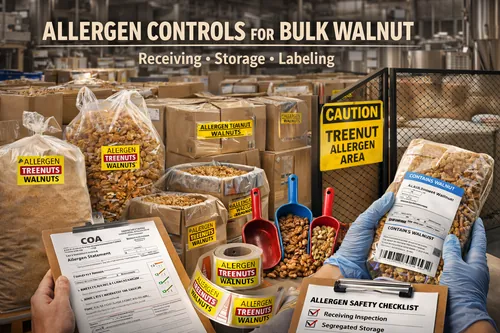
Bulk walnuts are a high-value ingredient—and a high-responsibility allergen. For most food manufacturers, the biggest operational risk is not “does walnut belong in the formula?” It’s unintended walnut presence in a product that is not labeled for tree nuts, or incorrect labeling on a product that is. This guide focuses on practical controls that QA, procurement, and operations teams use to reduce cross-contact risk across receiving, storage, and labeling.
The goal is simple: build a walnut program that is predictable enough to run efficiently, audit-ready enough to satisfy customers, and disciplined enough to protect consumers and brands.
Previous: Walnuts in Plant-Based Foods: Texture, Flavor, and Allergen Labeling • Next: Packaging Formats for Bulk Walnuts: Bags, Cartons, and Liner Choices
Related: bulk walnut products • products catalog • request a quote
Why allergen controls matter in bulk walnut programs
Walnuts are a tree nut allergen. In industrial environments, tree nut allergens require disciplined controls because they can transfer through surprisingly small routes: residual dust on a pallet, re-used scoops, mis-labeled partial bags, or shared conveyors. The risk is compounded in bulk programs because ingredients are handled in larger quantities, repacked, staged in warehouses, and sometimes reworked or returned to inventory.
Where allergen risk shows up most often
- Receiving variability: mixed loads, damaged bags/cartons, missing labels, or incomplete paperwork.
- Warehouse cross-contact: open cases, spilled product, shared forklifts or staging zones.
- Changeovers and rework: walnut runs followed by non-walnut runs without validated cleaning controls.
- Labeling errors: wrong packaging film, outdated ingredient statement, or mis-applied case labels.
Practical definition: allergen control is less about “never having an allergen in the building” and more about preventing it from ending up in the wrong product with the wrong label.
Start upstream: supplier documentation buyers should request
A solid walnut allergen program begins before the truck arrives. Procurement and QA teams typically align on a documentation packet that reduces uncertainty and speeds approvals. Documentation requirements vary by customer program and product category, but the basics are consistent.
Common documents for bulk walnut procurement
- COA (Certificate of Analysis): lot-specific results aligned to your spec (moisture, defects, microbiology if applicable).
- Allergen statement: clear declaration of walnut and any other allergens handled in the facility/program.
- Traceability details: lot codes, pack dates, country of origin, and internal references for rapid trace-back.
- Product specification sheet: grade/style, size, defect limits, and handling/storage recommendations.
- Food safety documentation: audit summaries or certifications when required by customer policy.
Questions that reduce back-and-forth
- Is this walnut product raw, roasted, or processed (and what processing step is controlled by the supplier program)?
- Is the facility a multi-allergen environment, and what segregation/sanitation controls are in place?
- How is product protected from foreign material and cross-contact during packing and warehousing?
- What is the recommended shelf-life and best storage condition for oxidation control?
Even when facilities are strong, misalignment on documentation can slow onboarding. If you want faster approvals, specify your required documents upfront in your quote request.
Receiving controls: what to check when bulk walnuts arrive
Receiving is the first point where your internal controls either catch issues early—or allow them to become expensive later. A receiving SOP for walnut allergens usually includes both paper checks and physical checks. The goal is to confirm that what arrived is what you ordered, that it is protected from damage and contamination, and that it can be stored without creating cross-contact risk.
Paperwork verification
- Lot codes match: COA lot, case labels, pallet tags, and your PO.
- Allergen statement present: and consistent with your expectations for the supplier program.
- Product identity clear: walnut type/style (halves/pieces), grade, roast status, and packaging format.
- Special handling noted: temperature limits, “do not stack” rules, or liner integrity requirements.
Physical inspection at the dock
- Packaging integrity: no torn liners, broken seals, wet cartons, or crushed cases.
- Pallet condition: no cross-contaminated pallets, visible spills, or residue from prior loads.
- Label readability: allergens and identity should be visible at pallet/case level (especially for partials).
- Damage management: define what happens if a bag/carton is compromised (reject, re-pack under control, or quarantine).
Tip: the highest-risk moment for cross-contact is when a damaged walnut package is “temporarily handled” outside normal controls. Build a clear quarantine and disposition path.
Warehouse storage and segregation: keeping walnut allergens contained
Once walnuts enter your warehouse, segregation controls protect both walnut and non-walnut ingredients. Storage is not only about allergen management—it’s also about preventing quality loss from heat, humidity, oxygen exposure, and pests. A good warehouse plan does both.
Segregation approaches that work in real facilities
- Physical zones: dedicated “tree nut” racking or caged areas with clear signage.
- Vertical segregation: storing allergens on lower racks to reduce fall/spill contamination (site-specific risk logic).
- Dedicated staging lanes: separate pre-production staging areas for walnut runs.
- Color-coded handling tools: scoops, bins, and pallets assigned to allergen categories.
Spill and dust control
Walnuts can generate fines and small fragments that behave like “allergen dust” in practice—especially with pieces. Facilities reduce risk by containing open product, using controlled transfer methods, and cleaning spills immediately with procedures that prevent spreading (for example, avoiding dry sweeping that disperses particles).
Inventory discipline matters
- Quarantine holds: inbound lots awaiting QA release should be physically separated and clearly labeled.
- Partial case controls: reseal and relabel partials; treat unknown partials as non-conforming.
- FEFO/FIFO: align rotation with shelf-life and oxidation risk to reduce long holds.
Warehouse success metric: no “mystery partials,” no open cases without secondary containment, and no spill cleanup that spreads allergen dust.
Processing and production controls: preventing walnut cross-contact
In many plants, walnuts are used in multiple formats (halves, pieces, meal, paste/butter). Each format creates different transfer risks. Halves are easier to contain; pieces and meal spread more easily; pastes can smear on equipment. A practical allergen plan reflects these realities.
Common control categories
- Scheduling: run walnut products in a planned sequence (often allergen-to-allergen, then non-allergen after validated cleaning).
- Dedicated or restricted equipment: where possible, keep allergen handling tools separate.
- Controlled rework: rework should be clearly defined, labeled, and limited to compatible allergen declarations.
- Changeover cleaning: documented cleaning procedures with verification steps before running non-walnut products.
Sanitation verification (what “good” looks like)
Verification can include visual inspection plus additional checks depending on your risk profile and customer requirements. The key is that the verification method is appropriate for the equipment and the product type—and it is consistently documented. If your label program includes “no tree nuts,” your internal bar for verification is typically much higher.
Operational reality: allergen risk increases when a plant relies on “tribal knowledge.” If only one operator knows how to clean a depositor correctly, you don’t have a control—you have a dependency.
Rework and changeover controls: where programs often fail
Rework and changeovers are where “good intentions” become real risk. Walnuts can migrate through rework streams, shared utensils, and hard-to-clean equipment. A strong program makes it hard to do the wrong thing by mistake.
Rework rules that reduce risk
- Allergen-compatible only: walnut-containing rework may only go into products with the same (or broader) allergen declaration.
- Clear identification: labeled containers with product name, lot/date, allergens, and disposition owner.
- Time limits: defined hold time and storage condition aligned to quality and micro risk.
- No “mystery rework”: unknown origin = nonconforming (discard or controlled disposition).
Changeover discipline
- Defined clean break: stop → remove product → disassemble as needed → clean → verify → release.
- Verification level matches claim: higher verification for “no tree nuts” lines than for “contains tree nuts” lines.
- Hard-to-clean hotspots: augers, conveyors, hoppers, gaskets, weigh heads, depositors, and dust collection points.
- Documentation: cleaning records that show who cleaned, what was cleaned, verification performed, and QA release.
If you have a “fast clean” option and a “validated clean” option, define exactly when each is allowed. Ambiguity drives cross-contact.
Labeling controls: the most expensive avoidable failure
Labeling failures are among the most damaging issues in allergen programs because they can trigger recalls, customer claims, and loss of retailer confidence. The good news: labeling risk is highly controllable when you build a disciplined process.
Key labeling checkpoints
- Ingredient statement alignment: walnut declared consistently across finished product, case labels, and specs.
- Allergen statement accuracy: “Contains: Walnut” (and other allergens) consistent with formula and facility controls.
- Packaging control: correct film/label version released and verified before production starts.
- Line clearance: removal of old labels and materials before new run begins.
- Verification: documented checks at startup, changeovers, and defined intervals.
Finished product and hold/release logic
Many facilities use a hold-and-release approach for high-risk labeling transitions: product is held until label checks, production records, and (where required) QA verification steps are complete. The exact workflow depends on your plant and customers, but the principle is the same: treat labeling as a controlled step, not an administrative afterthought.
Two “simple but powerful” label safeguards
- Single-source label release: only one controlled location releases packaging materials to the line.
- Positive ID at startup: a documented check that the allergen statement on the label matches the scheduled formula.
Packaging options for bulk walnut programs (and how packaging affects allergen risk)
Bulk walnuts commonly arrive in bags, cartons (often with liners), or other bulk formats. Packaging is more than logistics—it’s part of your allergen barrier. Damaged packaging increases cross-contact risk and increases the chance of warehouse spills.
Packaging features that matter for allergen control
- Reliable liner integrity: reduces exposure to dust and fragments during handling.
- Reseal capability for partials: supports safe partial-case management.
- Clear external labeling: allergen identity visible without opening packaging.
- Pallet stability: reduces crushed cases and spill events during transit and receiving.
If your plant frequently handles partials, ask for packaging guidance early. A “good” bulk format for one plant can be a headache for another, depending on receiving systems, storage layout, and how ingredients are dispensed to production.
Packaging decision rule: choose the format that minimizes “open handling.” Every open transfer is an allergen exposure opportunity.
Troubleshooting matrix: issue → likely root cause → first corrective action
Most allergen incidents come from repeatable patterns. Use this matrix as a fast triage tool for CAPA conversations and SOP updates.
| Issue observed | Likely root cause | First corrective action |
|---|---|---|
| Damaged bags/cartons at dock | Transit damage; weak palletization; no disposition path | Quarantine + define reject/repack SOP + document |
| “Mystery partial” in warehouse | Relabeling not enforced; partials not resealed/contained | Treat as nonconforming; enforce reseal + relabel + secondary containment |
| Walnut fragments found on non-walnut line | Inadequate changeover; shared tools; dust migration | Stop + clean + verify; identify hotspot equipment; dedicate tools |
| Rework used in wrong product | Weak rework labeling; uncontrolled rework storage | Allergen-compatible-only rule + labeled containers + owner signoff |
| Label mismatch / wrong film on line | Line clearance failure; uncontrolled packaging release; missing verification cadence | Lock packaging control + startup verification + hourly checks; hold/release for transitions |
Most effective mindset: design controls for what humans actually do under time pressure—especially at dock receiving and changeovers.
Spec and documentation checklist for walnut allergen programs (quote-ready)
If you want fewer emails and faster approvals, include these details in your walnut sourcing request. It helps suppliers match the correct program and helps your QA team evaluate fit quickly.
- Product format: halves/pieces/meal/paste, raw vs roasted, intended application.
- Grade and style: size expectations and defect limits (as required by your spec).
- Moisture target: and storage expectations for shelf-life control.
- Micro requirements: align to your product category and risk posture.
- Allergen statement requirement: walnut declaration + other allergens handled in facility.
- Traceability: lot codes, pack dates, country of origin, and recall-response expectations.
- Packaging: bags/cartons/liners + pallet configuration + receiving constraints.
- Volume and cadence: first order, forecast, delivery schedule.
- Destination: shipping location(s) and any import/export needs.
- Docs: COA, allergen statement, spec sheet, and additional compliance docs if required.
Include one sentence about your labeling posture: “Products are labeled for tree nuts” vs “Facility also produces non-tree-nut products with strict cross-contact controls.” This changes what “acceptable risk” means.
Copy/paste RFQ line (fast)
“Walnut program must support strict allergen controls: dedicated/segregated storage, clear case/pallet labeling, controlled partials, defined rework rules, validated changeovers, and label verification. Documentation required: lot COA + allergen statement + traceability.”
FAQ: walnut allergen controls (buyer + plant teams)
Are walnuts handled differently than other tree nuts?
The control principles are the same (segregation, sanitation, verification, labeling), but walnuts often create more fines/fragments than some nut formats, which increases dust/spill sensitivity—especially with pieces and meal. That makes containment and spill response more important.
What’s the single biggest avoidable failure?
Labeling/packaging mix-ups. It’s also one of the easiest failures to prevent with controlled packaging release, line clearance, and verification cadence.
Do we need dedicated equipment for walnuts?
Not always. Many plants run walnuts on shared equipment with validated changeovers and verification. Dedicated tools and dedicated smallwares (scoops, bins) are often a high-ROI middle ground.
What should we do with unknown partials?
Treat them as nonconforming. Unknown partials are a common “silent” pathway for allergen mistakes.
Next step
If you share your walnut format, application, packaging preferences, and allergen handling requirements, we can recommend practical documentation targets and supply-lane options for bulk walnut programs. Use Request a Quote or email contact@atlastradehouse.com.