
Almonds • Oil roasted • Quote-ready specs

Bulk Oil Roasted Almonds

Atlas Nut Supply, LLC supplies bulk oil roasted almonds to manufacturers, brands, and distributors. We cooperate with multiple California supplier programs to align the right roast profile, salt/seasoning, packaging, documentation, and delivery lane for your procurement.

Share your end application (snacks, inclusions, toppings, mixes) and any downstream processing (enrobing, chocolate, baking, bar extrusion) so we can target the right roast level, salt adhesion, and oil-roast handling notes.

Format
Oil roasted almonds
Programs
U.S. + global export
Support
COA • traceability • docs

Request a quote View specs Read applications Back to catalog

Fastest quoting: share roast level (color/flavor/crunch), salt/seasoning, almond size/type (as applicable), pack size, volume, and destination.

Whole kernels Salted / unsalted Seasoned programs Bulk packaging Docs-ready

Note: availability and target tolerances vary by supplier program. We align specs to your application and confirm with current COA/lot documentation.
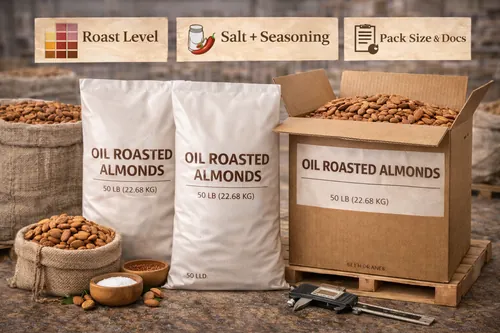
Bulk Oil Roasted Almonds for wholesale supply — Atlas Nut Supply

Oil roasted almonds options

Common program variables (availability varies by season and supplier program):

  • Roast level targets: color, flavor intensity, crunch/texture.
  • Oil-roast handling: packaging and storage expectations to manage shelf-life and oxidation.
  • Salt/seasoning: salted or seasoned programs (specify inclusion limits and label needs).
  • Size/type: whole almonds by size (e.g., 23/25, 25/27, etc.) and variety/type where applicable.
  • Bulk packaging: bags/cartons/pails/totes; pallet constraints supported for manufacturing lines.
  • Documentation: COA, micro results, and traceability documentation available per program.

If you’re replacing an incumbent SKU, send their spec sheet and we’ll mirror key targets: moisture/oxidation limits, micro requirements, salt %, foreign material controls, and packaging format.

Industrial applications

Typical manufacturing and ingredient uses:

  • Snack mixes and seasoned nut blends
  • Bakery toppings and inclusions
  • Bars, confectionery, and cereal/granola
  • Foodservice and private-label snack programs (program dependent)

Why oil roasting?

Oil roasting can improve perceived flavor, increase surface adhesion for salt/seasonings, and produce a consistent “snack-style” crunch. It also requires tighter handling around oxygen/heat exposure to protect flavor and shelf-life.

For deeper application guides, see the Atlas Nut Academy.

Roast profile (how to specify)

If your spec sheet does not define roast, use these practical targets. We can align by sample match, color reference, or sensory targets (preferred).

Light roast

  • Color: pale golden
  • Flavor: mild nutty, lower toast notes
  • Texture: firm crunch, less brittle
  • Use cases: inclusions where you want “clean” almond character

Medium roast

  • Color: golden to medium brown
  • Flavor: balanced toasted notes
  • Texture: crisp snack crunch
  • Use cases: snack nuts, mixes, toppings

Dark roast

  • Color: deeper brown
  • Flavor: stronger toast notes (confirm “no burnt” requirement)
  • Texture: crisp/brittle
  • Use cases: bold snack programs, strong seasoning blends

Tip: for seasonings, specify salt % target, max seasoning variance, and any anti-caking expectations for blends (if used).

Product specifications (quote-ready)

Send your spec sheet if you have one. Otherwise, start here for faster alignment. Below ranges are typical industrial targets; final tolerances are confirmed by supplier program and current COA.

Commercial spec checklist

  • Product: Oil roasted almonds (whole kernels)
  • Almond type/variety: Nonpareil / California / Mission (as applicable)
  • Size/count: e.g., 23/25, 25/27, 27/30 (or custom)
  • Roast target: light/medium/dark or custom (color + flavor + crunch)
  • Salt/seasoning: unsalted, salted (salt %), or seasoned (blend + label constraints)
  • Packaging: bag-in-box, cartons, pails, totes (and pallet constraints)
  • Volume: first order + forecast cadence
  • Destination: city/state/country (and port if export)
  • Delivery window: required ship/receipt dates
  • Documentation: COA, traceability/COO, certifications if required

For fastest quotes, include your target salt % and any “no peanut / dedicated line” allergen expectations (if applicable).

Typical product declaration

Ingredient statement Common patterns include: almonds + vegetable oil (e.g., sunflower/canola/safflower) and salt for salted programs. Seasoned programs add a seasoning blend (program dependent).
Allergen Contains: Almond. Facility cross-contact statements vary by supplier program.
GMO Typically non-GMO by ingredient nature; program documentation available upon request.
Country of origin USA (California supplier programs), unless otherwise specified on documentation.
Intended use Ready-to-eat ingredient/snack component. Confirm if you require kill-step validation language.

If you have labeling constraints (no artificial flavors, clean label, organic), include them in your inquiry so we route to the right program.

Analytical targets (typical)

Targets below are commonly used for roasted almonds in institutional procurement and can be used as a starting point for your spec.

Moisture ≤ 3.5% (roasted target; confirm per program)
Free fatty acids (FFA) ≤ 1.5% (as oleic)
Peroxide value (PV) ≤ 5.0 meq/kg oil
Aflatoxin Aflatoxins testing and certification available per program; specify your limit requirement.

For claims/QA alignment, specify your test method references (e.g., AOAC/ISO) and your sampling plan expectations.

Microbiological targets (typical)

Requirements vary by customer, destination, and program. These are widely used “starting point” limits for roasted almonds.

Aerobic Plate Count < 10,000 CFU/g
Yeast & Mold < 1,000 CFU/g
E. coli Negative
Salmonella Negative (commonly per 25g or larger composite, per customer spec)
Listeria spp. Negative (where required)
Staph. aureus < 10 CFU/g (or MPN-based equivalent)

Tell us your customer’s micro spec and destination (U.S./EU/other). We’ll align the right program and documentation package.

Whole-kernel sizing (count per ounce)

Many industrial specs reference kernel count per ounce (e.g., 23/25, 25/27, 27/30). If you need “uniform” appearance in window packs or premium mixes, call out tighter sizing tolerances.

18/20 20/22 23/25 25/27 27/30 30/32 32/34 34/36 36/40

Not sure what size you need? Tell us your application and target “visual” (premium vs. value blend) and we’ll recommend a size range.

Bulk packaging & logistics

  • Bag-in-box / lined cartons: common for snack and ingredient programs (e.g., 25 lb / 50 lb)
  • Pails: controlled handling for foodservice or repack lines
  • Totes: high-volume manufacturing lanes (program dependent)
  • Pallet configuration: specify max height, slip sheet needs, and receiving dock constraints
  • Export: confirm port, incoterms, documents, and labeling requirements

For oxidation control, programs may offer nitrogen flush or vacuum pack options where applicable. Ask if your shelf-life target is tight.

Storage & shelf-life handling (oil roasted)

Oil roasted almonds should be kept sealed, cool, and protected from heat, oxygen, and light. Avoid temperature swings and keep containers closed between use to reduce oxidation and flavor drift.

  • Best practice: cool/dry storage, low odor environment, protect from pests and moisture.
  • Shelf-life: program dependent; many specs reference ~9–12 months sealed under ideal conditions.
  • After opening: reseal in airtight packaging and minimize headspace/oxygen exposure.

Share your storage temperature, expected hold time, and destination climate (especially for export) and we’ll recommend the right packaging approach.

Quality documentation & compliance

Documentation availability varies by supplier program. Tell us what you require so we can route you to the right lane.

Common documents (by request)

  • Certificate of Analysis (COA): moisture, micro, and key analytical parameters
  • Traceability / lot identification support
  • Country of Origin (COO)
  • Allergen statement
  • Ingredient statement / product declaration
  • Third-party audit proof (program dependent)
  • Export support docs (as required by destination)

What to include in your inquiry

  • Any “must meet” micro limits (Salmonella, APC, yeast/mold, etc.)
  • Oxidation targets (FFA, PV) and shelf-life requirement
  • Aflatoxin limit requirements (especially for export)
  • Certifications: organic, kosher, halal, etc. (if required)
  • Label constraints (clean label, no artificial, no specific additives)

If you are onboarding a new ingredient, request a sample and confirm roast + seasoning performance in your process before first full PO.

We cooperate with multiple supplier programs; we do not publish a single fixed “one-size-fits-all” COA. We align the right program to your spec and confirm on documents.

FAQ: Oil roasted almonds

What specs do you need to quote bulk oil roasted almonds?

At minimum: almond type/size (if relevant), roast target (color/flavor/crunch), seasoning/salt (if any), packaging, volume, destination, and timeline.

Do you ship oil roasted almonds outside the United States?

Yes. We support export lanes depending on destination, volume, and required documentation. Share the country/port and timeline for planning.

Can you provide COA and traceability documentation?

Yes. COA and traceability documentation are available per supplier program. If you require certifications, note them in your inquiry.

What does an almond size like 23/25 or 25/27 mean?

Typically, it refers to the count of whole almond kernels per ounce (e.g., 23–25 kernels per ounce). If you require tighter uniformity, specify your acceptable count distribution or ask for a sample match.

Do you offer salted, lightly salted, or seasoned oil roasted almonds?

Often yes, depending on supplier program. For quote-ready alignment, specify your target salt %, the seasoning blend (or “house blend” approval), and any label constraints (e.g., no artificial flavors, anti-caking limits).

How should oil roasted almonds be stored for best shelf-life?

Keep sealed, cool, and protected from heat, oxygen, and light. Avoid temperature swings and keep containers closed between use. Share your storage conditions and hold time for more specific handling guidance and packaging options.

What packaging is best for manufacturing lines?

Many plants prefer bag-in-box or lined cartons (e.g., 25 lb / 50 lb) for controlled dispensing. High-volume lines may use totes. Share your receiving/dispensing setup and we’ll recommend a format.