
Bulk Almond Retail Packaging Programs
Atlas Nut Supply, LLC coordinates bulk almond retail packaging programs for brands, distributors, and co-manufacturers that need packaged almonds ready for retail, club, or e-commerce channels. We work with California supply partners to align the right input almonds, pack format, food safety & labeling requirements, case pack / pallet, and delivery lane—with documentation support (program dependent).
If you already have a target SKU, send net weight + pack type + case pack + destination and we’ll help confirm MOQ, lead time, and quote-ready inputs. If you’re still designing the line, use the specs and packaging guide below to choose a path that matches shelf-life, channel constraints, and margin targets.
Request a quote Program specs Quote checklist Back to catalog
Fastest way to quote: SKU (raw/roasted/seasoned) + net weight + pack type + case pack + annual forecast + ship-to/DC/port. If you’re switching from an existing supplier, tell us the benchmark pack format and shelf-life target so we can match film/barrier expectations.
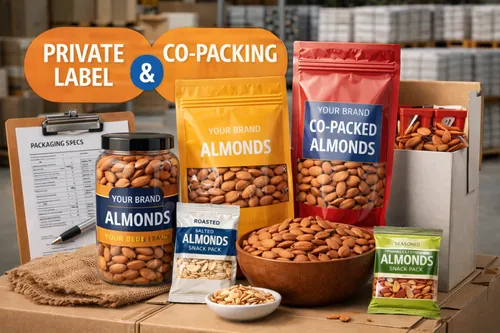
Retail packaging program options
Common program routes (availability varies by partner capability, season, and channel requirements). Retail-pack almonds are usually quoted as a complete system: input almonds + processing + packaging materials + case pack/pallet + lane.
- Private label & co-pack coordination: align input almonds, processing, packaging materials, and run details
- Pack formats: stand-up pouches (zipper), pillow packs/flow-wrap, jars/canisters, single-serve & select multi-pack programs
- Net weights & case packs: define net weight range, case count, and pallet pattern constraints
- Product types: raw kernels, roasted SKUs, seasoned blends, sliced/diced cuts (program dependent)
- Quality alignment: grade/defect limits, roast profile (if applicable), oxidation and sensory expectations
- Label & compliance support: ingredient statements, allergen declarations, and supporting documents (program dependent)
- MOQ & lead time planning: run scheduling, changeovers, and forecast planning for repeat orders
- Domestic + export lanes: U.S. distribution and export shipments depending on destination requirements
Retail packaging is a supply chain project. Faster quotes happen when we match SKU definition (product + net weight + pack type) to channel constraints (case pack, pallet, labeling rules, and timeline).
Common retail channels & use cases
Where retail-pack almonds typically go:
- Grocery retail: branded or private label packaged almonds, seasonal displays, everyday snack packs
- Club & value: larger net weights, strict case pack and pallet requirements, retail-ready displays
- Convenience: snack-size packs and multi-pack configurations
- E-commerce: ship-friendly formats and case protection for parcel handling
- Export: label language requirements, destination documentation, and lane planning
For broader product and procurement guidance, see the Atlas Nut Academy.
Tip: Channel often determines the packaging route. Club may prioritize case/pallet efficiency; e-commerce may prioritize puncture resistance and secondary packaging; grocery may prioritize shelf presence and zipper convenience.
Program specifications (buyer-ready)
Below are the most common specification inputs used to scope private label and co-pack almond runs. Share what you know now; we’ll fill gaps with program-appropriate defaults and confirm what must be fixed vs what can vary.
A) Product / processing
- SKU type: raw / dry roasted / oil roasted / seasoned / blend
- Kernel style: whole kernels, pieces, sliced, diced (program dependent)
- Roast profile (if applicable): light/medium/dark, color targets, flavor intensity
- Seasoning: salt level, spice blend, sweet coatings, or “clean label” constraints
- Food safety program: micro targets and pasteurization requirements (if needed)
- Quality parameters: moisture targets, sensory expectations, defect tolerance, oxidation expectations
B) Packaging / materials
- Pack format: stand-up pouch, pillow/flow-wrap, jar/canister, single-serve, multi-pack
- Features: zipper, tear notch, hang hole, window, laser score, tamper evidence
- Barrier needs: oxygen/light/moisture barrier aligned to shelf-life targets
- Optional oxidation controls: nitrogen flush / MAP (program dependent), oxygen absorbers (as specified)
- Net weight: target unit weight and any acceptable range
- Case pack: units per case, case dimensions/weight constraints, retail-ready display needs (if any)
C) Labeling / compliance
- Artwork: print-ready files vs needs support
- Nutrition Facts: panel format and serving definition as applicable
- Allergen declarations: tree nuts (almond) and cross-contact statements as required
- Net quantity & identity: PDP layout requirements for your market
- UPC/GS1: barcode approach and placement (channel dependent)
- Export: language, country-specific label rules, and required destination documents
D) Supply / logistics
- MOQ: first run quantity; repeat-run assumptions
- Lead time: packaging procurement + scheduling + production window
- Destination: ship-to/DC/warehouse/port and delivery window
- Shipping method: LTL/TL/container (export) as applicable
- Lot coding: traceability and “best by” date conventions
- Documentation: COA, traceability, COO, certifications if required
If you’re unsure about film/barrier selection, share your target shelf-life, your channel, and your storage conditions (ambient vs warm distribution). We’ll align the packaging approach and confirm what metrics or vendor documentation you need.
Packaging formats & shelf-life drivers
Nuts are sensitive to oxidation and off-flavors when exposed to oxygen, heat, and light. Retail packaging programs typically manage shelf-life through barrier films and, in some programs, modified atmosphere approaches (program dependent). Your channel and shelf-life target dictate the packaging route more than the product name does.
Stand-up pouches (zipper or non-zip)
- Most common format for branded/private label snack nuts
- Options: zipper, tear notch, hang hole, window, matte/gloss finishes
- Often paired with higher barrier structures when long shelf-life is required
- Considerations: pouch stability, seal integrity, puncture resistance in distribution
Good fit for: grocery/e-comm snack lines, flavor SKUs, everyday retail packs.
Pillow / flow-wrap & single-serve
- Often used for portion control, vending, convenience, and multipacks
- Film choice and seal performance are major shelf-life drivers
- Considerations: high-speed packing constraints and pack robustness
Good fit for: convenience, foodservice, multipacks, promotional packs.
Jars / canisters
- Premium shelf presence and reclose convenience
- Considerations: liner/closure, induction seal options, headspace management
- Often preferred in some club/value channels for larger net weights
Good fit for: club/value, premium lines, pantry storage emphasis.
Retail-ready displays (RRP)
- Display-ready trays/shippers for faster shelf stocking (channel dependent)
- Case pack and pallet pattern become primary constraints
- Considerations: secondary packaging strength and merchandising requirements
Good fit for: club and high-velocity retail where shelf stocking speed matters.
Barrier selection: If your QA team requests it, ask for packaging supplier documentation related to oxygen/moisture barrier performance (often referenced as OTR/MVTR) and confirm test methods your organization prefers (program dependent).
Want help choosing a route? Share: channel (grocery/club/e-comm), net weight, desired shelf-life, and whether you need zipper convenience or display-ready cases.
Labeling & compliance checklist (practical)
Retail packaging programs usually stall on labeling details—not almonds. If you have an internal label QA process, send your checklist. Otherwise, this set of inputs reduces revisions and speeds approvals.
- Statement of identity: what the product is (“Almonds”, “Dry Roasted Almonds”, “Seasoned Almonds”, etc.)
- Net quantity statement: net wt in required units and placement rules for your market
- Ingredient statement: required for seasoned/flavored SKUs; include processing aids if applicable
- Allergen declaration: almond (tree nut) and cross-contact statements per your QA policy
- Nutrition Facts: panel style, serving size assumptions, and claims (if any) reviewed for compliance
- Responsible firm: manufacturer/distributor name/address and any required contact info
- Country of origin: market-dependent; export may require specific formats
- Lot code / date coding: traceability, recalls, and retailer requirements
- Barcodes: UPC/GS1 needs and placement requirements by channel
Export programs may require language, nutrition format differences, and destination-specific labeling rules. Share the destination country and retailer requirements early to avoid reprint risk.
Traceability & documentation expectations
Retail buyers often require document readiness even when product specs are straightforward. Program availability varies, but common deliverables include:
- COA: key quality parameters and lot identification (as applicable)
- Traceability: lot records and input-to-output linkages for recall readiness
- Allergen statement: almond (tree nut) declarations and cross-contact policy (program dependent)
- COO documentation: country-of-origin documents as required for export or customer policies
- Certifications: only when required by your customer/channel (program dependent)
Rule-of-thumb: If a retailer asks for “traceability,” they usually mean lot coding + documented chain-of-custody and the ability to execute rapid withdrawal/recall procedures. Share your customer’s vendor compliance guide if you have it.
If your program falls under FDA’s Food Traceability Rule requirements, tell us—so we can align the documentation and data expectations to your compliance workflow.
How retail packaging programs are scoped
To keep retail runs predictable, most programs are scoped in layers: the input almonds, the SKU definition, and the lane (domestic distribution or export). Sharing these details up front reduces back-and-forth and speeds quoting.
1) Input almonds
- Format: raw kernels, roasted, sliced/diced, or blends
- Quality: grade, defect limits, moisture/oxidation expectations
- Food safety: pasteurized programs and micro requirements (if needed)
2) SKU + packaging
- Net weight, pack format, and barrier needs for shelf-life
- Case pack, pallet pattern, and retail-ready display needs (if any)
- Artwork/label status and compliance requirements (market dependent)
3) Logistics lane
- Destination (DC/warehouse/port) and required delivery window
- Domestic distribution vs export documentation needs
- Incoterms and shipping method (truckload/LTL/container) if applicable
4) Repeatability
- Forecast cadence and reorder triggers
- Run planning for seasonal spikes and promotions
- Lot coding and traceability expectations
If your goal is a repeatable program (not a one-off run), include monthly/quarterly demand assumptions. Co-pack economics and scheduling improve dramatically when the line is planned for repeats.
Specs checklist (quote-ready)
Send your brief or spec sheet if you have one. Otherwise, use the checklist below for faster alignment.
- Program type: private label / co-pack / contract pack
- Product SKU: raw kernels, roasted (dry/oil), seasoned, sliced, diced, blend
- Quality targets: grade, defect tolerance, moisture and oxidation expectations
- Food safety: pasteurized requirement and micro targets (if applicable)
- Net weight: target grams/oz per unit and any acceptable range
- Pack format: pouch (zipper or not), flow-wrap, jar/canister, single-serve, multi-pack
- Film/barrier needs: shelf-life target, oxygen/light/moisture barrier expectations (as specified)
- Artwork/label: print-ready vs needs support; label language requirements (export)
- Case pack: units per case + retail-ready display needs (if any)
- MOQ/forecast: first run quantity + repeat order forecast
- Destination: ship-to address or port, delivery window, and shipping preference
- Documentation: COA, traceability/COO, allergen statement, certifications if required
Share your channel (grocery/club/convenience/e-comm/export) and target shelf-life and we’ll help confirm the best packaging route, case pack, and program structure for consistent supply.
FAQ: almond retail packaging programs
What almond products can be packed in retail programs?
Common options include whole kernels, sliced/diced cuts, roasted SKUs (dry or oil roasted), seasoned blends, and snack-size packs. Availability depends on the partner program and your channel requirements.
What are typical packaging formats for private label almonds?
Common formats include stand-up pouches (often with zippers), pillow packs/flow-wrap, jars/canisters, and select multi-pack configurations. Your shelf-life target and channel requirements influence film/barrier needs and case protection.
What information is needed to quote a retail packaging run?
At minimum: product format and grade, roast/seasoning requirements, net weight, packaging type, label/artwork status, case pack, MOQ/forecast, destination, and required documentation (COA/traceability/certifications if needed).
Can you support nitrogen flushing / MAP for shelf-life?
Some packaging programs support modified atmosphere approaches such as nitrogen displacement (program dependent). The correct approach depends on your shelf-life target, pack format, and packaging material selection. Share your shelf-life requirement and channel and we’ll align a program-appropriate packaging route.
Can you build club packs, retail-ready displays (RRP), or shipper cases?
Many retail programs are scoped around strict case pack and pallet constraints (especially club). Share retailer requirements (case dimensions, case count, display-ready needs) so we can align an executable configuration.
Do you support U.S. deliveries and export shipments?
Yes. We support domestic lanes and export shipments depending on program, destination, and documentation requirements. Share the destination/port and timeline for planning.