Nut butter • Viscosity targets • California sourcing

Bulk Almond Butter

Atlas Nut Supply, LLC supplies bulk almond butter to manufacturers, brands, and distributors—aligned to your roast profile, grind (smooth/crunchy), viscosity, oil separation expectations, and packaging needs. We cooperate with multiple California supply programs to qualify the right lane for bars, fillings, spreads, and plant-based systems.

If you are running pumpable systems, depositor lines, or high-shear mixing, share your target temperature and viscosity window so we can match a butter that behaves consistently in production. For crunchies, include nozzle size / screen limits so we can align inclusion size.

Formats
Smooth • crunchy • formulated
Programs
USA + export lanes
Support
COA • traceability • docs

Request a quote Product specifications Quote checklist

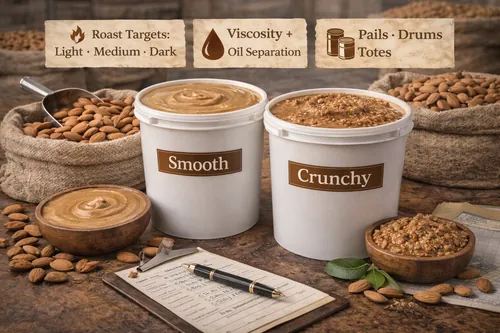
100% almonds (no-additive) Salted / lightly sweetened Smooth or crunchy (defined particles) Roast profiles (light → dark) Pails / drums / totes

Need other formats? See bulk almond products (kernels, meal/flour, oils, and retail programs).
Bulk Almond Butter for wholesale supply — Atlas Nut Supply

What buyers qualify in bulk almond butter

Procurement and QA teams typically qualify almond butter on process-fit first (viscosity/pumpability, particle size), then sensory (roast intensity, bitterness, sweetness/salt), then stability (oil separation, oxidation control), then packaging + documentation.

  • Viscosity window: defined range at a defined temperature (critical for pumping/depositing)
  • Texture definition: smooth (grit/PSD) or crunchy (inclusion size distribution)
  • Roast profile: light/medium/dark targets aligned to color and flavor
  • Oil separation tolerance: acceptable separation over time + handling guidance
  • Food safety + documentation: COA, lot traceability, allergen statements; certifications if required

Fastest alignment happens when you share your process conditions (mix shear, depositor type, pump, temperature range), plus your target texture (smooth grit or crunchy inclusion size).

Market-standard program options (what similar suppliers offer)

Across private-label and industrial nut butter programs, typical SKUs include 100% almond (no-additive) formulas, smooth or crunchy textures, and sealed-pack shelf-life targets commonly around 12 months (program-defined). Many programs also offer salted, lightly sweetened, or custom ingredient declarations depending on channel needs.

  • No-additive: 100% almonds (often used for “clean label” positioning)
  • Salted / lightly sweetened: for snack + spread profiles
  • Smooth vs crunchy: defined by particle/inclusion size (critical for depositors)
  • Private label: label + case pack alignment for retail/club/e-comm

If you’re building a retail line, ask about label compliance and case-pack constraints early to reduce rework.

Almond butter options

Common specification levers (availability varies by season and supplier program):

  • Roast-and-grind profiles: light/medium/darker roasts and flavor intensity targets
  • Texture: smooth vs crunchy; specify inclusion size or grit if you have a target
  • Viscosity / pumpability: align to your depositor, extruder, or pumping equipment (temperature matters)
  • Oil separation expectations: define acceptable separation over time and handling guidance
  • Formulas: no-additive, salted, sweetened, or custom programs (program dependent)
  • Food safety: micro requirements and allergen handling expectations (as applicable)
  • Packaging: pails / drums / totes; pallet constraints supported
  • Documentation: COA and traceability available per program; certifications upon request

If your finished product is temperature-sensitive (bars, fillings, dairy-alternative bases), include your processing temperature range and cooling profile so we can align a butter with predictable viscosity and separation behavior.

Industrial applications

Typical manufacturing and ingredient uses:

  • Spreads & fillings: retail-style spreads, sandwich fillings, confectionery centers
  • Bars & snacks: binder systems, inclusions, coatings, and layered products
  • Plant-based dairy bases: nut-forward bases and emulsions (spec dependent)
  • Bakery: swirls, inclusions, and flavor systems
  • Sauces & culinary: nut-forward emulsions and flavor carriers

For deeper application guides, see the Atlas Nut Academy.

Product specifications (quote-ready)

Use this as a starting point for procurement discussions. Final targets vary by supplier program, formula, and intended use. If you already have an internal spec sheet, send it—we’ll match the closest program and confirm COA parameters.

SKU definition (most important)

  • Base: 100% almonds (no-additive) or formulated (salt/sweetener/custom)
  • Roast: light / medium / dark (color + flavor target)
  • Texture: smooth (grit/PSD) or crunchy (inclusion size range)
  • Process-fit: pumpable vs depositor-ready vs scoopable at a defined temperature

Documentation

  • COA: moisture + micro + program-specific quality parameters
  • Traceability: lot coding and supplier program documentation
  • Allergen statements: almonds are a tree nut (label declarations required for most markets)
  • Certifications: if required (organic, kosher, halal, etc.)
Category Typical parameters to specify
Ingredients / formula No-additive: 100% almonds
Optional formulas: salted, lightly sweetened, custom ingredients (program dependent) Tip: Provide your desired ingredient statement + any “no” claims (no palm oil, no added sugar, etc.).
Sensory Roast intensity (light/medium/dark), aroma, bitterness tolerance, sweetness/salt targets (if used), color target. Best practice: Share a reference sample or sensory notes to reduce lot-to-lot surprises.
Texture Smooth (define grit/particle target) or crunchy (define inclusion size range + max oversize). For depositors/nozzles: include minimum orifice size or any screen/filtration limits.
Viscosity / rheology Target viscosity window + measurement temperature + method (if you use one). Temperature matters: a butter that’s “pumpable” at 30–35°C may be too thick at 20–25°C.
Oil separation Acceptable separation over time (e.g., after 2 weeks / 1 month), storage temperature expectations, and remix/warming guidance. In no-additive formulas, some separation is normal; define what’s acceptable for your use case.
Physical / quality Moisture target, defect limits, foreign material controls, and any color/particle constraints. Example reference targets exist in industry spec sheets (program-defined): moisture max and defined defect/foreign material limits.
Micro (typical)** Define your QA requirements. Typical checks include: Salmonella (absence), yeast/mold, APC, E. coli, coliforms (program-defined). **Micro targets vary by program and destination. Share your internal spec or retailer requirements.
Contaminants If required: aflatoxin limits (program-defined), heavy metals testing, pesticide residue expectations (especially for organic programs).
Packaging Pails / drums / totes (program-defined). Include inner liner requirements, pallet height/weight limits, and handling method (forklift/pump). Tip: Include receiving constraints (dock access, temperature controls, max pallet height) to avoid delivery issues.
Shelf life & storage Provide required shelf-life window and storage conditions (ambient vs cool storage), plus your rotation/FIFO expectations. Cool, dry storage away from heat/light is commonly requested for nut products to protect flavor stability.

Want a faster quote? Send: roast + texture + viscosity @ temp + separation tolerance + packaging + destination. If you have a benchmark butter, include the brand/spec (or send a sample via your normal QA process).

Request a quote Quote checklist Back to catalog

Process-fit checkpoints

To reduce surprises during scale-up, these are the most common “make-or-break” details for almond butter programs—especially when you pump, deposit, or blend under tight temperature control.

Viscosity window

  • Share target viscosity and measurement temperature
  • Note whether you need pumpable, depositor-ready, or scoopable texture
  • Include shear conditions if you test under specific rpm/geometry

Separation tolerance

  • Define acceptable oil separation over your shelf-life window
  • State storage temperature expectations
  • Ask for handling guidance (mixing, warming, rework)

Roast & flavor

  • Light/medium/dark targets impact color and aroma
  • Provide a reference sample or sensory notes if possible
  • Note if you require blanched vs natural almond inputs

Texture (smooth/crunchy)

  • Specify inclusion size for crunchy formats
  • Define “smooth” by grit/particle size if line is sensitive
  • Call out depositor nozzle size or filtration limits

If you’re seeing clogs, inconsistent deposits, or separation drift during trials, share process temperatures + pump/depositor setup. Small adjustments in grind profile and oil phase behavior often solve “line pain.”

Allergens & labeling notes

Almonds are a tree nut. Many markets require clear allergen declaration on labels. If you are building a private label SKU, include your target market(s) and label language requirements so the program can align on compliant declarations.

  • Allergen declaration: almonds (tree nut) must typically be declared clearly on labels
  • Cross-contact controls: share facility restrictions or customer requirements
  • Ingredient statement: confirm whether formula is 100% almonds or includes salt/sweetener/custom inputs

If you need “free-from” claims, list them in your inquiry (and your validation expectations) so we can match the right supplier program.

Packaging, handling & logistics lane

Bulk nut butters are typically shipped for industrial receiving. Your lane is faster and cleaner when packaging and handling are aligned to how you unload and move product inside your facility.

  • Pack types: pails / drums / totes (program dependent)
  • Handling: manual scoop, heated room, pump transfer—share your method
  • Pallet constraints: max height/weight and dock constraints
  • Lot coding: align lot-level traceability requirements and label format

Export lanes: include destination port, required documents, and labeling requirements early for smooth clearance.

Specs checklist (quote-ready)

Send your spec sheet if you have one. Otherwise, start with the checklist below for faster alignment.

  • Product: Almond butter
  • Roast profile: light/medium/dark; desired flavor intensity and color target
  • Texture: smooth or crunchy; include particle/inclusion size targets if applicable
  • Viscosity: target range + test temperature (and method if you use one)
  • Oil separation: acceptable separation over time; storage temperature and handling expectations
  • Formula: 100% almonds (no-additive) vs salted/sweetened/custom (if applicable)
  • Micro requirements: pasteurized program or specific micro targets (if applicable)
  • Packaging: pails / drums / totes; pallet constraints and liner requirements
  • Volume: first order + forecast and delivery cadence
  • Destination: city/state/country (or port) and required delivery window
  • Documentation: COA, traceability/COO, allergen statement, certifications if required

Share your end application (bars, fillings, spreads, dairy-alternative base) and processing steps (pumping, mixing shear, depositor type). We’ll help confirm the best almond butter spec targets for performance and shelf-life.

Request a quote Contact options Back to catalog

FAQ: almond butter

What specs do you need to quote bulk almond butter?

At minimum: roast profile, smooth vs crunchy, viscosity/separation expectations, packaging, volume and delivery lane. If you have a spec sheet, share it; otherwise use the checklist above.

Do you offer 100% almond (no-additive) formulas?

Many programs support 100% almond formulas (no-additive) as well as salted/sweetened/custom versions (program dependent). Share your ingredient statement and “no” claims so we can match the right program.

How do I define “smooth” for industrial lines?

“Smooth” can still vary by particle size distribution. If your line is sensitive, define smooth using a grit/PSD target and share nozzle sizes, screens/filters, and your depositor or pump setup. That prevents clogs and inconsistent deposits.

How should almond butter be stored for best shelf-life?

Storage guidance depends on the specific formula and packaging. In general, keep product in a cool, dry area away from heat/light, use FIFO rotation, and follow program-specific handling guidance (warming/mixing if needed). Share your facility conditions (temperature range), handling method (pumping vs manual), and shelf-life target and we’ll recommend best practices.

Do you ship almond butter outside the United States?

Yes. We support export lanes depending on destination, volume, and required documentation. Share the country/port and timeline for planning.

Can you provide COA and traceability documentation?

Yes. COA and traceability documentation are available per supplier program. If you require certifications, note them in your inquiry.