
Sorting, Sizing, and Defect Removal: How Almond Grades Are Built
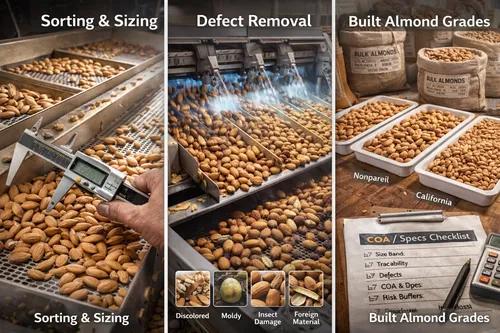
Industrial buyer guide to California almonds: how sorting, sizing, and defect removal create the grades you buy. Learn the field-to-warehouse flow, the major sorting technologies, and which quality checkpoints matter most for bulk almond procurement.
Previous: Drying Targets for Almond Kernels: Moisture, Storage Safety, and Quality • Next: Storage and Warehousing for Almonds: Temperature, Humidity, and Oxidation
Related: bulk almond products • products catalog • request a quote
Why sorting, sizing, and defect removal matter to industrial buyers
In bulk ingredient buying, “grade” is not just a label. It’s the practical outcome of many separation steps designed to deliver predictable edible yield, predictable roasting and processing behavior, and predictable complaint risk. Two lots can both be sold as the same general almond grade while behaving differently in production if they differ in sizing distribution, defect posture, or foreign material controls.
Understanding how grades are built helps procurement teams interpret offers, set realistic specifications, and avoid over-buying. It also helps QA teams decide which receiving checks and COA fields actually protect outcomes: line performance, appearance consistency, and shelf-life stability.
- Sizing influences: roasting uniformity, coating uptake, inclusion appearance, dosing accuracy, and breakage.
- Defect removal influences: edible yield, sorting labor, scrap, and complaint risk.
- Foreign material controls influence: food safety posture, line stops, and customer trust.
- Moisture and storage influence: mold risk posture and oxidation behavior over time.
Procurement reality: If your spec doesn’t define what matters to your process (size band, defect posture, FM posture), you may pay for rework later—hand picking, re-screening, slower throughput, or customer complaints.
Field-to-plant flow: where “quality” is created (or lost)
Almond quality is shaped across a long chain from orchard to finished ingredient. The later steps (sorting, grading, packaging) can remove defects and stabilize output, but they cannot fully “undo” early-season stress, harvest issues, or moisture events. Buyers who understand the chain can ask better questions and plan smarter buffers.
High-level sequence
Orchard management → bloom/pollination → growing season conditions → harvest operations → field drying / windrows → pickup → hulling/shelling → cleaning → sizing → density separation → color/optical sorting → defect removal → packaging → warehousing → shipment
Where variability often enters
- Weather events: rain or high humidity during drying windows can raise moisture risk and increase defect expression.
- Harvest timing: too early or too late can affect shell separation, kernel integrity, and defect appearance.
- Field sanitation: soil contact and debris increase foreign material load and sorting burden.
- Drying quality: uneven drying can increase storage risk and drive inconsistent processing behavior.
These upstream factors influence the downstream “grade build” because the plant can only remove what it can detect and separate. When incoming product is more variable, sorting must work harder, yields can drop, and costs can rise.
Cleaning & pre-sorting: getting almonds ready for precision grading
Before sizing and fine defect removal, almonds typically pass through a set of cleaning and pre-sorting steps that reduce the bulk load of non-almond material. This improves the efficiency of later sorting stages and supports consistent grade output.
Common cleaning steps and what they remove
- Scalping and screening: removes large debris, sticks, and oversized material.
- Aspiration: uses airflow to remove lightweight material (hulls, leaves, dust).
- De-stoning / density separation: removes heavy foreign material such as stones and hard debris.
- Magnets and metal detection (program-dependent): controls metal risk; placement depends on process design.
Buyers don’t always see these steps, but they are foundational: better pre-cleaning reduces downstream defects and foreign material risk, and it can improve the reliability of optical sorting by reducing “noise” in the product stream.
Buyer tip: If you have recurring foreign material issues, ask suppliers what their preventive controls are (screens, aspiration, density separation, and metal controls) and how they validate them.
Sizing: why screen counts and size bands matter in industrial use
Almond sizing is the separation of kernels into consistent size ranges. This matters because almonds are processed by heat, coatings, and mechanical handling—and size directly influences how almonds behave under those conditions.
Why industrial buyers specify almond size
- Roasting uniformity: smaller kernels heat faster; mixed sizes can yield uneven roast color and texture.
- Coating performance: size affects surface area, pickup rates, and appearance in seasoned products.
- Inclusion appearance: in bars and bakery, consistent size looks cleaner and more intentional.
- Dosing accuracy: size uniformity supports consistent piece count per unit and reduces variability.
- Breakage and fines: handling mixed sizes can increase breakage, especially when equipment settings are optimized for one band.
How sizing is commonly expressed
Suppliers may describe size in different ways depending on program and product form. Common approaches include:
- Count per ounce (or similar count language): used in many snack and kernel programs to define size bands.
- Screen size ranges: based on screening equipment; helps standardize separation in a plant-friendly way.
- Pieces size distribution: for diced/sliced/slivered products, where size impacts inclusion visibility and processing performance.
When to tighten sizing (and when not to)
Tighten sizing for premium snacks, roasting programs with tight color targets, and products where appearance and dosing are critical. Relax sizing for blended uses, milled products, or applications where almonds are not visually prominent.
Defect categories: what gets removed and why buyers care
Defects matter because they reduce edible yield, create rework, or increase complaint risk. Industrial buyers typically focus on defect categories that show up as operational pain: extra sorting labor, line interruptions, and downstream sensory or appearance issues.
Common almond defect categories in industrial buying
- Insect damage: rejectable kernels; reduces yield and can create bitter notes.
- Mold/decay: quality risk; often treated as “no visible mold/decay” at receiving.
- Discoloration: affects appearance; more important in premium visible applications.
- Chips, splits, and breakage: affects sizing consistency and creates fines.
- Doubles: can affect appearance and processing behavior depending on format and customer expectations.
- Foreign material: shells, stones, plastic, metal; controlled by both limits and preventive controls.
Defects that “hit” different applications differently
Not all defects matter equally in every product. For example, slight discoloration can be irrelevant in a dark chocolate bar but unacceptable in a premium blanched snack almond. Breakage can be acceptable in a diced inclusion but painful in a whole-kernel snack pack. The best specs reflect the finished product needs.
Useful framing: Defect limits are a way to buy process stability. Lower defects usually mean less rework, fewer line interruptions, and fewer customer complaints.
Sorting technology: how processors separate good kernels from defects
Almond grading is built using multiple separation tools. Each tool is good at removing certain defect types, but no single tool removes everything. That’s why grade-building is typically a sequence: remove big problems early (debris, stones, shells), then use more precise tools for color, surface defects, and foreign material.
Common sorting tools and what they do well
- Mechanical screening: separates by size; efficient and scalable for high-throughput lines.
- Air classification (aspiration): removes light material (hulls, dust) that can interfere with later sorting.
- Density separation / de-stoning: targets heavy foreign material and density differences.
- Color sorting: removes discolored kernels and some visible defects; effectiveness depends on defect visibility.
- Optical sorting (advanced): can detect a wider set of visual differences; often used to reduce defect load and foreign material risk.
- Hand sorting / inspection: used as a final polish step for premium programs or to validate performance.
- Magnets/metal detection: risk control for metal; placement and validation are critical.
Why multiple passes may be used
Some programs use multiple sorting passes to improve consistency, especially for premium visible products. More passes can reduce defects, but they can also reduce yield and increase cost—so buyers should match the program to the product need.
What buyers should ask (without getting too technical)
- Which defect categories are actively controlled (and how)?
- What foreign material controls exist (screens, de-stoning, metal detection)?
- How does the supplier verify sorting performance (internal QA checks, retain samples, or lot verification)?
How almond grades are built: a practical explanation
Think of an almond “grade” as the result of stacking layers of selection: you start with incoming product variability, then remove non-almond material, then separate by size, then remove visible defects, then verify against standards. The final grade reflects both the incoming condition and the intensity of the sorting program.
Step-by-step “grade build” (simplified)
- Incoming preparation: hulling/shelling (as applicable), debris removal, aspiration, and density separation.
- Primary sizing: screen or sizing separation into target bands.
- Defect removal: color/optical sorting and targeted removal of discolored or defective kernels.
- Foreign material controls: validated removal tools (including metal controls) to reduce risk.
- Verification: QA checks to confirm the lot meets the grade and the buyer’s key spec fields.
- Packaging & coding: sealed liners, lot code visibility, traceability identifiers.
Why “same grade name” can still vary
Variation can come from crop year conditions, orchard variability, harvest moisture, and how aggressively a processor sorts a given lot. This is why industrial buyers often build two lanes: a premium lane for visible applications and a standard lane for blended or robust applications.
Procurement specs: what to write so you buy consistent outcomes
The best almond specs are short, buyer-friendly, and tied to your finished product outcomes. Over-specification reduces supply flexibility and increases cost; under-specification increases rework and complaint risk.
Minimum spec fields most industrial buyers should include
- Product form: whole kernels, halves, diced, sliced, slivered, meal/flour; raw or roasted.
- Variety/program (if relevant): especially when appearance or blanching performance matters.
- Size band: count range or screen range for kernels; size distribution for pieces.
- Defect posture: insect damage, mold/decay posture, discoloration tolerance, breakage/fines.
- Foreign material posture: shell fragments tolerance and escalation rule for high-risk FM.
- Moisture: target range/max and verification method.
- Packaging: lined cartons/bags; seal integrity; lot code visibility; pallet config if needed.
Spec language that prevents disputes
- Define rejectable conditions: “no visible mold/decay” and “no hard foreign material” are common escalation rules.
- Define the receiving method: composite sampling and visual/sensory checks under consistent conditions.
- Define decision authority: who can place product on hold and who releases it.
Fast win: If you add only one field, add a clear foreign material posture (shell fragments vs hard FM vs metal) plus an escalation rule. This prevents the most expensive, reputation-damaging surprises.
COA checklist: fields that support acceptance and traceability
COA content varies by supplier program and destination requirements. A practical COA shortens receiving time, improves traceability, and prevents “missing documentation” holds that disrupt production planning.
Common COA fields buyers request
- Lot identification: must match packaging labels and shipping documents.
- Product description: form (kernels/sliced/diced), raw/roasted, and any size band identifiers.
- Moisture: value and (if provided) method reference.
- Allergen statement: tree nut (almond) declaration aligned to labeling needs.
- Country of origin: for compliance and labeling workflows.
- Traceability identifiers: production/shipment identifiers for issue isolation.
- Grade/defect summary (if provided): aligned to your spec’s key defect categories.
- Microbiology (program-dependent): aligned to your finished-product category requirements.
If your customers require additional documents (audit certificates, recall program summaries, food safety plan elements), request availability early. Documentation availability varies by program and destination.
Receiving inspection checklist (buyer-friendly)
- Packaging integrity: no punctures, water damage, broken seals; correct labeling and lot codes.
- COA match: lot ID on COA matches case labels and shipping documents.
- Odor check: clean, fresh almond aroma; no stale, musty, rancid, or chemical notes.
- Visual check: size distribution aligned to your target; acceptable color/appearance; minimal debris.
- Defect scan: look for insect damage, discoloration beyond tolerance, chips/breakage, and any visible mold/decay.
- Foreign material scan: check for shell fragments and escalate immediately on hard foreign material or metal.
- Moisture verification: confirm against target (especially in warm/humid seasons or long transit lanes).
- Retains: keep a retained sample per lot for investigation and shelf-life tracking.
QA tip: For appearance- or flavor-sensitive programs, keep a retained “golden lot” reference sample and evaluate lots under consistent lighting.
FAQ: almond sorting, sizing, and grades
Is almond “grade” the same as “size”?
No. Size is one component of a grade build, but grade also includes defect posture and how aggressively defects and foreign material are removed. Two lots can be similar in size but different in defect load or appearance consistency.
Do tighter specs always reduce complaints?
Tightening the right specs reduces complaints—especially foreign material posture, mold/decay posture, and sensory acceptance language. Tightening everything can increase cost without improving outcomes. Focus on the fields that impact your finished product.
Why do some lots roast differently even within the same size band?
Roasting behavior can still vary due to moisture, kernel density, and surface condition differences. This is why many buyers pair size targets with moisture expectations and consistent storage/handling practices.
What’s the simplest way to qualify a new almond supplier?
Start with: a clear spec (form, size, defect posture, FM posture, moisture), a COA checklist, and a repeatable receiving inspection. Then run a controlled trial and retain samples by lot so you can correlate incoming quality with line performance and shelf-life outcomes.
Next step
If you share your application (snacks, bakery, confectionery, ingredient blending) and the format you need (whole kernels, roasted, diced, sliced, meal), we can recommend practical size bands, defect checkpoints, COA fields, and packaging options aligned to your program and destination. Use Request a Quote or email info@almondsandwalnuts.com.
For sourcing, visit bulk almond products or browse the full products catalog.