
Refined vs Crude Almond Oil: Use Cases, Odor/Color, and Documentation
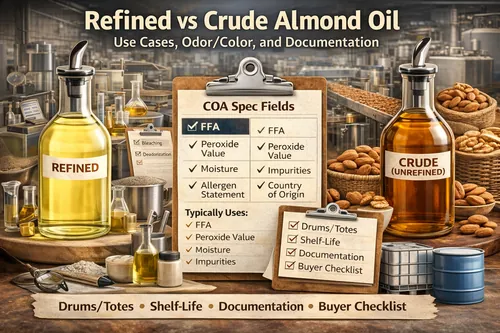
Industrial guide to refined vs crude almond oil: where each format fits, what odor/color differences to expect, how refining changes stability, and which specifications and documents reduce purchasing risk in bulk supply programs.
Previous: Cold-Pressed Almond Oil for Food Applications: Flavor Profile, Smoke Point, and QA • Next: Almonds in Plant-Based Dairy: Base Building, Solids, and Stabilization Notes
Related: bulk almond products • products catalog • request a quote
Why this decision matters in industrial buying
In industrial formulation, almond oil is rarely purchased for “taste alone.” It is purchased for performance: a consistent fat system, repeatable odor and color, predictable oxidation behavior, and documentation that aligns with your category (food, personal care, supplements, or industrial). The refined vs crude choice can impact:
- Sensory: odor intensity, nutty notes, and how the oil reads in finished goods.
- Appearance: color tone, haze/clarity, and how it affects light-colored products.
- Line behavior: filtration burden, pumpability, foaming, and compatibility with emulsification steps.
- Stability: shelf-life under your storage reality (temperature swings, light exposure, oxygen headspace).
- Compliance: allergen statements, COA, traceability, and fit with customer audit requirements.
Practical takeaway: choose crude almond oil when you want more natural character and can manage variability; choose refined almond oil when you want neutral sensory, lighter color, and tighter control for large-scale production.
Quick navigation
Jump to: definitions • odor & color • use cases • refining steps • spec checklist • documentation • packaging • shelf-life • requesting a quote • FAQ
Definitions buyers actually use: crude vs refined almond oil
Terminology can vary by industry and region, so it helps to clarify what “crude” and “refined” mean in your purchasing lane. In bulk programs, the difference is less about marketing language and more about how far the oil has been processed after extraction.
What “crude almond oil” typically means
Crude almond oil is the oil as it comes from the extraction process (pressing and/or extraction) with limited downstream cleanup. It is commonly filtered to remove obvious solids, but it typically retains more native components that affect odor, color, and stability. Depending on the program, crude oil may still have:
- More color bodies (deeper yellow/amber tones).
- More odor-active compounds (a noticeable almond/nut character).
- More natural “minor components” that can be desirable for certain personal care uses, but can also increase variability.
- Higher variability lot-to-lot, influenced by crop, handling, and extraction conditions.
What “refined almond oil” typically means
Refined almond oil has undergone additional processing designed to reduce odor, lighten color, and improve shelf stability. Refining is often described with terms like RBD (refined, bleached, deodorized) or “deodorized” depending on how the supplier labels the final output. Refined oil is chosen when you need:
- Neutral sensory (lower odor impact in delicate products).
- Lighter and more consistent color (important in pale creams, sauces, confections).
- Lower impurities for more predictable processing (less haze, fewer solids, lower risk of off-notes).
- More predictable oxidation performance in typical warehousing and shipping conditions.
Note: “Cold-pressed” and “crude” are not the same thing. Cold-pressed may still be filtered and standardized, and “crude” may come from different extraction paths depending on the supplier program. If your spec depends on the extraction method, request that detail explicitly in the quote stage.
Odor and color: what changes and why it matters
Odor and color are often the first differences a receiving team notices, and they are also the first differences your customers will notice if the oil is used in a lightly flavored or lightly colored product. The industrial question is not only “what does it smell like today?” but “what will it smell like after heat, shear, aeration, and storage?”
Odor expectations
- Crude: typically more almond-forward, with a broader aromatic range that can read as “nutty” or “seed-like.” This can be desirable in premium, natural-positioned, or lightly processed applications.
- Refined: typically more neutral, designed to minimize aroma transfer and reduce the risk of off-notes in sensitive matrices (milk alternatives, white chocolate-style coatings, neutral creams).
Color and clarity expectations
- Crude: deeper tone is common; clarity may vary depending on filtration, waxes, and temperature.
- Refined: lighter and more consistent color is common; clarity and haze performance are often improved, especially at cooler storage temperatures.
How to manage sensory risk in production
If your application is sensitive, treat odor and color like measurable parameters rather than qualitative surprises. Practical risk controls include:
- Retained sample review: keep retains by lot and compare against a reference lot for odor and color drift.
- Pre-warm and mix standardization: standardize sampling temperature so haze doesn’t masquerade as contamination.
- Set acceptance ranges: define pass/fail rules for odor intensity and color (instrument or visual reference) rather than relying on subjective receiving decisions.
- Choose the right refining level: if you only need a small reduction in odor, a supplier may offer intermediate processing; if you need “neutral,” you likely need deodorized/refined output.
Common pitfall: approving a crude lot in the lab and discovering odor magnification after heating (frying, baking, high-shear emulsification) or after several weeks in finished-product storage.
Where each format fits in production
The “best” format is the one that hits performance targets with minimal rework and minimal sensory risk, while keeping your supply lane stable. Below are typical industrial patterns. Your plant conditions (temperature, oxygen pickup, residence time, and packaging) may shift the optimal choice.
Food manufacturing
- Refined almond oil is often favored for: neutral-flavor baked goods, confectionery systems, fillings, emulsified sauces, ready-to-drink or dairy-alternative bases where odor control matters, and products with light color targets.
- Crude almond oil is often favored for: natural-positioned dressings, premium snack seasonings, nut-forward bakery, or applications where a mild almond character is a benefit rather than a defect.
Personal care and cosmetics
- Refined is often favored for: neutral odor in creams/lotions, products with fragrance systems where the carrier must stay “quiet,” and formulations with strict color requirements.
- Crude is often favored for: natural claims, artisanal body oils, or products where a more “natural” sensory profile is desirable (while accepting variability).
Supplements and softgels (where applicable)
These programs tend to be documentation-heavy and consistency-driven. Refined oils are often preferred when oxidative stability, odor control, and standardized specs are priorities. If used as a carrier oil, clarity and stability under storage are common decision points.
Industrial and functional uses
While almond oil is primarily purchased for food and personal care, some buyers evaluate it for niche functional uses where a plant-derived oil is needed. In these cases, the same principles apply: refine for consistency and low odor; choose crude only if the added variability is acceptable and the application benefits from native components.
What refining does to the oil: a practical overview
Refining is a toolbox, not a single step. The goal is to reduce impurities and odor-active compounds and to improve consistency. The exact sequence and intensity varies by supplier and program. Buyers don’t need a chemistry degree, but it helps to understand what each stage is intended to remove.
Typical stages you may see referenced
- Filtration / winterization (program-dependent): removes suspended solids and can reduce haze-formers that appear at cooler temperatures.
- Degumming (program-dependent): targets phospholipids and related materials that can impact stability and processing.
- Neutralization (program-dependent): reduces free fatty acids (FFA), often improving stability and sensory profile.
- Bleaching: reduces color bodies and some trace contaminants using adsorbents; often improves appearance consistency.
- Deodorization: reduces volatile odor-active compounds; this is the stage most associated with achieving a neutral sensory profile.
What changes from a buyer perspective
- Odor impact decreases: improved neutrality in sensitive finished goods.
- Color lightens and standardizes: fewer surprises in pale products.
- Oxidation behavior often improves: better resistance to off-notes under typical storage, depending on packaging and handling.
- Lot-to-lot consistency increases: fewer manufacturing adjustments.
If you are qualifying a new supply lane, ask the supplier to describe the refining level in plain terms (not only abbreviations) and confirm which stages are included for your program.
Format and spec checkpoints buyers should confirm
A good almond oil spec sheet acts as a “shared language” between your procurement team, quality team, and supplier. It reduces back-and-forth and prevents receiving conflicts caused by assumptions (for example, assuming “refined” automatically means odorless, or assuming “crude” automatically means dark).
Core spec items that usually matter
- Refining level / description: crude, refined, deodorized, RBD, filtered, winterized (as applicable).
- Sensory expectations: odor intensity and character, plus any unacceptable notes (painty, stale, oxidized).
- Color target: define a method or reference standard when possible, especially for light-colored finished goods.
- Clarity / haze: especially if you store at cooler temperatures or use clear packaging.
- FFA (free fatty acid) target: commonly used as a quick indicator of quality and processing control.
- Peroxide value (PV) target: a common oxidation indicator for fats and oils.
- Moisture & volatiles: important for stability and processing performance.
- Insoluble impurities: relevant for filtration burden and line reliability.
- Optional oxidation indicators: some buyers also use anisidine value (AV) or calculated totals, depending on program needs.
Food safety and micro considerations
In many oil programs, microbiological risk is lower than in high-moisture ingredients, but your category may still require microbiology reporting or a documented rationale. Align requirements with your HACCP/food safety plan and your customer expectations. Also confirm allergen controls for tree nuts.
Common “fit-for-purpose” add-ons
- Smoke/heat use expectations: if you heat the oil (frying, baking, thermal processing), define your processing conditions and ask whether the oil is appropriate for that profile.
- Functional requirements: emulsification behavior, foaming tendencies, and pumpability at your plant temperatures.
- GMO / claims: if your finished goods require specific claim support, align early (availability varies by program).
- Country of origin / traceability depth: especially for customers with strict traceability or import requirements.
Tip: If you do not yet have an internal spec sheet, start with a supplier baseline spec and add only the parameters that truly change your risk outcome. Over-specifying can reduce supply flexibility and raise cost without improving your finished product.
Buyer-friendly spec checklist (copy/paste)
You can paste this into an inquiry to reduce quote cycles:
- Oil type: almond oil (refined / deodorized / crude / filtered)
- Target odor: neutral / light almond / defined acceptance description
- Target color: light / standard range (method if applicable)
- FFA target: ________
- Peroxide value target: ________
- Moisture & volatiles target: ________
- Insoluble impurities target: ________
- Allergen statement required: yes/no (tree nut)
- Documentation required: COA / micro / country of origin / traceability / other
- Packaging: drums / totes / IBC (liner type if required)
- Annual volume + first order: ________
- Destination + timeline: ________
Documentation: what buyers request and why
Documentation is not “paperwork for paperwork’s sake.” It is the fastest way to align supplier output with your internal approval process and your customer audit expectations. Availability varies by program and supplier, so the best approach is to request only what your system truly requires and confirm it is available before you lock your supply lane.
Common documents for bulk almond oil programs
- COA (Certificate of Analysis): lot-specific results for agreed parameters (often PV, FFA, moisture, and sensory notes as applicable).
- Specification sheet: the baseline acceptance limits and method references.
- Allergen statement: almond is a tree nut; confirm allergen controls and cross-contact considerations.
- Country of origin statement: used for labeling and customer compliance workflows.
- Traceability details: lot coding and supplier traceability depth (important in recalls and audits).
- Food safety / quality certifications (if applicable): program-specific certifications or audit summaries when available.
- GMO / claims support (if applicable): program-specific statements where required.
How to avoid documentation mismatches
- Match the COA to your spec: ensure the COA reports the parameters you will actually receive against.
- Confirm units and methods: PV and FFA can be expressed differently across labs; align method references where possible.
- Define acceptance rules: decide whether you accept “typical” values or require explicit max limits.
- Clarify re-test rules: define what happens if a parameter is near the limit (retain testing, re-sampling, third-party lab).
Quality team note: If you have a finished-product shelf-life target, align oil acceptance limits with that target and your actual storage environment. A “passing” oil can still be a shelf-life risk if your packaging and oxygen exposure are not controlled.
Packaging options for bulk programs
Packaging is where good oil can become problematic oil. Oxygen headspace, light exposure, and temperature stress accumulate during shipping and warehousing. For industrial programs, choose packaging that fits your receiving constraints and your consumption rate, while reducing oxidation exposure.
Common bulk packaging formats
- Steel or HDPE drums: common for moderate volumes; manageable for many receiving docks.
- Totes / IBC: common for higher volume users; reduces unit handling and supports consistent consumption.
- Liners and closures: confirm liner compatibility, tamper evidence, and how closures manage headspace exposure after opening.
Receiving and handling details that matter
- Pallet configuration: confirm max pallet height/weight and forklift access.
- Temperature management: avoid prolonged heat exposure; high temperatures accelerate oxidation.
- Oxygen exposure control: minimize headspace time after opening; consider nitrogen management if your process is sensitive.
- Filtration plan: if your plant requires inline filtration, align mesh/filtration strategy with the oil format (crude may require more filtration burden).
Processing and shelf-life considerations
Almond oil is susceptible to oxidation over time. The practical drivers are oxygen, heat, light, and residence time in partially filled containers. Refining can improve stability and sensory neutrality, but it does not make the oil “immune” to poor handling.
Key shelf-life drivers
- Temperature: higher storage temperatures accelerate oxidative changes; avoid heat exposure during transport and warehousing.
- Light exposure: can degrade quality and accelerate off-notes; opaque packaging helps.
- Oxygen headspace: the more headspace and the more often containers are opened, the higher the oxidation risk.
- Time-to-consume: choose packaging size that matches your actual drawdown rate, not only price-per-pound.
How to align oil shelf-life with finished-product shelf-life
If your finished product has a long shelf-life, treat the oil as a shelf-life-critical input. That often means tighter PV/FFA controls, better packaging, and less time sitting open in partially used containers. If your finished product turns quickly, you may be able to accept broader ranges and still meet your outcome.
Storage practices that reduce variability
- Store in a cool, dry area away from direct light.
- Use first-in/first-out (FIFO) by lot and keep retains for complaint investigation.
- Standardize sampling temperature and agitation approach before sensory evaluation.
- Document container open/close cycles if oxidation risk is a recurring issue.
How to request a quote with fewer back-and-forths
Bulk oil quotes move fastest when the supplier can map your use case to a defined spec, packaging, and logistics plan. Send enough information to prevent assumptions. The goal is to get a quote that is not only priced correctly, but also operationally workable.
Information to include in your first message
- Application: food / cosmetics / supplement / other; include whether the oil is heated and at what conditions.
- Format: crude, refined, deodorized, filtered/winterized (as required).
- Sensory targets: neutral vs light almond character; unacceptable notes.
- Spec targets: PV, FFA, moisture/volatiles, impurities (and any others you truly need).
- Packaging: drums vs totes/IBC; receiving constraints; any liner requirements.
- Volumes: first order volume and annual forecast.
- Destination: ship-to location and timeline.
- Documentation: COA + any additional statements you require.
Fastest path: attach your spec sheet (even if it is a draft). If you don’t have one, provide your acceptance targets in plain language and we can align to common industrial ranges.
A simple decision guide (refined vs crude)
If you need a quick internal rule to reduce debate, this framework is often useful for procurement and R&D teams:
- Choose refined almond oil when: you need neutral odor, light color, predictable performance, and minimal sensory surprises in large-scale production.
- Choose crude almond oil when: you want more natural character, can accept some variability, and have processing controls that manage odor/color and stability.
- When unsure: qualify both with pilot runs and accelerated sensory checks (heat exposure + short storage) to see which format behaves best in your real process.
FAQ: refined and crude almond oil in bulk supply
Is refined almond oil always odorless?
Refined oils are typically designed to be more neutral, but “odorless” is not a universal guarantee without defining what “odorless” means in measurable or sensory-panel terms. If your product is extremely sensitive, specify a neutral odor expectation and define unacceptable notes.
Does crude almond oil always have more nutrients?
Crude oils may retain more native minor components depending on extraction and processing, but industrial buyers should focus on outcomes: if your finished product requires documented composition or claims support, align the requirement explicitly with your supplier program.
Which is better for light-colored products?
Refined oil is commonly chosen where color consistency matters (white creams, pale sauces, confectionery). Crude oil can work, but requires tighter color acceptance rules and may still introduce drift.
What is the most common reason for rejections in bulk oil receiving?
In practice, rejections often happen due to sensory mismatch (unexpected odor), oxidation indicators exceeding limits, or packaging/handling issues (leaks, headspace exposure, temperature stress). Clear specs and packaging expectations reduce these failures.
Next step
If you share your application and the format you need, we can confirm common spec targets, packaging options, and the fastest supply lane. Use Request a Quote or email info@almondsandwalnuts.com.
For related sourcing: explore bulk almond products or browse the full products catalog.