Diced Walnuts for Bars and Snacks: Cut Size, Dust, and Line Performance
Diced walnuts are a common inclusion for bars and snack mixes, but “dice” can mean very different particle distributions. The cut you choose affects bite, visual dispersion, feeder performance, and dust generation. This guide explains practical cut-size specs, dust/fines control, and how to reduce oxidation risk in bulk diced walnut programs.
Previous: Dry Roasted vs Oil Roasted Walnuts: Flavor Development and Oxidation Risk • Next: Walnut Meal for Bakery Systems: Absorption, Texture, and Consistency
Related: bulk walnut products • products catalog • request a quote
Why cut size matters for bars and snack lines
Diced walnuts sit at an awkward intersection: small enough to distribute evenly, but large enough to contribute bite and identity. If the particle distribution is too wide, you can get inconsistent deposit weights, separation in blending, and variable chew.
- Too large: uneven dispersion, “hard spots,” feeder bridging, higher breakage during mixing.
- Too small: more dust, faster oxidation, muddier flavor, and higher oil migration into binders/coatings.
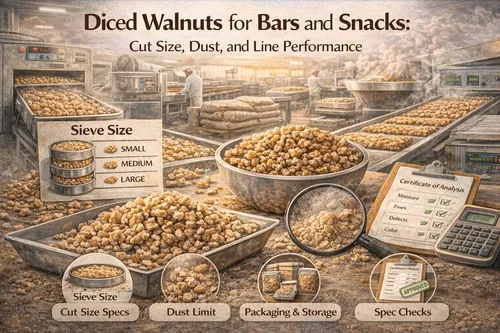
Buyer shortcut: don’t only specify “diced.” Specify a sieve distribution (what % stays on/through key screens) plus a max fines limit.
How to write a cut-size spec (without overcomplicating it)
The most useful specs define a target band and a fines ceiling. Common approaches:
- Screen/sieve spec: e.g., “primarily between Screen A and Screen B” with a max % under the fines screen.
- Nominal cut: e.g., “small dice” or “medium dice” plus a sieve table to remove ambiguity.
- Application spec: “bar inclusion, low-fines” or “snack mix, high-flow” to guide milling/sorting choices.
If your line is sensitive (multihead weighers, volumetric cups, tight depositor tolerances), prioritize a tighter distribution even if the product costs slightly more.
Dust and fines: why they happen and what they break
Walnut “dust” is typically a mix of very small fragments and meal created during cracking, cutting, conveying, and transport. It matters because fines:
- Accelerate oxidation (more exposed surface area).
- Change binder uptake in bars (can stiffen texture or create dry pockets).
- Reduce line cleanliness and increase housekeeping / allergen control burden.
- Increase weight variability if fines segregate or compact differently than dice.
Buyers should treat “low dust” as a measurable requirement, not a vibe.
Line performance considerations (bars, clusters, snack mixes)
- Feeder flow: tighter cuts reduce bridging and improve consistent delivery.
- Segregation risk: wide particle distributions can separate during vibration and conveyance (large pieces rise, fines fall).
- Breakage during mixing: walnuts are more fragile than many inclusions; aggressive mixing can create dust even if you buy a clean dice.
- Oil migration: smaller pieces/fines can release oil into binders/coatings more quickly, impacting texture and shelf-life.
Oxidation and shelf-life risk for diced walnuts
Walnuts are oxidation-sensitive, and the risk increases as particle size decreases. The biggest practical levers are:
- Fines control (lower surface area exposure).
- Packaging that limits oxygen (and fast seal after packing).
- Cool, stable storage (heat swings are the enemy).
- Shorter open-time at the plant once bags are opened (plan staging and batching).
Spec checkpoints buyers should confirm (diced walnuts)
For diced walnut programs, consider adding these to your spec sheet:
- Cut type: diced/pieces, and whether the supplier sorts for “low fines.”
- Particle distribution: sieve targets (primary band) + max % fines.
- Moisture: target + max to support crunch/handling and reduce storage risk.
- Defects: insect damage, mold risk indicators, foreign material controls.
- Color/grade expectations: clarify if color matters for your SKU appearance.
- Micro requirements: match to your category and kill-step assumptions.
- Sensory: “clean/nutty” vs bitter/off-notes; define reject criteria for rancid notes.
- Documentation: COA fields, allergen statement, country of origin, any compliance add-ons.
Packaging options for bulk diced walnut programs
Bulk programs commonly use lined bags/cartons. For oxidation-sensitive inclusions, align packaging and storage with your distribution reality.
- Share receiving constraints: pallet config, storage temperature range, repack needs, and staging practices.
- Reduce oxygen exposure after opening: reseal protocols or smaller pack sizes can help if you use walnuts intermittently.
How to request a quote with fewer back-and-forths
Send these fields up front for diced walnut inclusions:
- Application (bar, cluster, snack mix) + target bite/visual (small vs medium dice).
- Desired particle distribution (screens) + max fines/dust.
- Moisture target + max; any defect/color limits; micro requirements.
- Packaging preference, first order volume, annual forecast, destination, and timeline.
- Documentation requirements (COA/micro/allergen/country of origin/certifications if applicable).
Next step
If you share your bar/snack format (extruded, slab bar, baked bar, cluster), target piece visibility, and your line constraints (feeder type, mixing intensity, depositor sensitivity), we can suggest a practical dice spec (screens + fines limit) and packaging approach that reduces dust and oxidation headaches. Use Request a Quote or email info@almondsandwalnuts.com.