Almond Meal vs Extra-Fine Almond Flour: Selecting the Right Grind for Production
Almond “meal” and extra-fine almond flour can look similar on paper, but grind size drives big differences in hydration, texture, flowability, and line performance. This extended guide helps buyers select the right grind for bakery, coatings, bars, and plant-based systems—while reducing clumping, segregation, and shelf-life risk.
Previous: Using Almond Flour in Commercial Baking: Texture, Moisture, and Yield • Next: Pasteurized Almond Kernels for Food Manufacturing: When and Why Buyers Specify It
Related: bulk almond products • products catalog • request a quote
On this page
- What “meal” vs “extra-fine flour” usually means
- Where each grind fits best in production
- Key definitions: PSD, mesh, moisture, aw, flowability
- Key functional differences buyers should plan for
- Format and spec checkpoints buyers should confirm
- Line performance: handling, bridging, dust, and segregation
- Processing and shelf-life considerations
- Packaging options for bulk programs
- Receiving QA: quick gates that prevent downtime
- Troubleshooting: symptoms, causes, and fixes
- Specs checklist (quote-ready)
- FAQ
- Next step
What “meal” vs “extra-fine flour” usually means
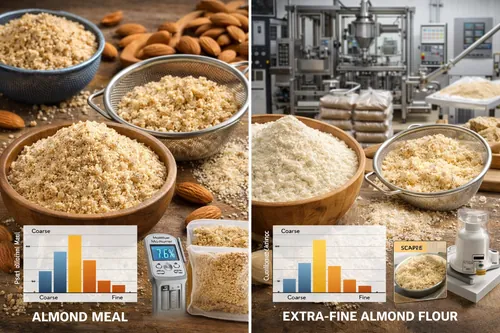
In practice, the difference is mostly particle size distribution (PSD)—not just “fine” vs “coarse.” Two products can share the same label but behave very differently if the distribution shifts, especially the fraction of very fine particles (which strongly impacts hydration, clumping, and viscosity).
Almond meal
- Coarser grind and wider particle distribution
- More “grain” / texture in finished products
- Often better for coatings, crunch, rustic bakery textures
- Can reduce stickiness vs very fine flours in some systems
- May segregate more if handled aggressively (wide PSD + vibration)
Extra-fine almond flour
- Finer grind with tighter distribution
- Smoother mouthfeel; better for tender crumbs and delicate textures
- Better dispersion in batters and some dairy-alternative bases
- Higher surface area can increase clumping and oxidation sensitivity
- More likely to bridge in hoppers if moisture control is weak
Buyer tip: don’t buy “fine” by name—buy the spec (PSD/mesh + moisture/aw + color) that matches your process and quality targets.
Where each grind fits best in production
Bakery & mixes
- Extra-fine flour: smoother cakes, macarons, soft cookies, batters where gritty texture is unacceptable, and premium “clean” crumbs.
- Meal: rustic breads, streusel/toppings, texture-forward cookies, inclusions where visible almond grain is desired.
Coatings, breading & crunch systems
- Meal: better bite and crunch; often less dusty than ultra-fine powders; can improve visual coverage in breading systems.
- Extra-fine flour: useful as a binder/film component in blends; may reduce crunch if used alone in heavy applications.
Bars, fillings & nutrition blends
- Extra-fine flour: smoother bite; can increase perceived density and moisture binding; can help with cohesion in some bars.
- Meal: adds texture; may reduce “paste-like” eating quality in high-fat or syrup-heavy systems; can improve bite and reduce gumminess.
Plant-based bases (formulation dependent)
- Extra-fine flour: better dispersion and a more uniform base, but higher risk of clumping if moisture and shear control are weak.
- Meal: may require higher shear or pre-hydration to avoid grit and settling; can be preferred where “natural” texture is acceptable.
If you’re choosing between grinds for a new SKU, define which failure you can’t tolerate: grit, clumping/bridging, segregation, or short shelf-life. The best grind is usually the one that avoids your most expensive failure mode.
Key definitions: PSD, mesh, moisture, aw, and flowability
If you only take one action from this page, make it this: align on definitions and test methods. Many disputes happen because one party uses “mesh” as a proxy for grind while the other evaluates with a different PSD method, or because moisture is measured differently lot-to-lot.
Particle size distribution (PSD)
PSD describes how much of the product falls into different particle size bands. In practice, PSD determines how a powder behaves: fines increase cohesion and thickening; larger particles increase crunch and reduce viscosity but can increase segregation. Buyers often care most about the “tails” of the distribution: too many fines (clumping/bridging) or too many coarse particles (grit/settling).
Mesh and sieve profile
“Mesh” typically refers to sieve size, but a single mesh number can hide important detail. Two lots can both pass a given sieve and still have very different fine fractions. If your process is sensitive, ask for a sieve profile (percent retained across multiple sieves) rather than a single pass/fail screen.
Moisture vs water activity (aw)
Moisture is total water content. Water activity (aw) describes how available that water is for reactions and quality drift. For almond meal/flour, small moisture shifts can change flowability and clumping. If your plant has humidity swings, specifying a realistic moisture target window (and packaging suited to it) is often more valuable than arguing “meal vs flour” by name.
Flowability (what ops teams feel first)
Flowability is how easily powder moves through hoppers, feeders, and conveying systems. Ultra-fine powders can bridge and rat-hole; wide PSD powders can segregate. In production terms, flowability determines whether you get consistent feeding, stable weights, and low downtime.
Buyer tip: if your line is sensitive, specify “critical-to-quality = flowability/viscosity/texture” and ask the supplier what PSD method they use and how they control it run-to-run.
Key functional differences buyers should plan for
- Hydration and viscosity: finer particles typically increase water binding and thickening. Small PSD shifts can change depositor settings and bake yield.
- Flowability and bridging: ultra-fine powders can bridge and clump more easily, especially if moisture drifts or bins are open too long.
- Dust and housekeeping: very fine flour can create more dust; dust control and aspiration considerations may matter in some plants.
- Segregation: wide PSD products can segregate during transport/handling—especially if vibration is high or blending is not controlled.
- Dispersion: extra-fine flour generally disperses faster; meal may require higher shear or pre-hydration in liquids.
- Texture: extra-fine flour smooths; meal delivers visible grain and crunch.
- Oxidation exposure: finer grind has more surface area; manage oxygen/light/heat accordingly to protect flavor.
Switching suppliers? Validate with a short plant trial—small PSD changes can cascade into viscosity, depositor speed, bake time, and finished texture.
Format and spec checkpoints buyers should confirm
For milled almond ingredients, “mesh” alone is rarely enough. Strong programs specify PSD (or a sieve profile), plus the stability drivers that cause the biggest headaches at scale: moisture/clumping, color consistency, and documentation alignment.
Core spec items (most programs)
- Grind / PSD target: meal vs extra-fine flour (include mesh targets and any distribution limits if available).
- Moisture target window: critical for clumping control and flowability; align to your plant humidity realities.
- Color and defect limits: impacts finished appearance, especially in light bakery items and dairy-alternative bases.
- Micro requirements: align to your category and customer requirements (program dependent).
- Allergen handling: confirm controls and statement language needed for your customers.
- Lot traceability: ensure COA fields match your receiving SOP and internal lot mapping.
When you should tighten the grind window
Consider a tighter PSD window if any of these are true:
- Your batter viscosity is a CTQ (depositors, pumps, extrusion, or high-speed lines).
- Your product is sensitive to grit (premium baked goods, delicate textures, certain beverage bases).
- Your plant struggles with bridging and clumping, and you can’t reliably control humidity at the source.
- You blend multiple powders and see segregation or inconsistent nutrition/fat distribution.
If you need predictability, ask for a “run-to-run PSD control plan” (what is measured, how often, and what triggers an adjustment).
Line performance: handling, bridging, dust, and segregation
Powder performance is where “meal vs extra-fine flour” becomes an operations decision. A product can be perfect in a lab sample and still cause downtime if it bridges in a hopper or segregates in a tote. The goal is to match the grind to your equipment and plant environment.
Flow problems to plan for
- Bridging: powder forms an arch in a hopper and stops flowing.
- Rat-holing: powder flows through a channel while the rest sticks to the walls.
- Caking/clumping: moisture pickup or temperature cycling creates lumps that block feeders.
- Dusting: ultra-fine flour can create airborne dust during dumping and conveying.
- Segregation: PSD blends separate under vibration, leading to inconsistent dosing and texture.
Practical steps that reduce downtime
- Minimize open time: keep bags and bins closed when not actively dosing; avoid leaving powder exposed to humid air.
- Control humidity at the point of use: even modest humidity swings can change powder cohesion and bridging behavior.
- Use consistent dump practices: aggressive dumping increases dust and can accelerate segregation.
- Validate with your feeding method: screw feeders, vibratory feeders, and gravity-fed systems can behave differently on the same PSD.
- Plan rework carefully: repeated exposure of opened flour/meal to air can increase staling and clumping.
Operations rule: if you’re fighting bridging, don’t just “go coarser.” Often the fix is moisture control + packaging + a slightly tighter PSD (fewer ultra-fines), not a complete format change.
Processing and shelf-life considerations
Almond meal and flour contain oil and are sensitive to oxidation. The main shelf-life levers are oxygen exposure, temperature, light, and time. Finer grinds often increase oxidation sensitivity because more surface area is exposed. Shelf-life is not only a supplier issue—storage and handling in your facility matter just as much.
Shelf-life risk drivers buyers can control
- Storage temperature stability: keep cool and stable; avoid warm warehouses and frequent temperature cycling.
- Open-bin exposure: minimize time in open hoppers or bins; reseal partial bags promptly.
- Humidity exposure: humidity increases caking and can accelerate sensory drift (and flow issues).
- Inventory turns: align FIFO to your flavor and shelf-life standards.
- Sensory gates: add quick odor checks at receiving for sensitive programs.
What “staling” looks like in practice
For milled almond ingredients, “staling” may show up as muted almond aroma, slightly waxy or stale notes, or increased clumping and poor dispersion. If your product is flavor-forward (premium bakery, beverages, fillings), build a simple sensory reference so receiving teams know what “good” smells like.
Buyer tip: if you’re struggling with shelf-life, focus first on oxygen exposure + heat. Packaging barrier and warehouse temperature stability usually deliver the fastest improvement.
Packaging options for bulk programs
Bulk programs typically use sealed, lined bags or cartons for meal/flour. Packaging choice should match your receiving method, plant environment (humidity), and inventory turns. If you are exporting or shipping through hot routes, consider higher barrier packaging.
Common bulk formats
- Sealed lined bags/cartons: common for meal/flour programs; confirm liner integrity and sealing approach.
- Bulk bags: used for high-volume programs; confirm discharge method, liner type, and dust control requirements.
- Drums / rigid packaging: used when additional physical protection is needed or where long storage is expected.
Packaging details buyers should share
- Pallet constraints: max height, pallet footprint, and dock/receiving equipment constraints.
- Plant environment: humidity risk, temperature swings, and how quickly opened materials are used.
- Re-pack or blending needs: liner compatibility, dust control expectations, and partial-bag reseal practices.
- Documentation requirements: lot coding format and any customer/retailer documentation needs.
Receiving QA: quick gates that prevent downtime
A simple receiving checklist reduces surprises and catches issues before they hit the line. You don’t need a lab to add value—consistent documentation checks and fast sensory/visual gates often prevent the most costly problems.
Practical receiving checks
- Lot match: verify lot codes on bags/cartons match COA and shipment documents.
- Packaging integrity: check liners for damage, improper seals, or evidence of moisture exposure.
- Odor check: quick aroma gate for rancid/stale notes, especially for long transit or warm storage risk.
- Clump/flow check: if your line is sensitive, do a quick “hand-flow” check (does it pour freely or cake?).
- Color check: compare to reference if appearance is critical in finished goods.
Receiving rule: if the powder arrives warm, clumpy, or with damaged liners, isolate it early—those are common predictors of flow problems and shortened shelf-life.
Troubleshooting: symptoms, causes, and fixes
Use this table to speed diagnosis when the product “should work” but doesn’t behave the same in your plant. Most issues map back to PSD (especially fine fraction), moisture exposure, or handling/packaging conditions.
| Symptom | Likely causes | What to do (program dependent) |
|---|---|---|
| Clumping / caking | Moisture pickup, humidity swings, warm storage, high fine fraction | Tighten moisture window; improve reseal practices; reduce open time; request tighter PSD (fewer ultra-fines); evaluate higher barrier packaging |
| Bridging / rat-holing in hopper | Cohesive powder, humidity, insufficient hopper design/flow aids, fine-heavy PSD | Control humidity; reduce bin dwell time; verify feeder settings; consider a slightly less fine PSD or blended PSD; review hopper agitation strategy |
| Grit / sandy texture | Too many coarse particles, wide PSD, insufficient dispersion/shear | Move to extra-fine flour or tighten coarse tail; add pre-hydration or higher shear; validate with a short trial |
| Viscosity too high / batter too thick | Finer PSD than expected, high ultra-fines, hydration changes, formulation sensitivity | Request tighter PSD window; reduce ultra-fines; adjust hydration or mixing order; validate supplier-to-supplier differences with controlled trials |
| Segregation in blends | Wide PSD, vibration during transport, poor blending protocol | Tighten PSD; standardize blend time/order; minimize vibration; consider pre-blended systems or matched particle sizes |
| Stale/rancid notes | Heat exposure, oxygen exposure, long storage, repeated open exposure | Improve storage temperature stability; reduce open-bin time; ensure packaging integrity; tighten FIFO; add sensory gates at receiving |
Helpful supplier message: include the symptom, your process step (hopper/feeder/mixer), photos of clumping/segregation, lot code, receiving date, and what changed versus the last good lot.
Specs checklist (quote-ready)
If you have a spec sheet, send it. Otherwise, these details usually get to a quote quickly:
- Product: Almond meal or Extra-fine almond flour
- Grind target: mesh/PSD expectation; tolerance for texture/grit; critical-to-quality outcome (viscosity/flowability/texture)
- Moisture / aw target: clumping and flowability expectations; plant humidity risk notes
- Color/defect limits: especially for light bakery products and plant-based bases
- Micro requirements: as applicable
- Packaging: bag/carton style; liner/barrier needs; pallet constraints; re-pack needs (if any)
- Volume: first order + forecast; delivery cadence
- Destination: city/state/country + required delivery window
- Documentation: COA, traceability, certifications if required
If line performance is sensitive, include: “critical-to-quality = viscosity/flowability/texture” and request a tighter PSD window and a consistent test method (sieve profile or PSD method).
FAQ
Is almond meal the same as almond flour?
In many industrial contexts, the practical difference is PSD. “Meal” is typically coarser with a wider PSD; extra-fine flour is finer with a tighter PSD. The name matters less than the spec: PSD/mesh profile, moisture/aw window, and your required performance outcomes.
Why does extra-fine almond flour bridge or clump in my hopper?
Extra-fine flour has more surface area and can be more cohesive—small moisture changes, humidity swings, and open-bin exposure can push it into bridging/caking. Tightening moisture control, reducing open time, improving reseal practices, and specifying fewer ultra-fines (tighter PSD) often solves the problem.
Which is better for macarons or delicate bakery textures?
Extra-fine almond flour is typically preferred where grit is unacceptable and a smooth crumb is a CTQ. If texture is still inconsistent, the next step is usually tightening PSD and validating with a plant trial—not simply switching labels.
Which is better for coatings and crunch?
Almond meal often performs better for crunch systems and coatings due to larger particles and lower dustiness. Extra-fine flour can be useful in blends as a binder component, but may reduce crunch if used alone.
What should I ask for on a COA?
For most bulk programs: lot traceability, moisture (and aw if used in your spec), color/appearance notes if critical, and any required micro/allergen documentation. If your line is sensitive, add PSD documentation (sieve profile or PSD method) as a program CTQ.
Next step
Share your end application (bakery formula, coating blend, bar system, plant-based base) and your texture/flow targets. We can recommend whether almond meal or extra-fine flour is the better fit, and confirm common spec targets, packaging options, and supply lanes. Use Request a Quote or email info@almondsandwalnuts.com.