Almond Bloom, Pollination, and Weather Risk: Why Crop Timing Matters
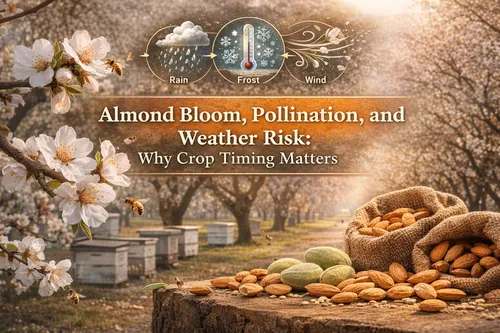
Almonds are a global ingredient, but their success begins in a short, high-risk window: bloom and pollination. A few weeks of spring weather can influence kernel set, size distribution, defect rates, and even downstream storage performance. For buyers, you don’t need to be an agronomist—but understanding the basics of crop timing helps you interpret offers, plan inventory buffers, and ask better questions when a crop year is “tight.”
Buyer promise: this is a field-to-warehouse translation guide. We focus on what bloom and weather mean for availability, specs, COA review, lot qualification, storage behavior, and delivery lanes—without getting lost in orchard jargon.
Previous: California Almond Varieties Buyers Should Know: Nonpareil and Beyond • Next: Orchard Irrigation and Water Stress in Almonds: Quality and Yield Impacts
Related: bulk almond products • products catalog • request a quote
On this page
- Why crop timing matters to buyers
- Buyer-friendly almond calendar
- Bloom basics
- Dormancy & bloom uniformity
- Pollination mechanics
- Weather risk during bloom
- After bloom: sizing, defects, variability
- Field-to-warehouse flow
- QA checkpoints that map to specs
- Storage, oxidation, logistics
- How buyers use bloom signals
- Symptoms → likely cause → buyer action
- Quote-ready checklist
- FAQ
- Next step
Why crop and harvest details matter to buyers
In procurement, “crop conditions” can sound like market noise—until it shows up on your receiving dock as higher moisture, more foreign material, variable sizing, or a new pattern of defects that complicates your finished product. Almonds are highly standardized compared to many agricultural products, but they are not immune to year-to-year variability.
Bloom timing and spring weather risk matter because they influence the earliest “quality foundation” of a crop: how many flowers convert to nuts, how uniformly they develop, and how well they tolerate later season stress. That foundation then flows into the practical buyer outcomes you care about:
- Availability and lead times: tighter sets can reduce supply and push programs to allocate.
- Size and grade mix: kernel sizing affects yield in slicing/dicing, coating, and retail-grade programs.
- Defect rates: defect and discoloration patterns can shift by year and location and change your sorting sensitivity.
- Moisture and storage behavior: weather and handling affect stability, oxidation risk, and shelf-life confidence.
- Documentation and QA workload: higher-risk years often require tighter COA review and receiving inspection discipline.
What changes for buyers when a crop year is “tight”
In a normal year, purchasing tends to feel routine: stable lead times, familiar grade mix, and predictable costs for special specs. In a tight year, the same specs can suddenly behave like “premium constraints” (limited availability, longer lead times, stricter allocation). This is why timing knowledge matters: it helps you decide when to lock coverage, when to add buffers, and which specs need backup options.
Practical takeaway: crop timing is not just a “farmer story.” It’s an upstream driver of your downstream costs— rework, additional sorting, higher QA sampling, and inventory buffers.
The almond calendar: a buyer-friendly timeline
Almond production can be summarized in a few major phases. The exact dates shift by region and year, but the sequence is consistent. Understanding the sequence helps you map procurement decisions to real-world constraints: what can be changed quickly (sorting intensity, packaging lane) versus what cannot (bloom weather, orchard set).
Field-to-warehouse flow (high level)
- Dormancy & chill accumulation: trees prepare for bloom; insufficient chill can reduce uniformity.
- Bloom & pollination: short window; weather-sensitive; drives nut set and uniformity.
- Nut development: spring through summer; water, heat, and pest pressure influence sizing and defects.
- Hull split & harvest: maturity and drying conditions matter; rain at the wrong time increases risk.
- Drying: moisture management is essential; impacts storage and microbial risk posture.
- Hulling/shelling & sorting: removes hull/shell and separates by grade; program-dependent.
- Warehousing & shipment: packaging and storage environment protect quality through the supply lane.
Where buyers feel the timing impact
- Contracting and allocation: early season signals influence forward coverage decisions.
- New crop transitions: production lines may notice sensory or behavior shifts when the crop year changes.
- Export lanes: transit time increases the value of good moisture and oxidation control.
- Program continuity: certain sizes/grades and specialty formats become harder to source if grade mix shifts.
Simple buyer model: bloom affects quantity + uniformity, summer affects sizing + defects, and harvest/drying/storage affect moisture + shelf-life posture.
Bloom basics: what’s happening in the orchard
Almond bloom is a brief flowering period when trees open blossoms that must be pollinated to set nuts. Many commercial almond plantings rely on cross-pollination between compatible varieties (often arranged in orchard patterns). Even when self-fertile plantings exist in the market, bee activity and weather still influence set and uniformity.
Why bloom timing varies
- Variety: different cultivars bloom earlier or later and have different overlap windows.
- Winter conditions: dormancy and chill influence bloom timing and bloom uniformity.
- Regional microclimate: orchard location affects temperature patterns, fog, wind exposure, and frost risk.
- Orchard vigor: tree health and stress can shift how bloom expresses and how uniformly flowers open.
Uniform bloom = easier downstream management
When bloom is relatively uniform, nut development tends to be more uniform too—leading to cleaner harvest decisions, more consistent kernel sizing, and fewer “mixed maturity” issues. When bloom is uneven, the crop can be more variable through maturity, which can show up as a wider range of kernel sizes and potentially more sorting sensitivity.
Buyer translation: “set” and “uniformity” become grade mix
Buyers rarely purchase “set,” but they purchase what set creates: a stable grade mix, predictable sizing, and consistent yields in downstream processing. If a year produces more variability, the market can feel it as (1) more price dispersion between sizes and grades, and (2) more emphasis on “program definitions” (what is included in a given spec, what is excluded, and what the tolerance is).
Dormancy, “chill,” and bloom uniformity: the quiet setup before pollination
Bloom doesn’t start in spring—it is influenced by what happens during winter dormancy. Orchard teams often talk about “chill” because winter conditions affect how evenly trees transition out of dormancy and how synchronized bloom becomes. From a buyer’s viewpoint, you don’t need to quantify chill; you need to understand the consequence: less uniform bloom can lead to less uniform development, which can widen size distribution and complicate harvest timing.
What “uniformity” looks like
- More blossoms open in the same window.
- More nuts develop on a similar timeline.
- Harvest decisions are cleaner (less mixed maturity).
- Downstream sizing is often more consistent.
What “non-uniformity” can create
- Longer bloom spread (harder to capture best pollination days).
- More variation at hull split and harvest timing.
- Wider size distribution (more sorting sensitivity).
- More QA variability at crop transition.
Buyer takeaway: when you hear “bloom was stretched out” or “bloom was uneven,” translate it to potentially wider sizing range and more lot-to-lot variability—not automatically “bad,” but worth planning around.
Pollination mechanics: the role of bees and orchard design
Pollination is the transfer of pollen from one flower to another compatible flower, enabling fertilization and nut set. In almonds, bees are a major pollination engine. From a buyer perspective, the details you need to remember are simple: pollination requires bee activity, and bee activity depends on weather and orchard conditions.
Pollination is logistics + biology
In the field, pollination success is influenced by multiple “stacked” factors: the overlap of compatible bloom, the presence and strength of pollinators, and a weather window that allows movement. When any of those pieces are constrained, the effective pollination window shrinks—and that can show up as reduced yield or less uniform development.
What can limit effective pollination
- Rain: reduces flight activity and can wash pollen; prolonged rain can shrink the effective pollination window.
- Cold snaps: cool temperatures can slow bee activity and reduce pollination success during the bloom window.
- Wind: high wind limits flight and may reduce orchard coverage.
- Short bloom overlap: if compatible varieties don’t overlap well, set can be reduced.
- Orchard layout limitations: if pollinizers are not positioned effectively, coverage can be uneven.
Why pollination risk matters to procurement
Poor pollination typically shows up as reduced yields and changes to size distribution. For buyers, that can mean tighter availability, more aggressive allocation, and wider price dispersion between “standard” and “hard-to-find” specifications (certain sizes, certain grades, or certain processing styles).
Buyer lens: you don’t need to audit pollination. You need to recognize that bloom weather can shift the market from “abundant” to “tight,” which changes the value of forward coverage and multi-lane sourcing.
Practical buyer note: “set” affects more than total pounds
When supply tightens, it’s not only total volume that changes—availability of specific specs can change first. Programs that are normally easy (common sizes/grades) may stay available, while more constrained specs can become sporadic. This is where buyers benefit from having “acceptable alternates” pre-approved (size tolerance, grade tolerance, or format flexibility).
Weather risk during bloom: the events that move the crop
Weather risk is not one thing. Different events have different consequences, and they hit at different moments. The bloom window is particularly sensitive because the crop has not yet “locked in” its yield potential. Think of bloom as a short window where the orchard needs “enough good days” to convert blossoms into a stable set.
Rain during bloom
Rain can reduce pollination efficiency by limiting bee flight and by interfering with pollen transfer. Even short periods of rain can compress the “effective” pollination days. Prolonged rain increases the chance that some portion of bloom simply misses the best pollination conditions.
Frost and cold events
Cold conditions can reduce successful set depending on timing and bloom stage. Even without obvious visible damage, cold weather can slow processes that support fertilization and early development. Frost risk is highly timing-dependent: the same temperature can have different effects depending on bloom stage and duration of exposure.
Wind events
High winds can reduce bee activity and coverage. Wind can also contribute to variability across blocks—some blocks may set better than others depending on shelter, orchard layout, and timing of wind relative to peak bloom.
Warm spells followed by disruption
Sudden warm periods can accelerate bloom, shortening overlap between varieties. If warm conditions are followed by rain or cold, the crop may experience “fast bloom, bad pollination days,” which can reduce set even when bloom looks visually impressive.
Buyer translation: “bloom looked great” doesn’t always mean “set will be great”
Buyers sometimes hear optimistic early visuals (lots of blossoms) and assume supply is guaranteed. The more practical question is: how many effective pollination days occurred during peak bloom? If the weather window is constrained, the orchard can bloom heavily but still set less uniformly.
After bloom: how early-season conditions shape quality and defects
Bloom and pollination set the stage, but quality outcomes continue to be influenced by conditions through spring and summer. For buyers, it helps to understand which downstream quality drivers are linked to early timing and weather patterns. This is where crop timing becomes “how the rest of the season behaves” rather than a single bloom event.
Kernel development and sizing
Uniform set and stable growing conditions generally support more consistent sizing. Stress during nut development can widen the size distribution, which affects programs that require specific sizing for slicing, roasting uniformity, or controlled inclusion behavior. Wider size distribution can also shift grade mix and change the economics of downstream processing.
Defects and variability (risk framing for buyers)
Weather patterns influence orchard pressure and variability. From a procurement standpoint, the key is not to memorize every agricultural risk, but to recognize that “high-variability years” can increase QA workload and tighten tolerance. In those years, buyers may see more emphasis on sorting, defect limits, and documentation transparency.
Moisture dynamics and harvest readiness
Crop timing influences when hull split occurs and when harvest is optimal. If harvest timing is disrupted by weather, the crop can face higher moisture and quality risk. This is where orchard-to-warehouse discipline matters: drying, handling, and storage can mitigate or amplify risks that began earlier in the season.
The buyer’s most useful mental model: early timing influences uniformity, and uniformity influences how predictable your lots feel at receipt (size/grade consistency, sorting sensitivity, and COA variability).
Key steps in the field-to-warehouse flow (expanded)
Buyers often see almonds as “a standardized ingredient,” but the path from orchard to warehouse includes multiple steps where quality and risk posture are managed. Understanding the steps helps you align your spec sheet to reality, especially when your application is sensitive (premium roasted, snack-grade, export shelf-life, or milled formats).
1) Harvest operations
- Timing: harvest timing affects moisture and the likelihood of quality issues.
- Weather exposure: rain during harvest increases risk; clean handling becomes more important.
- Segregation: lots may be separated by orchard block or timing to preserve quality consistency.
2) Drying and moisture management
Moisture is one of the most important “quiet” variables for shelf-life confidence. Too much moisture increases clumping risk, can elevate the risk of quality degradation, and may complicate export lanes with long transit time. Even when a COA reports moisture within target, storage and handling discipline remain important to prevent re-absorption.
3) Hulling/shelling and sorting
Hulling and shelling remove the outer material and separate kernels. Sorting then removes foreign material and separates by grade, color, and defect profile. For many buyers, this is where “crop variability” is either corrected (through sorting intensity) or becomes visible (if the crop is unusually variable).
4) Warehousing, packaging, and shipment
After processing, storage conditions influence oxidation and sensory stability. Packaging choices and warehouse discipline become increasingly important for export lanes and long shelf-life products. Buyers should align their purchasing strategy with their true shelf-life sensitivity: some applications tolerate normal variability; others are extremely sensitive to staling notes.
5) New crop transitions and lot management (where continuity is protected)
“New crop” is not a single day—it's a transition where processors shift into new-season inventory and buyers begin receiving it. For some SKUs, the transition is smooth. For sensitive SKUs (premium roasted, mild-flavor lines, high-visibility snacks), many buyers prefer to qualify the new crop before switching production.
How procurement teams manage crop transition risk
- Pre-qualify new crop: run a small receiving + sensory check before full changeover.
- Define “no transition during launch” windows: avoid changing crop year mid-launch for premium products.
- Control lot switching: align production runs to lot boundaries when possible (reduces mixed-lot variability).
- Document “as received” performance: odor, color, and process behavior in your plant become your baseline.
Quality checkpoints that connect directly to procurement specs
“Crop risk” becomes procurement reality through measurable checkpoints. These are the areas where your QA team and supplier program should be aligned—especially if you run high-volume or sensitive applications (snacks, bakery inclusions, milled products, or premium roasted).
- Moisture target: impacts shelf-life, flowability, and storage behavior.
- Defect limits: insect damage, discoloration, doubles, chips, and other defects (as applicable to your program).
- Foreign material controls: critical for manufacturing lines and compliance.
- Size/grade targets: important for roasting uniformity, slicing yield, and inclusion performance.
- Micro requirements: align to your category and risk posture (RTE, further processing, etc.).
- Sensory expectations: “fresh” profile, absence of rancid notes; critical for premium applications.
- Documentation: COA, traceability, allergen statements, country of origin, and certifications if required.
Why COA alignment matters more in variable years
In stable years, buyers may treat COAs as a routine check. In variable years, COAs become the front line for early detection. The goal is not “more paperwork”—it’s catching drift early so you can (1) separate lots, (2) direct them to appropriate SKUs, and (3) avoid full-line disruptions.
If a crop year is described as “weather-challenged,” the practical response is not panic—it’s tighter specs, clearer COA expectations, and earlier lot qualification.
Receiving discipline that prevents downstream surprises
A simple receiving discipline often catches issues before they become production problems: check COA alignment, inspect packaging integrity, confirm odor/visual expectations, and store product under conditions aligned with your inventory timeline. If you run export lanes or long-hold inventory, storage discipline becomes even more valuable than price savings.
Storage, oxidation, and logistics: where shelf-life is won or lost
Even when almonds are harvested and processed well, storage and logistics determine whether the ingredient arrives “fresh” and stays stable in your system. Almonds are sensitive to oxidation, and oxidation risk increases with heat exposure, oxygen exposure, and long transit times. Buyers often experience oxidation risk as “flavor drift,” “stale notes,” or reduced premium perception.
Why timing connects to storage risk
Crop timing influences when product enters warehouses and how long it may be carried before it reaches your plant. For some buyers, “carry-in inventory” is a tool for continuity. For others, it is a risk if the product is stored in less-than-ideal conditions. Align your buying strategy with your shelf-life sensitivity and your real distribution environment.
Packaging and handling expectations
- Lined cartons/bags: common for kernels and cuts; help protect from humidity and contamination.
- Bulk programs: pallet configuration and receiving constraints matter—share them early to avoid delays.
- Export lanes: longer transit makes moisture and oxidation controls more important; plan buffers accordingly.
Practical receiving discipline
On the buyer side, the most effective shelf-life risk reduction is consistent receiving discipline: verify COA alignment, inspect for odor/visual issues, and maintain storage conditions that match your inventory timeline. When issues occur in the market, buyers often discover the root cause is not “the orchard” but heat exposure during storage or transit.
Export lane checklist (quick)
- Confirm packaging barrier expectations for humidity and oxygen exposure.
- Define ship window and arrival window so inventory age remains within your comfort range.
- Align documentation (COA, traceability, origin, certifications) to the destination requirement set.
- Plan a buffer for port congestion or schedule variability if timing is critical.
How to use bloom and weather knowledge in buying decisions
Buyers don’t control orchard weather—but you can control how you plan around it. Crop timing knowledge becomes useful when it informs your contracting strategy, qualification plan, and risk buffers. The goal is not to “predict the crop perfectly”; it’s to make fewer surprise decisions under time pressure.
When to lean on forward coverage vs spot buying
- Forward coverage fits: high-volume core SKUs, strict specs, and applications where substitution is expensive.
- Spot flexibility fits: non-critical inclusions, secondary SKUs, or programs where multiple grades/formats can work.
How to reduce “surprise” risk in variable years
- Qualify two supply lanes: even if one is a backup, it reduces single-point failure.
- Lock spec clarity early: define moisture, defect limits, sizing expectations, and documentation requirements.
- Ask about lot strategy: how are lots segregated (by block, timing, grade), and how consistent is the program?
- Run incoming validation: especially at crop transitions or when the market signals higher variability.
Signals buyers watch (practical, non-technical)
You don’t need daily orchard data. Most buyers simply track high-level bloom conditions and early crop signals so they can decide whether to increase buffers or lock coverage earlier. Examples of “useful signals” include:
- Bloom weather summary: were there enough good flight days, or was bloom interrupted?
- Set commentary: is set reported as uniform or variable across regions?
- Early supply tone: are processors talking about allocation, longer lead times, or tighter special specs?
- New crop transition expectations: when will new crop likely begin flowing through your lanes?
Buyer questions that get practical answers
- What are the moisture targets and how are they verified before shipment?
- What defect and foreign material controls are standard in this program?
- How is the product stored prior to shipment, and what is the typical “age” at delivery?
- For export lanes, what packaging and documentation are standard, and what lead times are realistic?
- If this is a transition period, can you identify the crop year on paperwork and keep lots segregated?
Symptoms → likely cause → buyer action (fast troubleshooting matrix)
When crop timing or weather increases variability, buyer teams often experience the issue as an “operational symptom” rather than an agricultural story. Use the matrix below to translate what you see into a practical procurement or QA action.
| What you see | What it often means | What buyers do first |
|---|---|---|
| Wider sizing range | More variability from set/uniformity or season conditions | Tighten size tolerance language; qualify alternates; request consistent lot strategy |
| More sorting sensitivity | Crop variability requiring more intensive sorting to hit premium specs | Confirm defect limits and how they’re controlled; plan lead time accordingly |
| Moisture closer to limit | Harvest/drying challenges or storage/transit exposure | Verify packaging integrity; confirm storage conditions; add receiving checks for clumping/odor |
| Flavor freshness drift | Oxidation risk from time/heat/oxygen exposure | Review storage + transit heat exposure; align packaging barrier expectations; tighten “age at delivery” preference |
| More COA variability | Higher-lot variability or multiple supply lanes feeding one program | Request clearer program definition; consider a tighter spec lane for sensitive SKUs |
The best buyer move in variable years is not overreacting—it’s tightening clarity: define what “good” is (moisture, size, defects, documentation), then align the lane and the lot strategy to that definition.
Specs checklist (quote-ready) for crop-year and timing-sensitive programs
If crop timing matters for your SKU, include these details in your inquiry so suppliers can align the right program quickly.
- Product + format: kernels, pieces, meal/flour, butter, oil (as applicable)
- Grade/size targets: include tolerance and any “no substitute” requirements
- Moisture target: plus clumping/flowability expectations if using milled formats
- Defect/color limits: aligned to your finished product needs
- Micro requirements: and any category-driven expectations
- Packaging: bags/cartons/pails/totes + pallet constraints
- Volume: first order + forecast + delivery cadence
- Destination: city/state/country + required delivery window
- Documentation: COA, traceability, certifications if required
- Timing sensitivity: note if you need “new crop” windows or want to avoid crop transitions during launch
If your product is sensitive (premium snack, roasted line, export shelf-life), add one sentence: “Critical-to-quality = moisture + defect limits + sensory freshness at receipt.” That single line helps align the right supplier program faster.
Copy/paste RFQ template (fast)
“We need [product/format] for [application]. Specs: [size/grade + tolerance], moisture target [x], defect limits [x], micro requirements [x]. Timing sensitivity: [new crop window / avoid transitions / export shelf-life]. Packaging: [bags/cartons/etc.] with pallet constraints [x]. Volume: [first order + forecast] shipping to [destination] on [cadence]. Please include COA and traceability; certifications required: [list].”
FAQ: bloom, pollination, and crop timing for almond buyers
Do buyers need to track bloom conditions every week?
Not usually. Most buyers benefit from a simple “high-level awareness” approach: note whether bloom was disrupted (rain/cold/wind) and whether the season is being described as uniform or variable. That is often enough to decide whether to add buffers, lock coverage earlier, or qualify alternates.
If bloom is weather-challenged, does that automatically mean poor quality?
Not automatically. Bloom challenges can reduce yield or increase variability, but processing and sorting can still produce excellent lots. The buyer adjustment is typically about risk posture: clearer specs, tighter documentation alignment, and earlier lot qualification for sensitive SKUs.
What does “new crop” mean operationally?
“New crop” means the market has begun transitioning into the latest season’s production. Operationally, it can be a period where different lots and programs shift. If your product is sensitive, you may prefer to qualify new crop lots before switching full production, and avoid switching mid-launch.
Which specs are most likely to tighten when supply is constrained?
Typically, the most constrained specs are those that require tighter sorting or narrower grade/size definitions. This is why buyers often benefit from identifying “acceptable alternates” early (tolerance ranges, acceptable grade substitutions, or alternate formats).
What’s the single best question to ask a supplier in a variable year?
Ask how the program controls the checkpoints that matter to you: moisture, defects/foreign material (as applicable), size/grade consistency, storage posture, and documentation consistency. The strongest supplier programs can explain how lots are managed and what the realistic lead times are for your spec lane.
Next step
If you share your application, format, and delivery lane, we can recommend practical spec targets and documentation checkpoints to match your risk posture—especially in timing-sensitive crop years. Use Request a Quote or email info@almondsandwalnuts.com.
If your product is sensitive to variability, include one extra detail in your message: “We prefer [single-lot continuity / defined lot switching / pre-qualification at crop transition].” That helps align the right sourcing lane and reduces surprises.