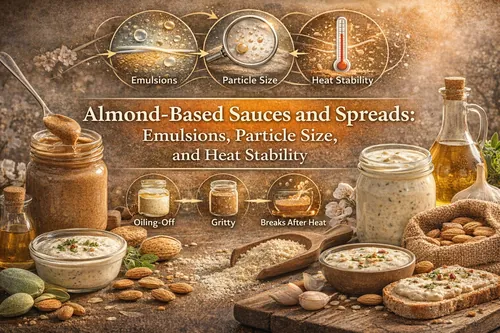
Almond-Based Sauces and Spreads: Emulsions, Particle Size, and Heat Stability
Almond-based sauces and spreads sit at an interesting intersection of emulsion science and ingredient realism. Unlike many oil-in-water sauces built primarily from refined oils and standardized emulsifiers, almond systems bring their own natural fat, proteins, fine solids, and flavor compounds. That’s an advantage for label and taste—but it also introduces variables: particle size distribution, oil separation tendency, and heat stability under pasteurization, hot fill, retort-adjacent processes, or cooking at the consumer level.
This guide explains how buyers and product developers can choose the right almond formats (butter/paste, meal/flour, oil), set quote-ready specifications, and align processing steps to achieve stable texture, consistent mouthfeel, and predictable shelf-life.
If your #1 pain is oiling-off, you’re dealing with structure and droplet/particle movement. If your #1 pain is graininess, you’re dealing with particle size distribution, hydration, and process sequencing. If your #1 pain is breakage after heat, you’re dealing with thermal robustness and how the system rebuilds on cool-down.
Previous: Using Almond Pieces in Bakery Fillings: Migration Control and Texture • Next: Almond Ingredients for Beverage Systems: Suspension, Mouthfeel, and Flavor Balance
Related: bulk almond products • products catalog • request a quote
On this page
- Where almond sauces & spreads fit
- Choose the right almond format
- Emulsions 101 for almond systems
- Particle size distribution & mouthfeel
- Oil separation: why it happens
- Heat stability: what breaks and why
- Formulation levers teams use
- Processing checkpoints
- Shelf-life & oxidation control
- Packaging & handling
- Specs buyers should confirm
- Troubleshooting matrix
- Quote-ready checklist
- FAQ
- Next step
Where almond sauces and spreads fit in production
In manufacturing, almond-based systems typically appear in three broad categories: (1) spoonable spreads (sweet or savory), (2) pourable sauces and dressings, and (3) concentrated bases that are later diluted, flavored, or finished in a downstream plant.
Common industrial use cases
- Sweet spreads: cocoa-almond, honey-almond, bakery-style fillings, swirl bases, wafer fillings, cookie centers.
- Savory spreads/dips: almond “hummus-style” dips, herb blends, pepper sauces, sandwich spreads, dairy-alternative dips.
- Dressings and sauces: creamy vinaigrettes, satay-inspired sauces, dairy-alternative cream sauces, simmer sauces.
- Ingredient bases: almond-fat + solids used to build mouthfeel in plant-based systems and ready-to-heat sauces.
Your target application matters because it defines the failure modes you must prevent: oiling-off in a jar, graininess in a chilled sauce, phase separation under heat, or viscosity drift during distribution. Choosing the right almond input format—and specifying it clearly—reduces reformulation and QC headaches.
Define “success” before you buy ingredients
Almond sauces and spreads are evaluated by what consumers can see and feel: does the product pour or hold as expected, is the surface clean and glossy, is there visible oil pooling, does it feel smooth, and does it remain consistent after opening and refrigeration? For industrial buyers, it helps to convert those sensory goals into measurable targets: viscosity range (at a defined temperature), separation tolerance (none / minor acceptable), and texture acceptance (“no grit,” “spoonable,” “pumpable through X-inch line”).
Practical framing: the “best” almond format is the one that achieves your texture and stability targets with the fewest processing steps and the most predictable supply lane.
Choose the right almond format: butter/paste vs meal/flour vs oil
Almond sauces and spreads are typically built with one or more of the following ingredient formats. Each format changes the structure of the system—especially emulsion behavior, perceived smoothness, and stability in heat and storage. Selecting the wrong format is one of the most common reasons teams “chase stability” with additives when the real fix is ingredient fit.
Almond butter / almond paste (roast-and-grind)
Almond butter is the workhorse format for spreads and creamy sauces. It carries natural fat, proteins, and fine almond solids. In a well-processed butter, the particles are small enough to feel smooth, while still contributing viscosity and body.
- Strengths: strong almond identity, rich mouthfeel, body and yield stress, label-friendly “real ingredient.”
- Watch-outs: oil separation if structure is weak, oxidation sensitivity, roast variability, handling temp impacts pumpability.
- Best for: spoonable spreads, thick dips, creamy bases, emulsified savory sauces.
Almond meal / almond flour (milled solids)
Meal and flour contribute solids, thickening, and “real ingredient” label benefits. They can introduce graininess if the particle distribution is too coarse or hydration is incomplete. In emulsified sauces, milled solids can support stability by increasing viscosity and reducing droplet movement—if your process hydrates them consistently.
- Strengths: boosts solids and body, supports viscosity, cost efficiency in some systems, label-friendly.
- Watch-outs: hydration drift (thickening over time), particle perception, settling in thin systems, moisture/micro sensitivity.
- Best for: thicker sauces, dips, spread structure, “whole-food” style formulations, baked/filling bases.
Almond oil (edible oil program)
Almond oil is primarily a fat-phase tool. It can increase richness and lubricity and help manage texture in spreads where almond butter alone is too thick. But adding oil without balancing solids/emulsification can increase oiling-off risk.
- Strengths: smooth mouthfeel tuning, consistent dosing, helps adjust firmness and spreadability.
- Watch-outs: can destabilize if structure is weak; oxidation control remains critical; label and cost impact.
- Best for: viscosity adjustment, premium mouthfeel, oil-phase balancing in emulsified sauces.
Blended approach (common in industrial reality)
Many successful products use a combination: butter/paste for flavor + body, flour/meal for structure, and oil for fine texture tuning. The key is to define what each input is doing in the system so you can debug problems quickly.
- Strengths: better control over viscosity, flavor, and stability.
- Watch-outs: more variables; requires tighter specs and processing discipline.
- Best for: scaled production where you need reproducibility across lots and plants.
Shortcut decision rule: if you need creaminess + almond identity, start with butter/paste. If you need structure + viscosity, use meal/flour (with hydration control). If you need texture tuning, use oil (but only after structure is stable).
Emulsions 101 for almond systems: what you’re actually stabilizing
Many almond sauces and spreads behave like emulsions—even if they are not “classic” mayonnaise-style systems. In practice, you are often trying to keep oil and water phases from separating while controlling texture and sensory perception. Almond ingredients complicate emulsions because they bring their own natural fat and solids, but that complexity can also help build stability.
Common structure types
- Oil-in-water sauces: water phase continuous, oil dispersed as droplets (dressings, pourable sauces, some dips).
- Water-in-oil style spreads: oil phase more dominant, water dispersed (some rich spreads and fillings).
- Suspension-style spreads: oil + solids network with limited free water (nut butter-like products).
The three things you stabilize in practice
- Droplet size: smaller droplets generally separate more slowly.
- Droplet interactions: avoid flocculation/coalescence that leads to oiling-off.
- Continuous-phase structure: viscosity and yield stress reduce movement of droplets and particles.
Why almond ingredients can help emulsions
Almond butter contains proteins and fine solids that contribute viscosity and can support surface activity. That means almond systems sometimes need less “classic emulsifier” than refined-oil systems—if the structure is built correctly. The risk is variability: if one lot has a wider particle distribution or different fat/solids ratio, the emulsion behavior can shift.
Stability is not one knob. It’s the interaction of droplet size, viscosity, emulsification aids, and how your solids network behaves over temperature and time.
Oil separation and “oiling-off”: why it happens in almond spreads
Oil separation is the #1 visual defect in many almond spreads and thick sauces. It can show up as a surface oil layer, a glossy ring near the jar wall, or a “wet” surface that looks broken. Importantly, oil separation is not always a sign of “bad almonds.” It’s usually a sign that the product’s internal structure is not strong enough to hold the oil phase in place over time and temperature change.
Four common reasons oil separates
- Weak solids network: not enough fine solids or the wrong balance of solids to oil phase.
- Large droplet domains: insufficient shear/homogenization in oil-in-water systems; partial emulsions that never fully form.
- Particle distribution tail: coarse particles disrupt structure and create channels for oil migration.
- Thermal cycling: product warms in transit, viscosity drops, oil moves; then cools and “locks” separation in place.
How buyers reduce oil separation risk
- Specify texture outcome: “no visible separation line,” “minimal oiling acceptable,” or “stir-required acceptable.”
- Align handling temperature: define receiving/storage conditions; avoid repeated warming/cooling.
- Ask about lot consistency: especially for butter/paste programs; confirm solids/fat expectations and texture targets.
- Validate with your process: pilot your heat exposure and storage profile (day 0, week 2, week 6 photos help).
If you see oiling-off, start by asking: is this a structure problem (solids + viscosity) or an emulsion build problem (droplet size + shear)? Many systems need both tightened.
Particle size distribution: the hidden driver of mouthfeel, viscosity, and “graininess”
In almond-based sauces and spreads, particle size distribution (PSD) influences both sensory and stability. Coarse particles create gritty perception and can accelerate separation by disrupting the structure of the system. Fine particles improve smoothness and can increase viscosity—yet extremely fine milling can increase surface area, which may affect oxidation sensitivity and processing heat generation.
What PSD affects in production
- Mouthfeel: smoothness vs gritty perception, especially in chilled or low-sugar systems.
- Viscosity and yield stress: whether it “holds” on a spoon and resists phase movement.
- Stability: fine particles can help create a stable network; coarse particles can settle or cause separation lines.
- Shear sensitivity: particle networks can break down under high shear, changing viscosity over time.
How to talk about PSD without over-engineering your RFQ
Many buyers don’t want to specify microns in a contract. That’s fine. You can still protect yourself by specifying performance outcomes and the acceptance tests that matter to you: “no grit,” “smooth mouthfeel,” “stable after hot fill,” “no visible separation line,” and “viscosity within X range at Y temperature.” If you are scaling a sensitive system, ask suppliers what grind profile is typical for “smooth spread” versus “pumpable sauce” programs.
Quick PSD acceptance ideas (buyer-friendly)
- Bench sensory check: rub test on palate for “grit” (simple but surprisingly effective).
- Visual stability: look for separation line or ring after controlled storage.
- Process behavior: confirm line pumpability and fill consistency (real-world pass/fail).
- Lot photos: standardize “day 0 / week 2 / week 6” documentation for comparison.
Heat stability: what breaks during pasteurization, hot fill, or cooking
Heat stability is one of the top failure points for almond-based sauces and spreads. Thermal steps can shift viscosity, change emulsion structure, and accelerate oxidation if the system is poorly protected. The tricky part is that products can look fine hot, but fail after cooling and a short hold—so “post-process stability” matters most.
Common heat-related failure modes
- Phase separation: oiling-off or water separation after heating and cooling cycles.
- Viscosity drift: thickening or thinning after thermal exposure (and after 24–72 hours).
- Graininess increase: incomplete hydration becomes more noticeable after heat/cool cycles.
- Flavor shift: amplified roast notes, “cooked” flavors, or early oxidation perception.
Why heat changes structure
Heating can reduce viscosity (temporarily) and allow droplets or particles to move more freely—then, during cooling, networks may rebuild differently than before. If your system relies on a delicate balance of solids and emulsification, thermal steps are where you find out if your structure is robust or fragile.
Processing choices that usually improve thermal robustness
- Control droplet size: consistent high-shear mixing or homogenization (process-dependent).
- Build viscosity in the continuous phase: structure reduces droplet movement and separation risk.
- Hydrate milled solids fully: avoid late-stage thickening or graininess after cooling.
- Sequence ingredients intentionally: add oils/emulsifiers at the right stage to avoid “partial emulsions.”
- Minimize air entrainment: oxygen pickup during hot processing can accelerate flavor drift.
Heat stability is best validated as a system: run your thermal step, cool, then evaluate at 24–72 hours and again after short storage. Many failures appear only after the structure rebuilds.
Formulation levers buyers and developers actually use
Most industrial teams don’t want a lab lecture—they want levers they can pull. Here are practical “knobs” that influence stability and mouthfeel in almond sauces and spreads.
1) Oil phase and solids balance
Almond butter brings both fat and solids. If a product oils off, the fix is not always “add an emulsifier.” Often the system needs better structure: higher continuous-phase viscosity, better particle distribution, or tighter control of the oil-to-solids ratio. In spreads, increasing solids structure can reduce oil migration; in sauces, improving emulsion build can reduce droplet coalescence.
2) Hydration strategy (especially with meal/flour)
Meal/flour can thicken over time. If you don’t hydrate fully, you may see viscosity drift after packing—or gritty texture that appears after a day. Many plants solve this with controlled hydration time, temperature management, and consistent shear. Buyer translation: if your plant can’t hold hydration time, don’t rely on ingredients that require it without acknowledging that risk.
3) Shear and homogenization
Better emulsions are usually built, not wished into existence. Shear reduces droplet size and improves stability. But excessive shear can generate heat and change the structure of thick spreads. The goal is reproducible droplet/particle structure, not maximum shear at any cost. If you have both batch and in-line options, validate the one you’ll actually use at scale.
4) Flavor balance and roast profile
Roast level changes flavor intensity and perception of bitterness/sweetness. In savory sauces, roast can read “toasty” or “bitter” depending on salt, acid, and spice. In sweet spreads, roast can amplify cocoa notes or create an over-roasted finish. When sourcing, specify whether you want a “light/clean” or “deep/roasted” profile.
5) Acid, salt, and spice: the hidden emulsion disruptors
Many sauces include acid (vinegar, citrus), salt, and spice particulates. These can change viscosity and droplet interactions. Acid can alter protein behavior, salt can shift hydration, and spice particles can act like “structure disruptors” if the system is weak. If you are scaling a spicy or acidic almond sauce, validate stability with the full formula—not a simplified base.
Processing checkpoints: mixing sequence, shear, and “hold time discipline”
Ingredient selection is only half the story. Almond systems are highly process-dependent. Two plants can run the same formula and get different results due to shear profile, hydration time, thermal exposure, and oxygen pickup. The goal is a process that is repeatable and robust enough to handle normal ingredient variability.
1) Pre-blend and wet-out (powders and pastes)
Meal/flour should be added under controlled shear to avoid fisheyes and dry pockets. Many plants use a vortex addition strategy or an eductor. Almond butter/paste may need tempering for pumpability and consistent dispersion. Treat your pre-blend as a “mini system” with a pass/fail: smooth, no visible lumps, and consistent viscosity before moving forward.
2) Emulsion build (where separation is prevented)
For oil-in-water sauces, build the emulsion intentionally: get the continuous phase structured first (hydration and viscosity), then add oil phase under sufficient shear. For spreads with limited water, focus on solids network and particle distribution. If you rely on in-line shear/homogenization, keep the pass count consistent and document it as critical-to-quality.
3) Thermal step + cool-down (where failures reveal themselves)
Heat can temporarily “hide” instability by lowering viscosity. Cooling can reveal it. That’s why you should evaluate stability after cool-down and a short hold. If you hot fill, control headspace and minimize oxygen exposure to protect almond flavor.
4) Hold time before filling (often overlooked)
Long holds can allow separation and settling. If your process includes a hold tank, treat hold time as a controlled variable: define maximum hold time and agitation expectations. Many “mystery” separation problems are actually hold-time problems.
Simple internal SOP: photograph stability and record viscosity at day 0, then after 24–72 hours, then at week 2. It makes lot comparisons objective and speeds up troubleshooting.
Shelf-life, oxidation, and sensory stability
Almond products are sensitive to oxidation—especially in high-fat systems with oxygen exposure during mixing, filling, or storage. In sauces and spreads, oxidation doesn’t just taste “rancid.” It can show up first as muted flavor, cardboard notes, or harshness. Oxidation also changes the perceived “freshness” of almond flavor, which matters in premium applications.
What increases oxidation risk
- Heat exposure: repeated heating/cooling, hot fill without controls.
- Oxygen exposure: high headspace, aggressive mixing that entrains air, poor sealing.
- Long storage at warm temperatures: warehouses, export lanes, slow-moving inventory.
- High surface area systems: very fine particles and powders can be more sensitive if not protected.
Controls that usually cost less than reformulation
- Packaging barrier alignment: match packaging to shelf-life and distribution lane.
- Storage temperature discipline: avoid warm holds that accelerate staling.
- Oxygen management: minimize entrained air during mixing and control headspace where possible.
- Lot strategy: avoid mixing lots in one run for premium SKUs; keep continuity where it matters.
Buyer-side “freshness” acceptance (practical)
- Odor check at receipt: establish what “fresh almond” smells like for your SKU.
- Reference retain: keep a small retain from each lot for comparison across time.
- Document storage conditions: so complaints can be traced to temperature/handling, not guessed.
Packaging options for bulk programs (industrial reality)
Almond-based sauces and spreads may use almond butter, meal/flour, or oil as inputs—each with its own typical packaging. Packaging affects not just logistics but also oxidation exposure and handling efficiency in your plant.
- Almond butter / paste: pails, drums, or totes (program-dependent) with liner expectations.
- Meal/flour: lined bags/cartons; confirm sealing and moisture control expectations.
- Oil: drums or totes; confirm edible program specifications and intended end use.
For procurement, the most common avoidable issue is mismatch between packaging and receiving constraints: pumpability requirements, pallet configuration, unloading equipment, temperature limits, and re-pack steps. Share those details early to prevent delays and off-spec handling.
Packaging is quality protection. If your lane includes long transit or warm distribution, packaging choice becomes a shelf-life tool—not just a logistics detail.
Format and spec checkpoints buyers should confirm (expanded)
When you source almond ingredients for sauces and spreads, specs should reflect the realities of emulsion performance, mouthfeel, and heat stability. These checkpoints reduce back-and-forth and help suppliers match the right program.
Core spec checkpoints
- Product format: almond butter/paste, meal/flour, oil (and intended use in your system).
- Roast profile: light/medium/dark or sensory target (especially if almond flavor is a headline note).
- Texture/PSD target: “smooth,” “no grit,” “pumpable,” and any screen/mesh or performance acceptance.
- Oil separation expectation: none / minimal acceptable / stir-required acceptable (state it explicitly).
- Moisture target: especially important for milled products and long storage lanes.
- Fat content expectations: relevant for butter/paste programs that drive mouthfeel consistency.
- Micro requirements: align to your category and process (RTE vs further processing).
- Allergen handling expectations: cross-contact controls and labeling alignment.
- Documentation: COA, traceability, country of origin, certifications if required.
Optional but valuable (for sensitive SKUs)
- Sensory notes on COA or lot sheet: roast direction and “freshness” expectation.
- Lot strategy: how lots are segregated and whether blending occurs.
- Handling guidance: storage temperature range and mixing instructions for paste/butter.
If your product is heat processed (pasteurized, hot-filled, cooked), say so in the inquiry. Heat stability requirements change the best-fit almond program.
Troubleshooting matrix: defect → likely cause → what to change first
When a sauce or spread fails, teams often waste time changing the wrong variable. Use the matrix below as a fast triage tool: identify what the defect looks like, then decide whether the first change should be ingredient format/spec, processing sequence, or storage/packaging.
| Defect you see | Likely cause (common) | Best first move |
|---|---|---|
| Surface oil layer | Weak solids network; oil/solids imbalance; thermal cycling | Tighten format/spec (butter texture + solids); evaluate storage temp swings |
| Separation line (oil ring) | Partial emulsion build; insufficient shear; hold-time separation | Fix sequence + shear; reduce hold time; validate after cool-down |
| Grainy or gritty | Coarse PSD tail; incomplete hydration; spice particulates amplified | Tighten PSD/texture target; add hydration time/temperature control |
| Thickens after packing | Late hydration of meal/flour; stabilizer interaction; cooling rebuild | Hydrate earlier; standardize hold; measure viscosity at 24–72h |
| Flavor “stales” early | Oxidation from oxygen/heat/time exposure; warm distribution | Review packaging barrier + storage temps; reduce air entrainment; align inventory age |
The fastest troubleshooting habit: evaluate stability at day 0, then again at 24–72 hours. Many problems “appear later,” and that timing points directly to hydration/structure rebuild—not just ingredients.
Processing and scale-up considerations: what plants should align early
Many almond sauce/spread problems show up only at scale. Pilot batches can hide issues that appear with larger tanks, longer hold times, different shear profiles, and more oxygen exposure.
Scale-up variables that commonly change outcomes
- Shear profile: in-line vs batch shear changes droplet size and texture.
- Hold time: long holds can allow settling or separation before filling.
- Thermal steps: heating and cooling rates affect structure rebuilding.
- Air entrainment: oxygen pickup can accelerate oxidation and change texture perception.
If you’re launching a new SKU, plan a structured qualification: confirm ingredient specs, run a pilot that mimics your thermal and shear conditions, and then validate stability after 24–72 hours and through expected storage conditions.
How to request a quote with fewer back-and-forths (sauce/spread edition)
The fastest path to accurate sourcing is a quote-ready inquiry that reflects your real application constraints. Include the following in your message:
- End use: sauce, dip, dressing, spread (plus “pourable vs spoonable” target).
- Process: mixing style, homogenization (if any), pasteurization/hot fill/heat exposure.
- Almond format: butter/paste, meal/flour, oil—and which part of the formula it supports.
- Texture target: smooth/no grit, viscosity range, separation tolerance.
- Roast profile: sensory targets or preferred roast style.
- Packaging: pails/drums/totes/bags + receiving constraints + pallet requirements.
- Volume: first order + forecast + cadence.
- Destination: city/state/country + required delivery window.
- Documentation: COA, traceability, allergen statements, certifications if needed.
One sentence that helps suppliers match the right program quickly: “Critical-to-quality = smooth mouthfeel + stable after heat + no visible separation line during shelf-life.”
Copy/paste RFQ template (fast)
“We need [almond butter/paste and/or flour/meal and/or oil] for a [sauce/spread/dip/dressing]. Target texture: [pourable/spoonable], [smooth/no grit], viscosity [range] at [temp]. Process: [batch/in-line shear], [homogenization if any], heat step [pasteurized/hot fill/cooked] and hold time [x]. Stability target: [no oil layer / minimal oiling acceptable / no separation line] through [shelf-life]. Roast profile: [light/clean or deeper/roasted]. Packaging: [pails/drums/totes/bags] with pallet/receiving constraints [x]. Volume: [x] initial with forecast [x] shipping to [destination] on [cadence]. Documentation required: COA + traceability + allergen statement + [certifications].”
FAQ: almond sauces and spreads (buyer-focused)
Is oil separation always a quality defect?
Not always. Some “stir-required” spreads accept a small oil layer as normal. The key is to define expectations: if your brand requires “no oil layer,” you need a stronger structure and tighter processing control. If “stir-required” is acceptable, you can often simplify the system—but still need oxidation control.
Do meal/flour systems always feel chalky?
No—but they require hydration discipline and a PSD that matches your texture target. In many systems, meal/flour works best as a structure tool used alongside butter/paste rather than as the only almond input.
Why does a product fail after heat but look fine before?
Heat changes viscosity and droplet/particle movement, and then cooling rebuilds structure. Weak systems can break during that rebuild. Always evaluate after cool-down and a short hold (24–72 hours) to catch real stability performance.
What’s the best “single” spec checkpoint to reduce surprises?
For many buyers, it’s specifying texture outcome (smooth/no grit) plus separation tolerance (none/minimal/stir-acceptable), and tying that to your process (heat exposure and hold time). Those three details prevent the most common mismatches.
Next step
If you share your sauce or spread application, thermal process, and texture target, we can recommend the most practical almond format, typical spec targets, and packaging options for stable performance and predictable supply lanes. Use Request a Quote or email info@almondsandwalnuts.com.