
Allergen Controls for Bulk Almond Programs: Receiving, Storage, and Labeling
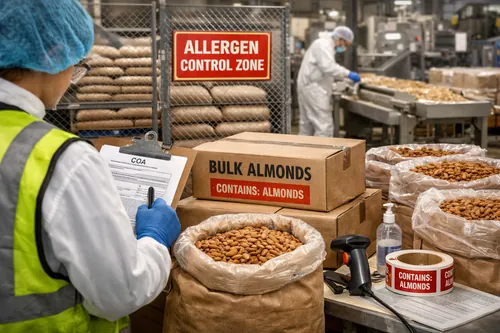
Almonds are a core ingredient across bakery, snacks, confectionery, cereals, dairy alternatives, and sauces—and they are also a tree nut allergen. For food manufacturers, the greatest risk usually isn’t whether almonds belong in an almond product. The real risk is unintended almond presence in a product that is not labeled for tree nuts, or incorrect labeling on a product that is.
This guide is designed for procurement, QA, and plant operations teams building or improving a bulk almond program. It focuses on practical controls that reduce cross-contact risk across receiving, warehouse storage, and labeling—the three places where expensive problems most often start.
Previous: Almond Meal for Meat Alternatives: Binding, Texture, and Label Considerations • Next: Specifying Moisture, Defects, and Color for Almond Kernels: Buyer Checklist
Related: bulk almond products • products catalog • request a quote
Why allergen controls matter in bulk almond programs
Almond allergen risk is often underestimated because almonds are “familiar” and widely used. In reality, tree nut allergens demand strong controls because cross-contact can occur through small and ordinary handling events: a spilled tote in the warehouse, a shared scoop at staging, dust from almond flour, or a partial bag that is re-closed without a clear label.
Common failure points to prevent
- Receiving gaps: missing lot identity, unclear allergen declaration, or packaging damage that leads to spills.
- Warehouse cross-contact: shared staging zones, open cartons, or partials stored without containment.
- Production changeovers: almond runs followed by non-almond runs without validated cleaning procedures.
- Labeling errors: wrong film/label version, outdated ingredient statement, or incorrect “Contains” declaration.
Practical definition: a strong allergen program prevents almonds from getting into the wrong product, and prevents the right product from shipping with the wrong label.
Supplier documentation buyers should request (to reduce risk and delays)
Before you evaluate receiving or storage controls, confirm you can consistently obtain the documentation your QA and customers require. The fastest bulk almond programs start with a clear “documentation packet” aligned to your spec sheet and intended application.
Common documentation for bulk almond ingredients
- COA (Certificate of Analysis): lot-specific results matched to your specifications (moisture, defects, microbiology when applicable).
- Allergen statement: confirms almond presence and identifies other allergens handled in the facility/program (where applicable).
- Traceability identifiers: lot codes, pack dates, country of origin, and internal references for rapid trace-back.
- Product spec sheet: format (kernels/slices/diced/meal/flour/butter/oil), grade/style, defect limits, and storage guidance.
- Program notes: processing steps relevant to your category (for example, roasting profile or pasteurization requirement if specified).
Questions that help procurement qualify the right program
- Is the product whole kernel, cut, sliced, meal, flour, paste/butter, or oil (each has different cross-contact behavior)?
- Is it raw or roasted, and is roasting managed in a dedicated line or shared environment?
- How are partials handled at the supplier level (reseal, relabel, liner controls)?
- What storage conditions are recommended to manage oxidation (shelf-life performance and sensory stability)?
Receiving controls: how to inspect bulk almonds at the dock
Receiving is the moment you can prevent a small issue from becoming a large one. A receiving SOP for bulk almonds typically includes both paperwork verification and physical inspection. The goal is to confirm identity, protect traceability, and prevent damaged product from entering general inventory.
Paperwork verification
- Lot code match: PO, packing list, pallet tags, case labels, and COA.
- Identity check: almond format and grade/style match what the production team expects.
- Allergen declaration: allergen statement present and consistent with your program needs.
- Special requirements: any customer-mandated controls (micro, handling, export documentation, etc.).
Physical inspection
- Packaging integrity: no torn liners, broken seals, wet cartons, or crushed bags.
- Pallet condition: stable, clean, and free of residues from prior loads.
- Label visibility: case and pallet labels remain readable after transit.
- Disposition path: define what happens to damaged packaging (reject, quarantine, controlled re-pack, or hold for QA).
Tip: cross-contact risk spikes when damaged bags or cartons are “temporarily set aside” without quarantine controls. Build a clear hold-and-disposition workflow.
Warehouse storage and segregation: controlling almond allergens in inventory
Storage controls should do two things at once: (1) reduce cross-contact risk, and (2) protect almond quality. Almond kernels, meal, flour, and butter/oil formats can be sensitive to oxygen exposure and heat, and milled products can spread more easily.
Segregation methods commonly used
- Allergen zoning: dedicated racking areas for tree nuts with clear signage and restricted access.
- Dedicated staging lanes: separate pre-weigh and pre-stage areas for almond runs.
- Tool control: color-coded scoops, bins, and carts assigned to allergen categories.
- Containment rules: no open cartons or exposed partials outside controlled zones.
Partial-case management (a frequent weak spot)
Partials are where traceability and allergen identity can break down. A strong system typically requires: resealing, relabeling, and storing partials in a contained way that prevents spills and prevents misidentification. Unknown partials are usually treated as non-conforming.
Quality protection supports safety
Keeping almonds dry, cool, and protected from oxygen exposure supports shelf-life and reduces rework/rejections that create extra handling. Less unnecessary handling means fewer opportunities for cross-contact.
Production controls: changeovers, sanitation, and rework rules
Bulk almonds show up in many process points: inclusions, toppings, pastes, flours, and compound systems. Cross-contact risk changes with format: kernels and slices are easier to contain; meal/flour can behave like “allergen dust”; butters can smear on equipment. Your sanitation and changeover plan should reflect the format you run.
Core production controls
- Scheduling: plan almond runs to reduce unnecessary changeovers and minimize non-almond exposure after almond handling.
- Dedicated tools where possible: allergen-specific utensils, hoppers, transfer bins, and weigh containers.
- Cleaning and verification: documented changeover steps with verification logic appropriate to your product risk.
- Rework discipline: rework must stay within compatible allergen declarations and be fully traceable.
Operational reality: a cleaning step that only one person can do correctly is not a control—it’s a single point of failure. Standardize and train.
Rework and changeover controls: where programs often fail
Rework and changeovers are where “good intentions” become real risk. Almond meal/flour can migrate through dust and shared utensils, and almond pastes can smear on equipment. A strong program makes it hard to do the wrong thing by mistake.
Rework rules that reduce risk
- Allergen-compatible only: almond-containing rework may only go into products with the same (or broader) allergen declaration.
- Clear identification: labeled containers with product name, lot/date, allergens, and disposition owner.
- Time limits: defined hold time and storage condition aligned to quality and micro risk.
- No “mystery rework”: unknown origin = nonconforming (discard or controlled disposition).
Changeover discipline
- Defined clean break: stop → remove product → disassemble as needed → clean → verify → release.
- Verification level matches claim: higher verification for “no tree nuts” lines than for “contains tree nuts” lines.
- Hard-to-clean hotspots: augers, conveyors, hoppers, gaskets, weigh heads, depositors, and dust collection points.
- Documentation: cleaning records that show who cleaned, what was cleaned, verification performed, and QA release.
If you have a “fast clean” option and a “validated clean” option, define exactly when each is allowed. Ambiguity drives cross-contact.
Labeling controls: preventing the most expensive avoidable error
Labeling errors are among the most costly allergen failures because they can trigger recalls, customer claims, and retail disruption. The best labeling programs treat labels like controlled materials, not packaging supplies.
Labeling checkpoints that reduce risk
- Label version control: only approved labels released to the line; obsolete labels removed from production areas.
- Line clearance: remove prior run labels/film, cases, and work-in-process packaging before startup.
- Startup verification: confirm product name, ingredient statement, and “Contains” statement at the beginning of the run.
- Ongoing checks: verify at defined intervals and at every changeover.
- Hold-and-release logic: when risk is higher (label transitions), hold finished goods until documentation is reviewed.
If your facility produces both almond-labeled and non-almond products, include a formal label review step any time formulas change, suppliers change, or allergen statements change. Small changes can ripple into labeling compliance quickly.
Two “simple but powerful” label safeguards
- Single-source label release: only one controlled location releases packaging materials to the line.
- Positive ID at startup: a documented check that the allergen statement on the label matches the scheduled formula.
Packaging options for bulk almonds (and how packaging affects allergen control)
Bulk almond programs commonly use lined bags/cartons for kernels and cuts, sealed bulk bags for meal/flour, and drums or totes for almond butter and oil formats. Packaging integrity matters because damaged packaging increases spills, dust exposure, and rework handling.
Packaging features that matter for safety and speed
- Durable liners and seals: reduce dust and fragment release during transport and warehouse handling.
- Clear external labeling: allergen identity visible at pallet and case level without opening packaging.
- Reseal capability: supports partial-case controls and prevents “mystery partials.”
- Pallet stability: reduces crushed cases and spill events at receiving and in racking.
Share receiving constraints and pallet configuration expectations early—especially if you have automated receiving, specific pallet heights, or limited staging space. Packaging and logistics alignment reduces damage events (and damage events drive allergen risk).
Packaging decision rule: choose the format that minimizes “open handling.” Every open transfer is an allergen exposure opportunity.
Troubleshooting matrix: issue → likely root cause → first corrective action
Most allergen incidents come from repeatable patterns. Use this matrix as a fast triage tool for CAPA conversations and SOP updates.
| Issue observed | Likely root cause | First corrective action |
|---|---|---|
| Damaged bags/cartons at dock | Transit damage; weak palletization; no disposition path | Quarantine + define reject/repack SOP + document |
| “Mystery partial” in warehouse | Relabeling not enforced; partials not resealed/contained | Treat as nonconforming; enforce reseal + relabel + secondary containment |
| Almond flour dust found in non-nut area | Open transfer; poor containment; dry sweeping disperses dust | Contain transfers + revise spill SOP (no dry sweep) + clean/verify |
| Rework used in wrong product | Weak rework labeling; uncontrolled rework storage | Allergen-compatible-only rule + labeled containers + owner signoff |
| Label mismatch / wrong film on line | Line clearance failure; uncontrolled packaging release; missing verification cadence | Lock packaging control + startup verification + hourly checks; hold/release for transitions |
Most effective mindset: design controls for what humans actually do under time pressure—especially at dock receiving and changeovers.
Quote-ready checklist: what to include when sourcing bulk almonds
To reduce back-and-forth and speed approvals, include these details in your quote request. It helps match you to the correct supply lane and helps QA evaluate documentation quickly.
- Format: kernels/slices/diced/meal/flour/butter/oil; raw vs roasted; intended application.
- Grade/style: size, cut spec, defect and color limits.
- Moisture target: and any special micro requirements tied to your category.
- Allergen documentation: COA + allergen statement + traceability expectations.
- Packaging: bags/cartons/liners or drums/totes; pallet configuration; repack needs (if any).
- Volume: first order + annual forecast; delivery cadence.
- Destination: ship-to location(s), export needs, and timeline.
- Facility posture: “products labeled for tree nuts” vs “facility also produces non-tree-nut products with strict controls.”
One sentence that helps suppliers advise correctly: “We run both almond and non-almond SKUs; we need packaging and lot labeling that supports strict segregation and partial control.”
Copy/paste RFQ line (fast)
“Almond program must support strict allergen controls: segregated storage, clear case/pallet labeling, controlled partials, defined rework rules, validated changeovers, and label verification. Documentation required: lot COA + allergen statement + traceability.”
FAQ: almond allergen controls (buyer + plant teams)
Are almonds handled differently than other tree nuts?
The control principles are the same (segregation, sanitation, verification, labeling), but almond meal/flour can create more dust than whole kernels, which increases spill and airborne transfer sensitivity. That makes containment and spill response more important.
What’s the single biggest avoidable failure?
Labeling/packaging mix-ups. It’s also one of the easiest failures to prevent with controlled packaging release, line clearance, and verification cadence.
Do we need dedicated equipment for almonds?
Not always. Many plants run almonds on shared equipment with validated changeovers and verification. Dedicated tools and dedicated smallwares (scoops, bins) are often a high-ROI middle ground.
What should we do with unknown partials?
Treat them as nonconforming. Unknown partials are a common “silent” pathway for allergen mistakes.
Next step
If you share your almond format, application, packaging preferences, and allergen handling requirements, we can recommend practical spec targets, documentation expectations, and the fastest supply lane for bulk almond programs. Use Request a Quote or email info@almondsandwalnuts.com.